Why AI CapEx Could Become ‘Money Down the Toilet’ According to One Strategist
Hyperscalers are pouring hundreds of billions into AI infrastructure, but one strategist thinks the technology itself will make those data centers obsolete before they pay off. The historical precedents he points to should make any AI investor uncomfortable.

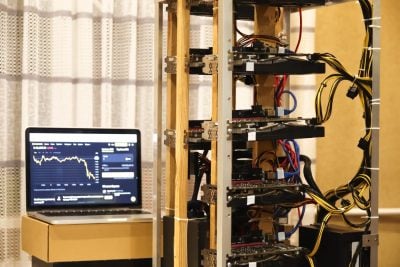
Although the AI buildout has minted trillions in market value across Wall Street and lifted NVIDIA (NASDAQ:NVDA | NVDA Price Prediction) to a market cap of $5.13 trillion, a quieter strategist is making the rounds with a pointed warning. Speaking on Thoughtful Money with Adam Taggart, Michael Liebowitz argued that the biggest risk to AI stocks may come from AI itself. The technology-packed Nasdaq Composite has been carried for two years by hyperscaler spending. But Liebowitz believes today’s data center CapEx could be rendered obsolete by the very innovations it funds. "It’s kind of almost self-fulfilling that AI will make some of these expenditures money down the toilet," he said.
That phrase echoes a pattern Wall Street has watched before, and the numbers driving the current cycle are staggering. Microsoft (NASDAQ:MSFT) doled out $30.88 billion in capital expenditures in Q3 FY2026, up 84% year over year. NVIDIA’s most recent quarter logged $75.246 billion in Data Center revenue, up 92%, and Jensen Huang has piled into $119.0 billion of supply-related commitments. Combined hyperscaler CapEx is tracking toward $400 billion-plus in calendar 2026.
The historical mirror nobody wants on the wall
I have been watching this debate unfold for the better part of a year, and the precedent that keeps surfacing is the telecom buildout of 1999 to 2001. Carriers vaulted into fiber projects, raised hundreds of billions, and laid glass that the market simply did not need. Roughly 95% of that fiber went dark for years. WorldCom and Global Crossing wrote down assets and tipped into bankruptcy. Nortel collapsed. Go back further to the railroad over-build of 1873 and the 1890s, and the same plot beats appear. Investors funded physical capacity for a future demand curve, the curve disappointed, and the assets were sold for cents.
What is particularly troubling about the AI version of this movie is the depreciation cycle. Fiber sat in the ground productively for twenty to thirty years once demand caught up. AI accelerators carry a useful life of roughly three to five years before the next architecture renders them economic dead weight. Blackwell is already supplanting Hopper. Vera Rubin is queued behind Blackwell. The writedown clock starts ticking the moment the chip is racked.
Liebowitz’s room-sized football game
Liebowitz’s father worked as a computer engineer at ComSat, where, he told Taggart, a room-sized supercomputer once ran a basic text football game. The point is that innovation relentlessly shrinks what used to require massive infrastructure. "What’s going to happen if there’s some innovation that an AI can help us with, that innovation that turns data centers into the size of this room?" Liebowitz asked.
Taggart connected the dots to China, where developers cut off from advanced Western chips were forced to write tighter, more compute-efficient software. "That to me sounds like something that AI can help you get better and better at," Taggart noted. One AI investor podcast I follow recently flagged that GPU utilization rates at some AI shops sit as low as 33% and rarely climb past 50%, owing to connectivity bottlenecks. That gap between installed capacity and useful work is exactly where Liebowitz’s thesis bites.
The valuation gut-check
NVIDIA trades at roughly 23.7x trailing revenue, a multiple that prices in years of compounding hyperscaler orders. Microsoft sits at a P/E of 29 and a P/FCF of 41, elevated for a company whose $627 billion commercial RPO is genuine but whose cash-out is accelerating in lockstep. The market is already flinching. Microsoft shares are down 19% year to date through June 12. NVIDIA has held up better at +10% YTD, though it tolled 9% lower over the past month.
Regulators are sharpening the knives too. A Polymarket contract on whether an AI data center moratorium would pass before 2027 resolved YES on June 14, 2026, after New York approved a one-year pause and similar measures rippled through local governments. Reddit chatter mirrors the unease. The r/investing post titled "I didn’t realize Microsoft was spending this much on infrastructure" has pulled 1,668 upvotes and appears in nearly every recent sentiment snapshot.
The Apple counterweight
Liebowitz pointed to Apple as the case study for restraint, arguing the company is "laying in the weeds" rather than racing into AI spending, content to wait until the technology settles before becoming what he predicts will be "the leading broker of AI products to consumers." His closing point lands the warning: "The bigger risk with AI, it’s not that it won’t be a big deal, but who will be those companies that lead the way?"
I have owned NVIDIA for over fifteen years and have no interest in selling it. Long term, Wall Street still heads higher in the decades to come, and AI will remain the most consequential platform shift of our investing lives. The Liebowitz warning is narrower and worth holding close: the silicon being racked today is a depreciating asset bought on the assumption that demand keeps compounding faster than software efficiency improves. History suggests that wager rarely holds for the entire buildout. Telecom proved it once. Railroads proved it twice. Pay attention to which AI names own the customer relationship, not just the gear that powers it.
Contact [email protected] for any questions or corrections.
I've been writing about stocks and personal finance for 20+ years. I believe all great companies are tech companies in the long run, and I invest accordingly.