Own 500 Shares of Pfizer and JNJ and Here’s Your Annual Dividend Income
Passive income is the closest thing investors have to financial gravity. It pulls in money whether you are at your desk, on a beach, or asleep, and it lands in your account no matter what the broader market did that…

This post may contain links from our sponsors and affiliates, and Flywheel Publishing may receive compensation for actions taken through them.

Passive income is the closest thing investors have to financial gravity. It pulls in money whether you are at your desk, on a beach, or asleep, and it lands in your account no matter what the broader market did that week. Earned income depends on showing up. Dividend income depends on a board of directors keeping a promise it has often kept for decades.
Healthcare megacaps have quietly become the bedrock of that promise. Two of the most widely held names in the sector, Pfizer (NYSE:PFE | PFE Price Prediction) and Johnson & Johnson (NYSE:JNJ), write checks four times a year to shareholders regardless of what biotech sentiment, election cycles, or Treasury yields are doing. Compared with rental property or private credit, a 500-share position can be liquidated in seconds and rebalanced without a closing attorney.
We screened our 24/7 Wall St. dividend equity research database, looking for stocks that pay massive dividends, and we found a collection of companies that, combined, can generate over $3,500 a year in passive annual income if you invest just 500 shares in each stock at the time of this writing.
Johnson & Johnson
- Yield: 2.35%
- Shares for $114,195: 500
- Annual Passive Income: $2,680
Johnson & Johnson is a diversified healthcare giant operating two reporting segments: Innovative Medicine and MedTech. The pharma side delivered $15.426 billion in Q1 2026 revenue, up 11.2% year over year, fueled by DARZALEX, TREMFYA, and CARVYKTI. The MedTech business added $8.636 billion, up 7.7%, with electrophysiology and Abiomed driving cardiovascular growth.
The dividend is built on reliability rather than headline yield. JNJ just declared its 64th consecutive annual dividend increase, raising the quarterly payout 3.1% to $1.34, payable June 9, 2026. That Dividend King status is structural: a AAA-rated balance sheet, 21.8% profit margins, and $19.7 billion in free cash flow last year back every quarterly check.
Institutional ownership sits at 76.85%, anchored by Vanguard, BlackRock, and State Street. Management raised full-year 2026 guidance to adjusted EPS of $11.45 to $11.65 on $100.3 billion to $101.3 billion in sales, and the planned DePuy Synthes orthopaedics spin-off should sharpen the remaining pharma-and-devices engine.

Pfizer
- Yield: 6.80%
- Shares for $12,605: 500
- Annual Passive Income: $860
Pfizer is a global biopharma operating across Primary Care, Specialty Care, and Oncology. The post-COVID hangover has been brutal at the top line, with Comirnaty down 59% and Paxlovid down 62% in Q1 2026, but the core franchise is doing the work. Eliquis grew 13% to $2.166 billion, Vyndaqel rose 8% to $1.602 billion, and Padcev jumped 39%, helping Q1 revenue reach $14.451 billion, a 5.4% YoY beat.
The yield is elevated because the stock has compressed. PFE has compressed to roughly $25.21, leaving the $1.72 annualized payout at a 6.8% yield backed by a 6.3% free cash flow yield. Management has prioritized the dividend over buybacks, explicitly stating no share repurchases are anticipated in 2026 despite $3.3 billion of remaining authorization.
Institutions own 69.38% of the float, with Vanguard and BlackRock again the largest holders. The Vyndamax patent settlement extending U.S. exclusivity to June 2031, the $7 billion Metsera obesity acquisition, and roughly 20 pivotal trial starts planned this year give CEO Albert Bourla room to defend the payout through the patent cliff.

Combined, these 2 positions generate $3,540 in annual passive income on a $126,800 investment, a blended yield of 2.79%. Johnson & Johnson contributes $2,680, and Pfizer adds $860 to round out the portfolio.
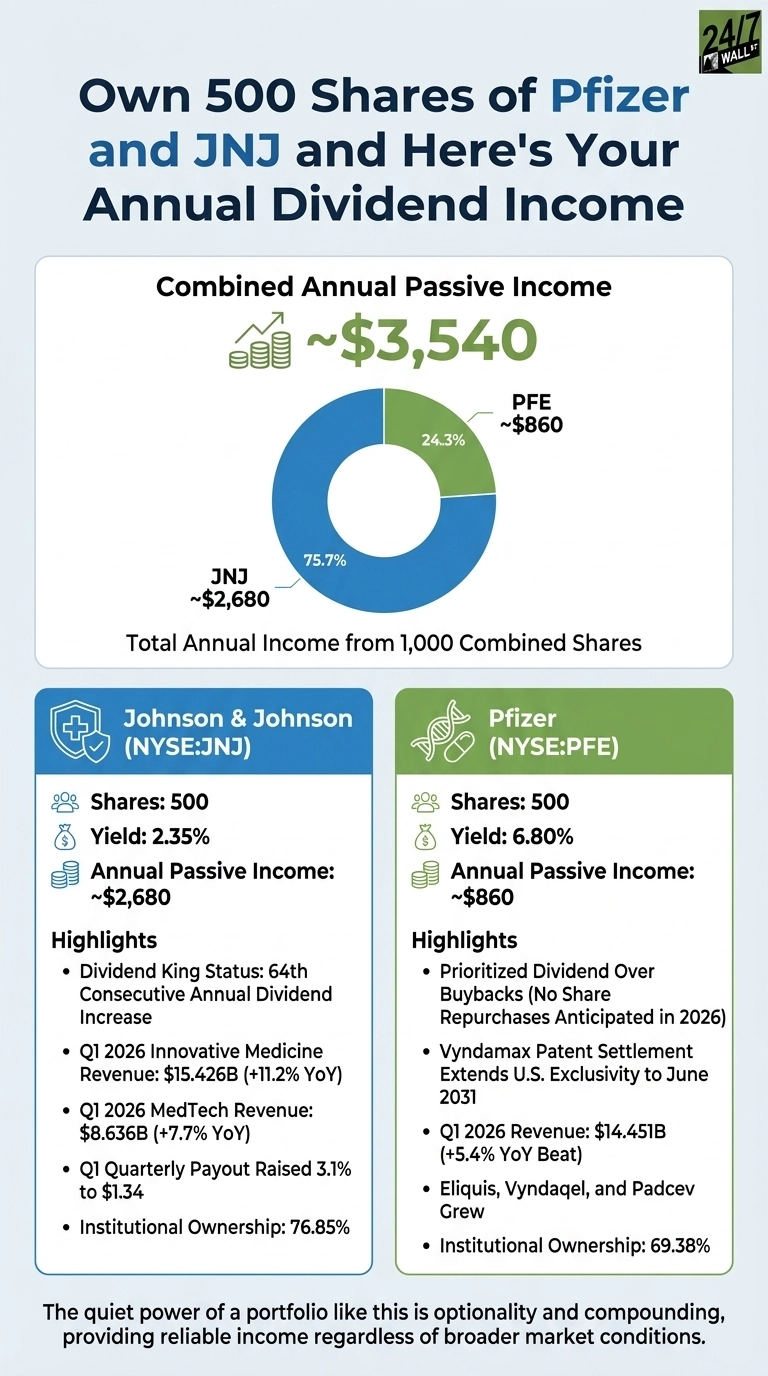
| Ticker | Annual Income | Share of Total |
|---|---|---|
| JNJ | $2,680 | 75.7% |
| PFE | $860 | 24.3% |
| Total | $3,540 | 100% |
The quiet power of a portfolio like this is optionality. Every reinvested dividend buys more shares at a lower cost basis when sentiment sours, and every cash payout can be redirected to the next opportunity when valuations stretch. That mix of compounding and flexibility is what makes dividend equities a different animal from any bond, rental unit, or fixed annuity competing for the same dollars.
Contact [email protected] for any questions or corrections.
Vandita Jadeja is a financial publisher with over a decade of experience writing about financial topics, including investment, savings, retirement, insurance and banking. Vandita is a Chartered Accountant who loves to debunk financial concepts for readers.
Her work has appeared on sites that include The Motley Fool, InvestorPlace, and Benzinga. She covers investing and focuses on stock picks and price prediction for 24/7 Wall St.
When not looking for the next stock investment opportunity, she can be found traveling, reading, chasing sunsets and enjoying her iced latte.