Why Investors Are Finally Separating Quantum Computing Winners From Losers
For much of the past two years, investors treated quantum computing as a single investment theme. Whether a company pursued trapped-ion systems, superconducting qubits, quantum annealing, or photonic architectures mattered less than the fact that it was associated with quantum…


For much of the past two years, investors treated quantum computing as a single investment theme. Whether a company pursued trapped-ion systems, superconducting qubits, quantum annealing, or photonic architectures mattered less than the fact that it was associated with quantum computing. Capital flowed broadly into the sector as investors searched for the next transformative technology platform following artificial intelligence.
Recent stock performance suggests that phase may be ending.
Investors are beginning to distinguish between companies demonstrating commercial progress and those that remain dependent on future technological milestones. This shift is important because it often marks the transition from speculative enthusiasm to fundamental analysis, a pattern that has repeated itself throughout technology history. The internet boom eventually separated Amazon from hundreds of failed dot-coms. Artificial intelligence ultimately produced clear winners such as Nvidia while countless AI startups disappeared. Quantum computing appears to be entering a similar phase.
Over the past six months, one company has clearly separated itself from the pack.
Quantum Computing Is No Longer One Trade
Investors often speak about quantum computing as if every company in the sector is moving in the same direction. Stock performance suggests otherwise. During the past six months, investors have become increasingly selective, rewarding companies demonstrating commercial progress while punishing those still dependent on future technological milestones. This shift is important because it suggests the market is moving beyond broad enthusiasm for quantum computing and beginning to evaluate individual companies based on execution, revenue growth, and customer adoption.
I show in Chart 1 that the four leading publicly traded pure-play quantum computing companies have produced dramatically different returns despite operating within the same industry.
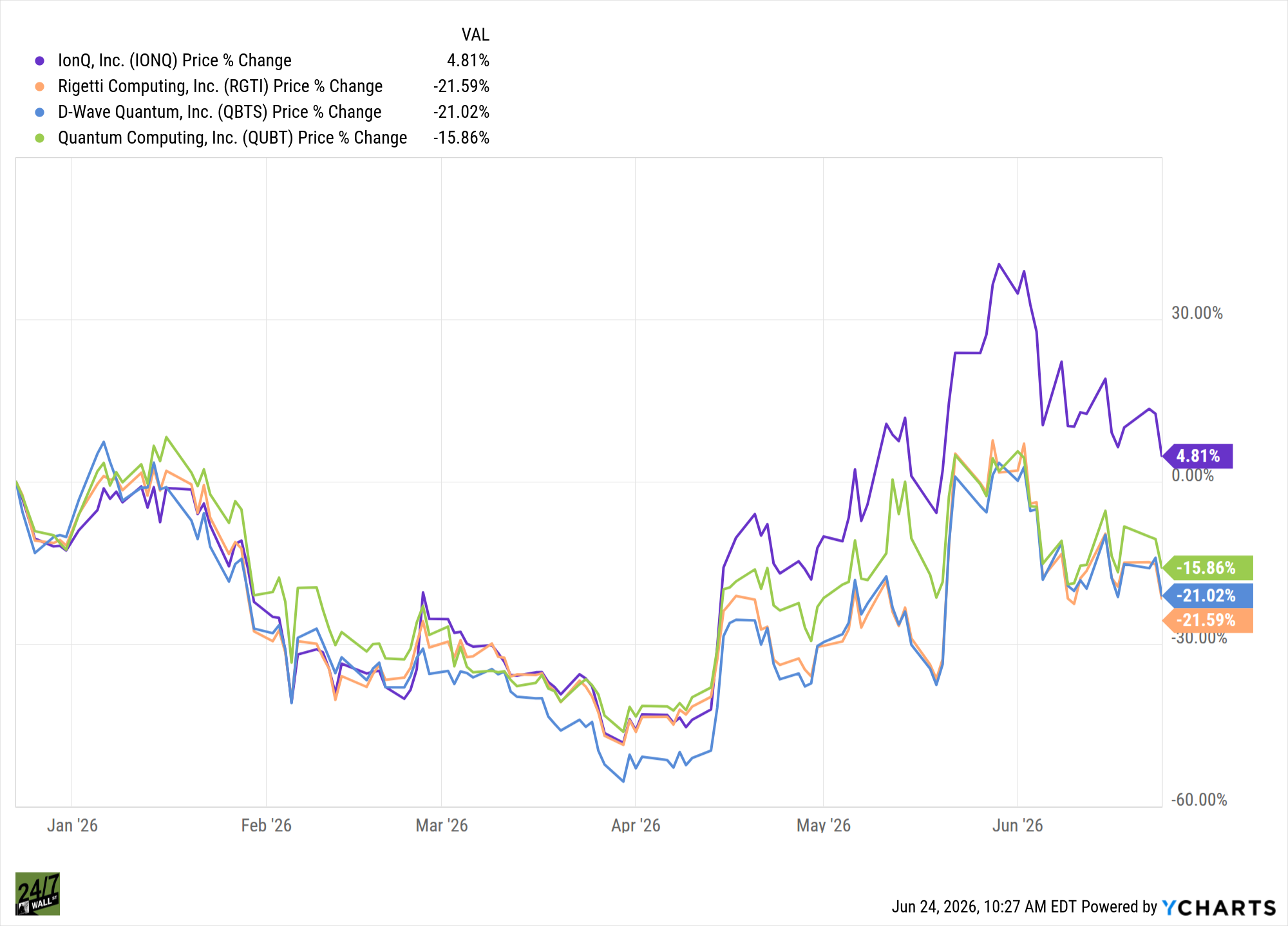
Chart 1. Six-Month Performance of Leading Pure-Play Quantum Computing Stocks
The chart highlights a growing divergence among the leading publicly traded quantum computing companies. While IonQ (NYSE: IONQ) has generated positive returns for investors, D-Wave Quantum (NYSE: QBTS), Rigetti Computing (NASDAQ: RGTI), and Quantum Computing Inc. (NASDAQ: QUBT) have all moved lower despite continued announcements of technological progress, partnerships, and product development. Investors appear to be rewarding evidence of commercialization while becoming less willing to finance future possibilities indefinitely.
This development is not necessarily a judgment on the quality of the underlying technologies. Rather, it reflects a growing emphasis on revenue growth, customer adoption, strategic partnerships, and balance sheet strength. As industries mature, investors gradually shift their focus away from scientific potential and toward business execution. The market is beginning to ask which companies can build sustainable businesses rather than simply demonstrate scientific achievements.
The Jensen Huang Turning Point
One of the catalysts for this transition can be traced back to comments made by Nvidia (NASDAQ: NVDA) CEO Jensen Huang in January 2025. When Huang suggested that practical quantum computing might still be decades away, the sector experienced a sharp selloff. Many investors interpreted the remarks as a dismissal of quantum computing’s future prospects.
What happened afterward tells a more nuanced story.
Nvidia did not retreat from quantum computing. Instead, the company increased its engagement with the industry through CUDA-Q development, quantum ecosystem initiatives, and partnerships designed to support hybrid quantum-classical computing environments. Huang’s comments ultimately highlighted a distinction that many investors initially overlooked. Fully fault-tolerant quantum computers capable of transforming entire industries may still be years away, but commercial quantum applications are already beginning to emerge in optimization, simulation, logistics, materials science, and scientific research.
That distinction helps explain why investors are becoming more selective. The debate is no longer whether quantum computing will eventually become important. The debate is which companies can bridge the gap between promising technology and sustainable revenue generation.
Why IonQ Is Pulling Ahead
While investors often group quantum companies together, the reality is that they pursue very different technologies and target different end markets. The sector remains fragmented, with no dominant architecture and no clear commercial standard. Some companies emphasize optimization, others focus on general-purpose quantum computing, while still others pursue photonic or software-centric approaches. The market is beginning to differentiate among these strategies based not on scientific promise alone, but on each company’s ability to generate revenue, secure customers, and establish a sustainable business model.
I show in Table 1 the principal publicly traded quantum computing companies and their current commercial positions.

Among these companies, IonQ appears to have gained an early advantage. The company’s trapped-ion architecture has attracted considerable attention, but investors seem equally focused on its expanding commercial relationships, government contracts, research partnerships, and growing financial resources. These factors provide a level of visibility that many competitors have yet to achieve.
By contrast, D-Wave continues to pursue a specialized quantum annealing strategy focused on optimization applications, while Rigetti remains committed to superconducting architectures that compete more directly with approaches used by larger technology companies. Quantum Computing Inc. continues to pursue photonic and software-based solutions, but investors remain cautious as the company works to establish meaningful commercial traction.
The Infrastructure Companies May Be the Real Winners
The challenge facing all of these companies is that quantum computing remains one of the most difficult engineering problems in modern technology. Error correction, system scalability, manufacturing complexity, software development, and hardware reliability continue to limit widespread deployment. Progress is occurring, but the pace remains slower than many investors originally expected.
This reality helps explain why some of the largest beneficiaries of quantum computing may ultimately be companies that never build a quantum computer themselves.
Microsoft (NASDAQ: MSFT), Amazon (NASDAQ: AMZN), Alphabet (NASDAQ: GOOG), IBM (NYSE: IBM), and Nvidia continue investing heavily in quantum infrastructure, cloud platforms, software frameworks, and hybrid computing environments. These companies are positioned to benefit regardless of which hardware architecture ultimately becomes dominant. The strategy mirrors Nvidia’s role in artificial intelligence, where the company became indispensable without developing the applications that captured headlines.
For investors, this creates two very different approaches to the sector. One approach involves selecting individual quantum companies and attempting to identify the eventual winners. The other involves investing in the infrastructure providers that stand to benefit from broader industry adoption regardless of which architecture prevails.
Investor Takeaway
History suggests that technology revolutions rarely produce as many winners as investors initially expect. During the internet boom, hundreds of companies promised to reshape commerce, communication, and media. A handful ultimately dominated while most disappeared. Quantum computing is likely to follow a similar path.
Investor enthusiasm for the sector remains understandable. The potential applications span drug discovery, advanced materials, financial modeling, logistics optimization, cybersecurity, and artificial intelligence. The opportunity is enormous if the technology can achieve commercial scale. The challenge is determining which companies will capture that opportunity and which will struggle to convert scientific progress into economic returns.
The stock market appears to be making its first decisions.
For now, IonQ is emerging as the early favorite among publicly traded pure-play quantum computing companies. Whether that leadership proves durable remains to be seen, but the market’s message is becoming increasingly clear. Investors are no longer buying quantum computing simply because it sounds exciting. They are beginning to reward companies that demonstrate a credible path toward commercialization and sustainable growth.
That shift may ultimately prove to be the most important development in the sector since quantum computing became an investable theme.
Contact [email protected] for any questions or corrections.
Dr. Robert Castellano has over 40 years of experience analyzing the high-tech industries. He is president of The Information Network (www.theinformationnet.com). He earned a PhD degree in Chemistry from Oxford University (UK). His PhD thesis advisor, John Goodenough, won the Nobel Prize in Chemistry in 2019 for the invention of the Lithium Ion Battery. He writes with George Gilder, novelist, futurist, and economist, and his team for Eagle Financial Publishing.