If You Bought the S&P 500 the Day Trump Won, Here’s Exactly What $10,000 Is Worth Today
A $10,000 investment in the SPDR S&P 500 ETF (NYSEARCA:SPY) on November 6, 2024, the morning after Donald Trump won the election, would be worth roughly $13,000 today, counting dividends. SPY closed that day at $591 and trades near $767…

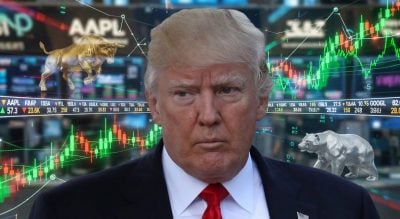
A $10,000 investment in the SPDR S&P 500 ETF (NYSEARCA:SPY) on November 6, 2024, the morning after Donald Trump won the election, would be worth roughly $13,000 today, counting dividends. SPY closed that day at $591 and trades near $767 as of late September 2026. No trading. No timing. Just owning the index through every headline that was supposed to break it.
What you actually bought
SPY is the original index fund wrapper, tracking the 500 largest US companies weighted by market cap. The mechanics are deliberately simple: the fund holds every name in the S&P 500 in proportion to the index, charges a 0.09% expense ratio, and lets market cap weights decide what dominates the portfolio.
The top ten holdings now make up roughly 38% of net assets, up from about 36% when the article was first published. A buy-and-hold position since election night is, in practice, a concentrated bet on a handful of AI-exposed mega-caps that investors made by accident rather than by design.
Did it deliver
Short answer: yes, with caveats. The price return from November 6, 2024 through late September 2026 was roughly 30%, and the total return with dividends reinvested was around the same ballpark, putting that original $10,000 at approximately $13,000. The one-year total return through mid-September 2026 was about 16.6%. Year-to-date, the fund is up roughly 12.6% on a total-return basis.
The five-year total return stands at about 83%. A high-yield savings account at 4% over the same nearly two-year window would have produced a small fraction of the gain. The index holder is up roughly $3,000 more on a $10,000 stake, and that gap remains the core argument for owning equities through political transitions you do not personally like.
The geopolitical shocks that paid you to ignore them
The nearly two years since election night were not quiet by any measure. A US-Iran military confrontation in mid-2026 rattled markets briefly before the index absorbed the shock and ground higher. Investors who had the discipline to stay put were rewarded; those who pulled their money out in 2025 found themselves staring at record highs with no clean re-entry point.
That pattern has repeated across every major geopolitical scare in SPY’s history: the initial shock creates the urge to sell, and the recovery punishes those who act on it. More recently, the Federal Reserve raised its federal funds target by 25 basis points to a range of 3.75% to 4.00% in September 2026, its first hike since 2023, introducing another variable for investors to navigate. The fund’s price absorbed that news without breaking its broader uptrend.
What the math leaves out
SPY pays a quarterly distribution, so an investor who did not reinvest dividends did somewhat worse than the total-return figure suggests. Concentration risk is also real and growing. The top three holdings, NVIDIA, Apple, and Microsoft, now account for roughly 21% of the fund combined, a far cry from the broadly diversified index your parents’ generation bought in the 1990s.
The part no one quoting an 18-month return wants to acknowledge is that this window happened to dodge a more severe or prolonged tariff drawdown. A spring 2025 pullback tested the resolve of buy-and-hold investors but ultimately proved temporary. A deeper or longer drawdown at an inopportune time could produce a very different outcome, and the next shock will arrive without a warning label.
Adding useful context, S&P 500 earnings per share jumped 51% year-over-year in Q2 2026 and have risen 26% over the past four quarters. Goldman Sachs has characterized this profit surge as a temporary acceleration driven by AI capital spending, elevated semiconductor margins, and large-cap investment gains rather than a structural earnings bubble. Those tailwinds are not guaranteed to persist.
Who this fits
SPY suits an investor who has concluded that stock-picking is not their edge and that a 0.09% annual fee is fair for owning the American corporate sector wholesale. It fits a retirement account, a taxable brokerage building a long-term base, or anyone who has accepted that the price of equity returns is sitting through geopolitical shocks, tariff scares, and rate-hike cycles without flinching.
SPY is a poor fit for an investor who needs the money within two years, who cannot stomach a 30% or worse drawdown when one arrives, or who needs current income above what the fund’s roughly 1% yield delivers. For income, a dividend-focused fund or short-duration Treasurys do that job more reliably.
The investor who bought SPY the day after the 2024 election and did nothing has made roughly $3,000 on a $10,000 stake. The next two years will demand the same discipline, and there is no guarantee they produce anything close to the same result.
Editor’s note: This article has been updated to reflect SPY’s current price near $767, raising the estimated value of a $10,000 election-night investment to approximately $13,000. Return figures have been refreshed throughout, the top-ten holdings concentration has been updated to roughly 38% of net assets, and new context has been added on the Federal Reserve’s September 2026 rate hike and Goldman Sachs’ finding that S&P 500 earnings per share jumped 51% year-over-year in Q2 2026.
Contact [email protected] for any questions or corrections.
Omor Ibne Ehsan is a writer at 24/7 Wall St. He is a self-taught investor with a focus on growth, cyclical, and dividend equities that have strong fundamentals, value, and long-term potential. He also has an interest in high-risk, high-reward investments such as penny stocks.