Qualcomm Wants to Bring AI Data Center Power to Your Smartphone
Artificial intelligence is rapidly shifting from the cloud to the devices we use every day. The first wave of generative AI relied on massive data centers packed with expensive graphics processors. The next phase is about making AI faster, cheaper,…

This post may contain links from our sponsors and affiliates, and Flywheel Publishing may receive compensation for actions taken through them.

Artificial intelligence is rapidly shifting from the cloud to the devices we use every day. The first wave of generative AI relied on massive data centers packed with expensive graphics processors. The next phase is about making AI faster, cheaper, and more private by moving more of that computing directly onto smartphones, laptops, and vehicles.
That transition has become a battleground for chipmakers, and Qualcomm (NASDAQ:QCOM | QCOM Price Prediction) believes the same technology it is developing for AI data centers can eventually power the next generation of edge devices.
Qualcomm’s Answer to AI’s Memory Problem
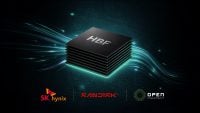
At the center of Qualcomm’s strategy is a new chip architecture called high bandwidth compute (HBC). According to Qualcomm, HBC places dedicated AI accelerator logic directly beneath vertically stacked LPDDR memory using through-silicon vias (TSVs), dramatically shortening the distance data must travel between memory and compute.
That may sound like semiconductor jargon, but the problem it addresses is simple. Modern AI models spend an enormous amount of time moving data back and forth between memory and processors. Engineers refer to this bottleneck as the “memory wall.” As AI models grow larger, that movement increasingly consumes more power than the calculations themselves.
Qualcomm says HBC offers several advantages over traditional high-bandwidth memory (HBM) designs:
| Feature | Qualcomm HBC | Traditional HBM |
| Memory type | LPDDR | HBM |
| Bandwidth efficiency | ~6x higher bandwidth per watt | Baseline |
| Cost | Lower | Higher |
| Primary target | AI inference | AI training and inference |
Those advantages could make HBC attractive not only for cloud providers but also for smartphones, PCs, and automotive systems where power efficiency is every bit as important as raw performance.
Qualcomm Is Building on Existing Technology — Not Reinventing It
Qualcomm isn’t inventing an entirely new category of computing. Companies including Nvidia (NASDAQ:NVDA), Advanced Micro Devices (NASDAQ:AMD), Samsung, Micron Technology (NASDAQ:MU), and SK hynix already rely on advanced 3D memory stacking in AI accelerators. AMD’s MI300 family, for example, combines CPUs, GPUs, and HBM into tightly integrated packages, while Samsung has invested heavily in processing-in-memory technology.
The difference is Qualcomm’s focus on inference rather than training.
Inference — the process of generating AI responses — is becoming the largest long-term AI workload. By pairing lower-power LPDDR memory with near-memory compute, Qualcomm believes it can deliver better performance per watt while reducing total system costs.
That strategy also aligns with Qualcomm’s historical strengths. The company has spent decades optimizing chips for battery-powered devices, giving it deep expertise in LPDDR memory and power management. Extending those capabilities from smartphones into AI servers — and then bringing the architecture back to consumer devices — is an unusual but logical roadmap.
Heat Remains the Biggest Challenge
Granted, stacking logic directly beneath memory creates one major engineering challenge: heat.
In any 3D package, heat generated by the compute die must travel upward through multiple silicon layers before reaching a cooling solution. That creates hotspots that can reduce performance or shorten component life if temperatures climb too high.
Data centers can offset this with liquid cooling and sophisticated thermal systems. Smartphones, laptops, and vehicles have far tighter space and power constraints.
Qualcomm believes several factors help manage those thermal challenges:
- LPDDR consumes less power than HBM.
- Advanced bonding materials reduce thermal resistance.
- Dynamic power management can throttle workloads before overheating occurs.
- Qualcomm’s experience designing mobile processors gives it an advantage in balancing sustained performance and battery life.
That said, investors should wait for independent benchmarks. Real-world testing will determine whether HBC delivers its promised gains without sacrificing sustained performance.
Key Takeaway
In short, Qualcomm’s high-bandwidth compute architecture isn’t a revolutionary break from existing semiconductor design, but it could become an important evolution in AI computing. Rather than chasing Nvidia in massive AI training clusters, Qualcomm is targeting the next wave of AI inference with an architecture designed around efficiency instead of brute force.
If Qualcomm succeeds, the payoff could extend well beyond data centers. Smartphones, PCs, and connected vehicles could run larger AI models locally, reducing cloud costs, improving privacy, and extending battery life. The remaining question isn’t whether the idea is compelling — it is whether Qualcomm can prove its thermal design and manufacturing approach work at scale. For long-term investors, those benchmarks and early customer deployments will be worth watching closely.
Contact [email protected] for any questions or corrections.
After two decades of patrolling the dark corners of suburbia as a police officer, Rich Duprey hung up his badge and gun to begin writing full time about stocks and investing. For the past 20 years, he’s been cruising the markets looking for companies to lock up as long-term holdings in a portfolio while writing extensively on the broad sectors of consumer goods, technology, and industrials. Because his experience isn’t from the typical financial analyst track, Rich is able to break down complex topics into understandable and useful action points for the average investor. His writings have appeared on The Motley Fool, InvestorPlace, Yahoo! Finance, Money Morning, and, of course, 24/7 Wall St. He has been featured in both U.S. and international publications, including MarketWatch, Financial Times, Forbes, Fast Company, and USA Today.