AMD Is Up 150% This Year But Here Are 5 Overlooked Stocks Betting on What Comes Next
The Pentagon just earmarked over $74 billion for drone dominance and counter drone technologies in the FY2027 budget request, and that is only one slice of the AI arms race AMD and NVIDIA are fighting over. While Wall Street obsesses…


The Pentagon just earmarked over $74 billion for drone dominance and counter drone technologies in the FY2027 budget request, and that is only one slice of the AI arms race AMD and NVIDIA are fighting over. While Wall Street obsesses over who wins the GPU throne, the real money in the next AI phase is flowing to the picks, shovels, wires, weapons, and power banks nobody is watching. Here are five of them.
1. Schrodinger (SDGR): The Surprise Pick Nobody Calls an AI Stock
Schrodinger (NASDAQ:SDGR) sits outside the chip complex entirely, which is exactly why it belongs at the top of this list. Its physics-based simulation platform, now fused with AI/ML, is the software layer that trains models on molecular ground truth rather than internet scrapings. That is where pharma is spending, and it is where AMD’s and NVIDIA’s silicon actually gets consumed at the enterprise level.
Q1 2026 revenue hit $58.59 million, beating consensus by 23%, with drug discovery revenue more than doubling to $22.88 million. Management guided FY2026 ACV to $218 million to $228 million, and CEO Ramy Farid teased the summer 2026 launch of “Bunsen, an agentic AI co-scientist designed to autonomously execute complex molecular discovery workflows”. Shares are down 9% year to date, which is the setup: the AI narrative has not yet arrived here.
The kicker: Eli Lilly is buying Ajax Therapeutics, in which Schrodinger holds roughly a 6% equity stake. That is the second multi-billion dollar exit validating this platform. If Bunsen lands, the re-rating happens fast. But software is worthless without something to weaponize it. That is where the next name comes in.
2. nLIGHT (LASR): The Obvious Heavyweight Wall Street Is Still Underwriting
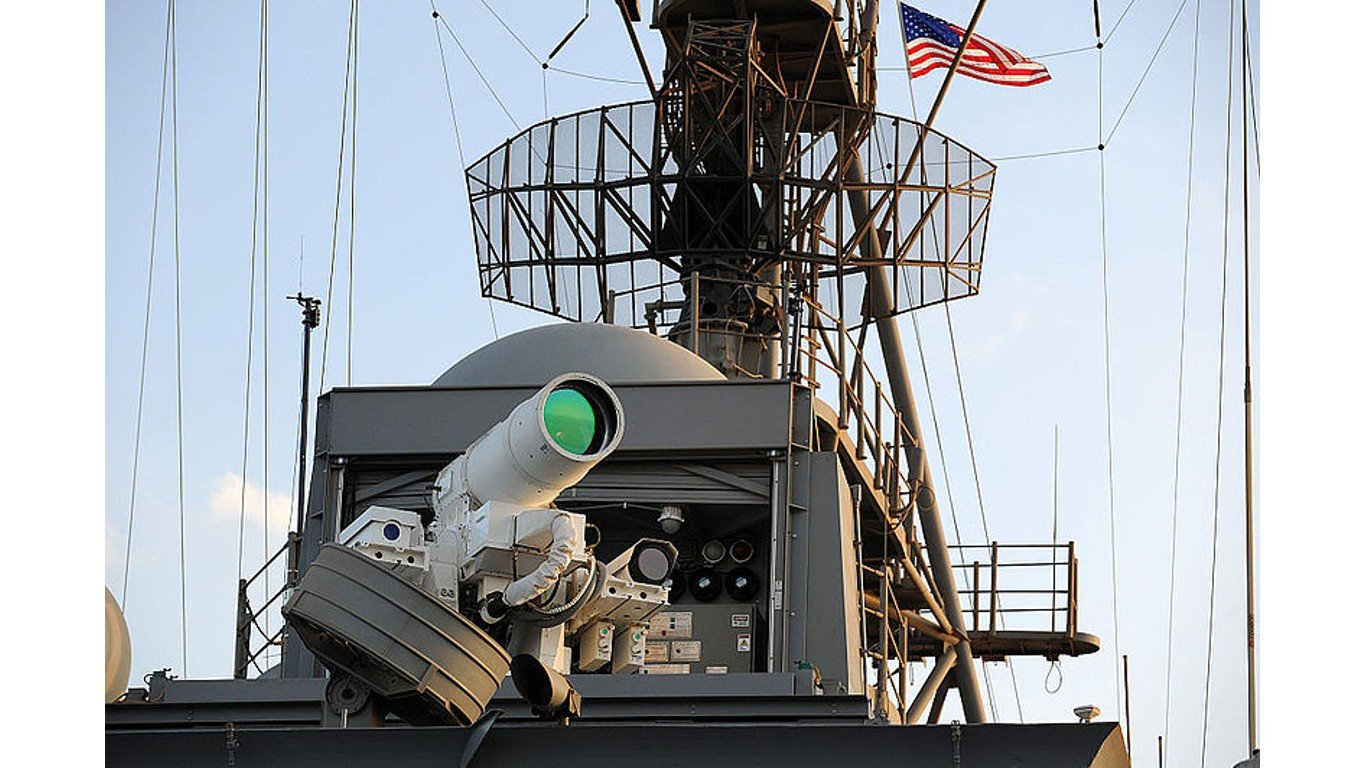
nLIGHT (NASDAQ:LASR) makes high-power semiconductor and fiber lasers for two of the hottest budget lines in America: directed-energy weapons and advanced chip microfabrication. Both are AI-adjacent. Directed energy is how you shoot down the autonomous drone swarms the Pentagon is now planning against. Microfabrication is how you etch the next generation of AI accelerators. LASR sells the light for both.
Q1 FY26 revenue printed $80.18 million, up 55% year over year, with defense product revenue nearly doubling to a record $33.10 million and gross margin expanding to 33% from 27%. Analyst target price sits at $86.43 against a current print, with seven Buy ratings and one Strong Buy. The stock is already up 86% year to date, and that is before Pentagon procurement dollars actually hit the P&L.
CEO Scott Keeney flagged a “pipeline of directed energy opportunities” and the company unveiled a 70kW-class laser weapon last quarter. Lasers vaporize incoming threats. But what pilots those threats to begin with? The next name.
3. Unusual Machines (UMAC): The Drone Play the DoD Is Force-Feeding
Unusual Machines (NYSE:UMAC) sells NDAA-compliant drone components through Fat Shark and Rotor Riot. Translation: it is one of the very few US-listed suppliers of drone parts that the Pentagon is legally allowed to buy. The FY2027 budget request explicitly earmarks $39.2 billion associated with the Drone Dominance mandatory funding request for autonomous systems procurement. UMAC sits directly in the crosshairs of that spend.
Q1 2026 revenue jumped to $8.10 million, up 296% year over year and beating estimates by 46%. Management says over half of Pentagon Drone Dominance program customers are UMAC clients and pegged the TAM at $90 million in 2026 and $250 million in 2027. Analyst target sits at $33.67 with six of six analysts rating it Buy or Strong Buy. CEO Allan Evans put it bluntly: “2026 has started with a bang…The demand signals are overwhelming.”
Retail has already sniffed this out. Reddit sentiment ran between 68 and 85 across June, with one WSB surge driving 4,564 upvotes in a single session. Shares are up 75% year to date. The volatility is real (beta of 14.56) but so is the tailwind. Drones fly on wireless. AI data centers do not. That bottleneck belongs to the next stock.
4. Lightwave Logic (LWLG): The Bandwidth Choke Point Nobody Priced In
Lightwave Logic (NASDAQ:LWLG) is developing electro-optic polymer materials that plug directly into silicon photonics and co-packaged optics. Why does that matter? AI data centers are running out of copper. Every extra terabit of GPU-to-GPU traffic strangles the fabric. Polymer modulators are one of the few paths to 200G-per-lane optics without melting the interconnect. That is the wire between every AMD and NVIDIA rack in the next build cycle.
This is a development-stage bet, with TTM revenue of just $243,100 and a market cap of roughly $1.46 billion. The stock is up 192% year to date and 663% over one year, though the Alpha Vantage analyst target sits at just $2.71, well below the current print. That gap tells you everything: the sell side has not caught up to the co-packaged optics narrative, and the stock is running without them.
This is aggressive-investor territory: no meaningful revenue, high dilution risk, a beta of 2.4, and a price-to-sales ratio of 5,995. But the payoff, if polymer modulators land in a hyperscaler qualification, is asymmetric. Which brings us to the punchline: the AI data centers running all this silicon and light need power. A lot of power. On demand. And that is a problem nobody has solved.
5. QuantumScape (QS): The Power Bank for the AI Grid
QuantumScape (NYSE:QS | QS Price Prediction) has spent five years being sold as an EV battery play. That framing is wrong now. On the last call, management explicitly extended its solid-state lithium-metal platform beyond automotive into data center, robotics, aviation, and defense markets. AI compute is the fastest-growing electricity load in the country, and hyperscalers are scrambling for on-site energy storage. QS is positioning to sell into that build-out with a chemistry incumbents cannot match.
Q4 2025 EPS came in at -$0.17 versus -$0.172 expected, with the full-year 2025 net loss narrowing to $435.05 million. Liquidity sits at $970.8 million, a cash runway management pegs into the end of the decade. First-ever customer billings hit $19.5 million for FY2025, the Cobra-process QSE-5 cells are shipping to Volkswagen, and the Eagle Line pilot was inaugurated February 4, 2026. Shares are down 27% year to date, but Reddit sentiment on WSB flashed a very bullish 82 in mid-June.
The sell side is not there yet: Alpha Vantage shows seven Hold ratings and two Sell ratings, zero Buys, with a target of $7.16. That is the setup. QS is a pre-revenue name with a 2.6 beta and a projected 2026 Adjusted EBITDA loss of $250M to $275M, so nothing here is safe. But if solid-state cells become the standard backup power for AI data centers, the re-rating trumps every consensus target on the board.
The Thread
AMD is racing NVIDIA for the AI crown, but the crown is only one piece of the kingdom. Software that feeds the silicon (Schrodinger), lasers that arm and etch it (nLIGHT), drones that carry it into the field (Unusual Machines), photonics that wire it together (Lightwave Logic), and batteries that keep it alive (QuantumScape) are all trading like they belong to a different narrative. In reality, they belong to the same one. The Pentagon budget, the hyperscaler capex cycle, and the pharma AI wave are all landing in 2026. The re-rating windows will not stay open long.
Contact [email protected] for any questions or corrections.
Joel South covers large-cap stocks, dividend investing, and major market trends, with a focus on earnings analysis, valuation, and turning complex data into actionable insights for investors.
He brings more than 15 years of experience as an investor and financial journalist, including 12 years at The Motley Fool, where he served as an investment analyst, Bureau Chief, and later led the Fool.com investing news desk. He has also co-hosted an investing podcast and appeared across TV and radio discussing market trends.