Why I Am Aggressively Loading the Truck on Nvidia on Repeat
I keep hitting the buy button on NVIDIA (NASDAQ:NVDA | NVDA Price Prediction), and the pullback to $200.09 has only made me more aggressive. This is the position I add to every time the tape gives me a discount, because…

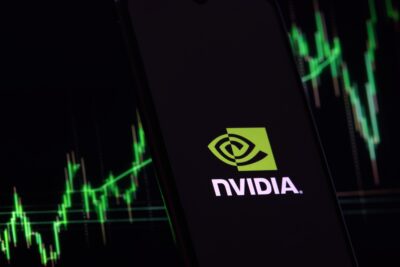
I keep hitting the buy button on NVIDIA (NASDAQ:NVDA | NVDA Price Prediction), and the pullback to $200.09 has only made me more aggressive. This is the position I add to every time the tape gives me a discount, because the business behind the ticker is compounding faster than the multiple is expanding. When institutions rotate on a yield curve flattening from 0.74% to 0.30%, I see a gift. That is the entire confession.
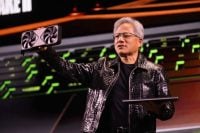
The core thesis is simple. Jensen Huang runs the only company that sells the picks and shovels for what he calls “the buildout of AI factories, the largest infrastructure expansion in human history”. Every frontier lab, every hyperscaler, and every sovereign AI project routes through CUDA, NVLink, and Blackwell. I am paying for a toll booth.
Reason one is the operational reality. Q1 FY2027 revenue landed at $81.615 billion, up 85.23% year over year, with Data Center at $75.246 billion (92% YoY growth) and networking at $14.8 billion (199% YoY growth). Non-GAAP EPS of $1.87 marked the fourth consecutive quarterly beat. Gross margin sits at 75.0% at this scale. Free cash flow reached $48.554 billion in a single quarter. Growth is accelerating.
Reason two is the valuation the market is handing me. Forward earnings sit at roughly 22x, with a trailing PE near 30x and a PEG of 0.593. For a business posting a 63% profit margin and 114.3% return on equity, that multiple is a compressed price for the highest quality earnings stream in technology. Analyst consensus target sits at $301.62 against my $200.09 cost basis today.
Reason three is capital return that finally shows up on my brokerage statement. Management raised the dividend from $0.01 to $0.25 per share, authorized an additional $80.0 billion in buybacks, and returned roughly $20.0 billion to shareholders in Q1 alone. Supply commitments climbed to $119.0 billion, telling me the order book behind the guidance is real.
Now the risk I refuse to ignore. China is the real headwind. Q2 FY27 guidance of $91.0 billion explicitly excludes Data Center compute revenue from China, and Q1 shipped no H20 products to China versus $4.6 billion in the year-ago quarter. If restrictions harden further, a growth vector closes. The reason my thesis holds: NVIDIA is already growing revenue 85% year over year with that China lane essentially at zero. The rest of the world is buying every wafer Taiwan Semi can allocate, and executives told analysts they are sold out on Blackwell demand.
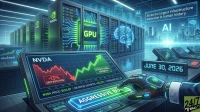
The one-month drawdown of 5.13% gave me a lower cost basis on a business that has compounded revenue from $46.743 billion to $81.615 billion in four quarters. Retail sentiment on Reddit already recovered from a capitulation floor at 22 on June 21 back to 67 on June 30. My conviction never left.
I keep buying because Vera Rubin follows Blackwell, agentic AI is scaling into every industry, and the toll booth is still the toll booth. The buy button stays green as long as that math holds.
Contact [email protected] for any questions or corrections.
Alex Sirois is a financial writer with experience spanning both retail and institutional investing. He has written for InvestorPlace and held roles at BNY Mellon and Bernstein, giving him a perspective that bridges Main Street portfolios and Wall Street analysis.
Alex holds an MBA from George Washington University and has built his career across multiple industries, including e-commerce, education, and translation — a breadth of experience that informs how he breaks down complex financial topics for everyday investors. His writing is conversational, actionable, and grounded in long-term, buy-and-hold investing principles.
At 247 Wall St., Alex focuses on delivering analysis that is both accessible and useful, with a clear emphasis on helping readers make more informed decisions with their money.