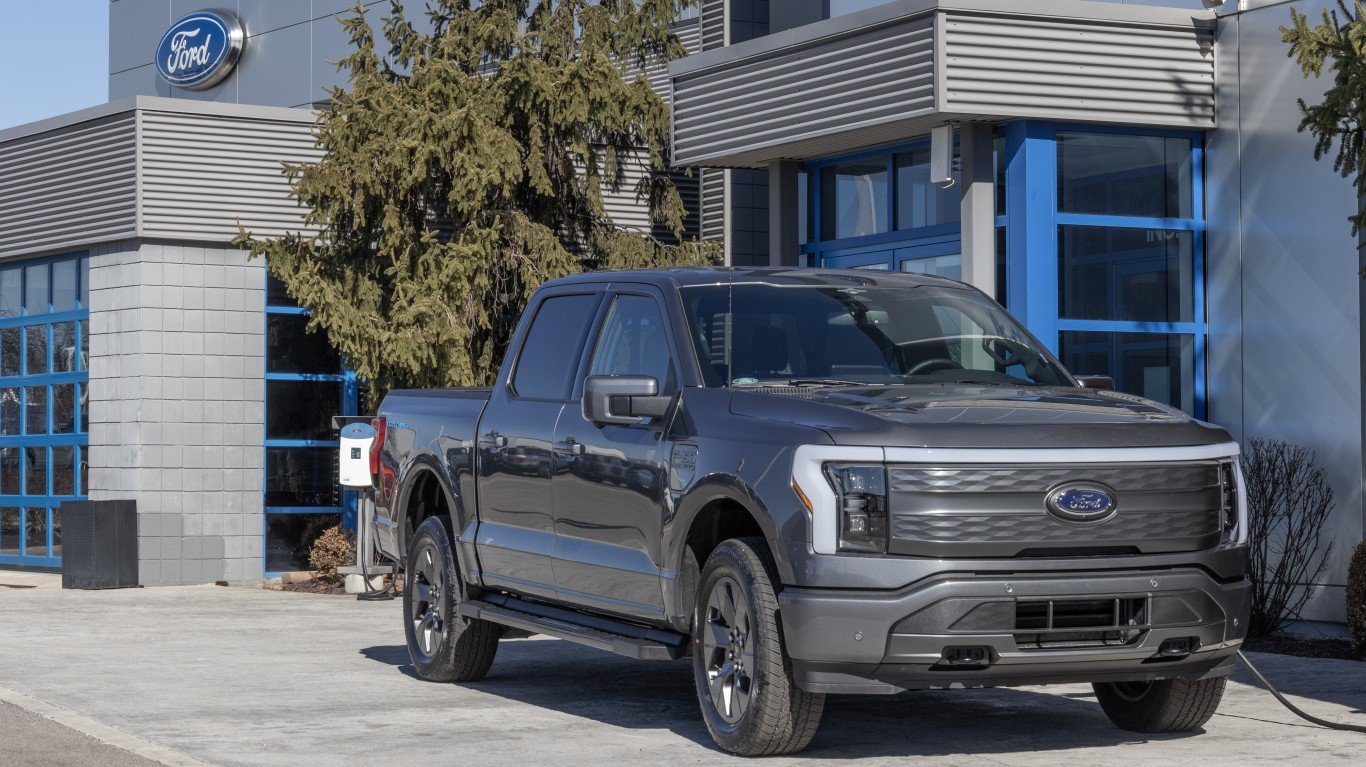
Ford Vs. Toyota: Buy Toyota to Secure Dominant Global Cash Flow and Hybrid Supremacy
Toyota (NYSE:TM | TM Price Prediction) and Ford (NYSE:F) closed very different earnings cycles. Toyota wrapped fiscal 2026 with $323.62 billion in revenue and a global hybrid engine humming across five brands. Ford posted a $43.25 billion Q1 and raised…

Toyota (NYSE:TM | TM Price Prediction) and Ford (NYSE:F) closed very different earnings cycles. Toyota wrapped fiscal 2026 with $323.62 billion in revenue and a global hybrid engine humming across five brands. Ford posted a $43.25 billion Q1 and raised its 2026 outlook, yet the story underneath is a U.S. truck franchise carrying an EV division still bleeding cash.
Hybrid Cash Machine Meets a Truck-Powered Turnaround
Toyota’s electrified mix hit 48.1% of retail sales, with BEV volumes up 68.4% to 243 thousand units. That mix, plus a Financial Services segment that grew operating income 24.6% to $5.44 billion, helped absorb an $8.81 billion U.S. tariff hit. Operating cash flow landed at $34.94 billion.
Ford’s quarter leans on Blue and Pro. Ford Blue revenue rose 14% to $23.9 billion, powered by F-Series, Bronco, and Expedition. Ford Pro delivered $1.69 billion EBIT with paid software subs up 30% YoY to 879,000. Model e lost $777 million, and a $1.30 billion IEEPA tariff benefit flattered results.
| Business Driver | Toyota | Ford |
| Main Growth Engine | Hybrids and Lexus premium | F-Series, Bronco, Ford Pro software |
| Management Focus | Cost reform, SDV, value chain | Ford+ plan, Universal EV platform |
| Key Drag | U.S. tariffs, China margin | Model e losses, aluminum costs |
Global Insulation vs. a Narrower U.S. Bet
Toyota earns roughly $132.70 billion in North America but balances that with $50.71 billion in Japan, $50.41 billion in Asia, and $40.84 billion in Europe. Ford is heavily U.S.-anchored, amplifying commodity and tariff swings. Jim Farley framed it bluntly: “We built the foundation for a more modern, resilient Ford, improving cost and quality and building our world-class team.” Model e guidance calls for a $4.0 billion to $4.5 billion loss this year.
Valuation frames the divergence. Toyota trades at a 9 trailing P/E with a 3.65% dividend yield and a 0.306 beta. Ford’s $0.15 quarterly payout is generous, but Q1 free cash flow was negative $1.87 billion.
The Next Test Is Who Compounds Through Tariffs
Toyota guided FY2027 operating income down 20.3% to JPY 3.0 trillion, absorbing more tariff pain and Middle East drag. Ford raised 2026 adjusted EBIT guidance to $8.5 billion to $10.5 billion. Watch whether Toyota’s BEV ramp to 598 thousand units lands without eroding hybrid margins, and whether Ford’s Universal EV platform narrows Model e losses before commodity headwinds hit their $2 billion peak.
Why I Lean Toyota for Cash Flow and Sleep-at-Night Ownership
Toyota is the more resilient business. The hybrid franchise generates cash Ford’s EV unit still consumes, and the global footprint softens shocks hitting Ford’s Michigan-heavy P&L directly. Ford’s Blue and Pro segments offer real optionality with raised guidance. Toyota offers durable free cash flow, a 0.823 price-to-book, and a dividend backed by $80.83 billion in cash. The setup weakens only if Model e losses shrink faster than Toyota’s tariff drag deepens.
Contact [email protected] for any questions or corrections.
Alex Sirois is a financial writer with experience spanning both retail and institutional investing. He has written for InvestorPlace and held roles at BNY Mellon and Bernstein, giving him a perspective that bridges Main Street portfolios and Wall Street analysis.
Alex holds an MBA from George Washington University and has built his career across multiple industries, including e-commerce, education, and translation — a breadth of experience that informs how he breaks down complex financial topics for everyday investors. His writing is conversational, actionable, and grounded in long-term, buy-and-hold investing principles.
At 247 Wall St., Alex focuses on delivering analysis that is both accessible and useful, with a clear emphasis on helping readers make more informed decisions with their money.