Is This Where AMD Catches Nvidia? Goldman Sachs Says It’s Gaining Ground
Artificial intelligence has become one of the biggest investment themes of the decade, but leadership inside the industry isn’t standing still. Nvidia (NASDAQ:NVDA | NVDA Price Prediction) has dominated AI accelerators for years, rewarding shareholders with extraordinary gains. Yet the…

Artificial intelligence has become one of the biggest investment themes of the decade, but leadership inside the industry isn’t standing still. Nvidia (NASDAQ:NVDA | NVDA Price Prediction) has dominated AI accelerators for years, rewarding shareholders with extraordinary gains.
Yet the next phase of the AI infrastructure buildout may look more competitive than the last. Companies are looking for alternatives to reduce dependence on a single supplier while hyperscalers continue investing hundreds of billions of dollars into AI data centers.
That changing landscape is exactly why Goldman Sachs believes Advanced Micro Devices (NASDAQ:AMD) is beginning to narrow the gap with Nvidia — and why AMD stock jumped 10% in morning trading following the firm’s latest upgrade.
Goldman Sachs Sees AMD’s AI Momentum Accelerating
Goldman Sachs raised its price target on AMD to $640 from $450 while reiterating its Buy rating, citing accelerating momentum in AI infrastructure, according to the firm’s research note. The upgrade reflects growing confidence that AMD is winning a larger slice of the AI spending wave rather than simply riding Nvidia’s coattails.
The market responded immediately. AMD shares climbed about 10% in morning trading, extending gains to 182% year-to-date and 306% over the past 12 months. Compare that with Nvidia, whose stock has returned 5% so far in 2026 and 23% over the past year.
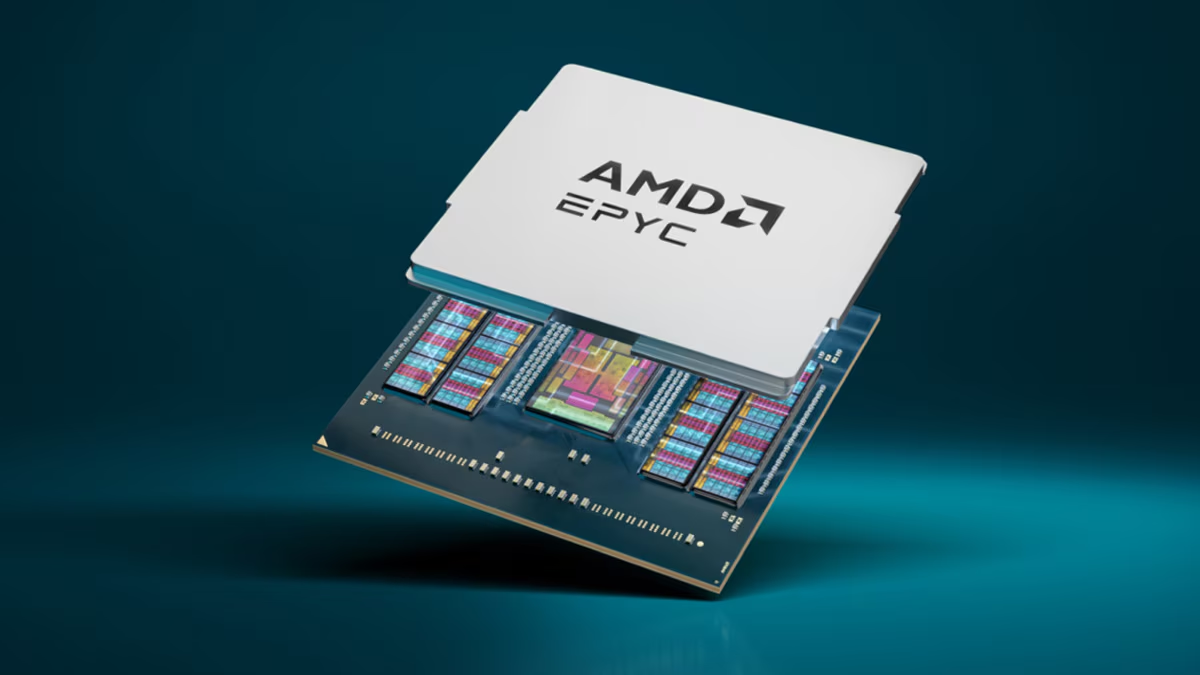
The rally hasn’t appeared out of thin air. AMD’s EPYC server processors and Instinct AI accelerators have become increasingly important pieces of AI infrastructure as cloud providers look beyond a single hardware supplier. AMD’s earnings releases have repeatedly highlighted expanding data center revenue driven by those product lines.
Let’s be clear, though. Nvidia remains the market leader. The story is that AMD is finally capturing enough demand to make investors reconsider just how wide that lead will remain.
Several Catalysts Are Arriving at the Same Time
Surprisingly, AMD’s latest momentum extends well beyond Wall Street upgrades.
AMD Ventures recently backed Japanese autonomous driving startup Turing, which now reportedly performs about 10% of its AI training using AMD GPUs instead of Nvidia hardware. While one customer won’t transform the industry overnight, it demonstrates that AI developers are increasingly comfortable building on AMD’s platform to reduce reliance on Nvidia.
At the same time, reports indicate Nvidia’s next-generation Kyber NVL144 AI rack system has slipped until 2028, giving AMD additional time to expand deployments before Nvidia introduces another major hardware leap.
Another catalyst arrives later this month. AMD’s Advancing AI 2026 conference takes place July 22-23 in San Francisco, where investors expect updates on next-generation AI chips, software, enterprise partnerships, and customer adoption. Product announcements have become increasingly important valuation drivers across the semiconductor industry.
These developments all reinforce the same theme: AMD isn’t merely benefiting from AI demand. It’s beginning to build its own competitive ecosystem.
The Opportunity Comes With Risks
Granted, catching Nvidia remains a tall order. Nvidia still commands the largest installed base of AI accelerators, enjoys a software advantage through CUDA, and continues generating enormous cash flow that supports aggressive research and development spending. It also continues producing industry-leading profitability while demand for AI infrastructure remains robust.
That said, AI customers increasingly value optionality. Cloud providers, enterprises, and AI startups don’t necessarily want to depend on one supplier for every accelerator they purchase. Even modest market share gains in a market expected to reach hundreds of billions of dollars annually could translate into meaningful revenue growth for AMD.
In any case, investors should also remember that AMD’s spectacular rally has raised expectations. Future earnings reports must continue demonstrating expanding AI revenue to justify those gains.
Key Takeaway
In short, Goldman Sachs isn’t arguing that AMD has already overtaken Nvidia. It’s arguing that the competitive gap is narrowing — and recent developments support that thesis.
A higher price target, growing adoption of EPYC and Instinct chips, a strategic investment in autonomous driving AI, reports of delays to Nvidia’s next-generation AI systems, and the upcoming Advancing AI 2026 event all strengthen AMD’s position at a time when AI infrastructure spending continues climbing.
Ultimately, Nvidia remains the AI king, but AMD is proving it deserves a seat at the table. For investors looking beyond today’s market leader, AMD increasingly looks like one of the strongest ways to participate in the next stage of the AI infrastructure boom.
Contact [email protected] for any questions or corrections.
After two decades of patrolling the dark corners of suburbia as a police officer, Rich Duprey hung up his badge and gun to begin writing full time about stocks and investing. For the past 20 years, he’s been cruising the markets looking for companies to lock up as long-term holdings in a portfolio while writing extensively on the broad sectors of consumer goods, technology, and industrials. Because his experience isn’t from the typical financial analyst track, Rich is able to break down complex topics into understandable and useful action points for the average investor. His writings have appeared on The Motley Fool, InvestorPlace, Yahoo! Finance, Money Morning, and, of course, 24/7 Wall St. He has been featured in both U.S. and international publications, including MarketWatch, Financial Times, Forbes, Fast Company, and USA Today.