Is Nvidia Undervalued or AMD Overvalued — or Both?
Artificial intelligence continues to reshape the technology industry at a pace few expected. What began as a race to build faster AI chips has expanded into a massive infrastructure buildout spanning data centers, networking equipment, memory, storage, and servers. That…


Artificial intelligence continues to reshape the technology industry at a pace few expected. What began as a race to build faster AI chips has expanded into a massive infrastructure buildout spanning data centers, networking equipment, memory, storage, and servers.
That evolution is creating fresh opportunities for investors willing to look beyond yesterday’s winners. Nvidia (NASDAQ:NVDA | NVDA Price Prediction) remains the undisputed face of the AI revolution, but the market is no longer rewarding every company equally. As AI workloads become more complex, the biggest opportunity may be shifting away from graphics processors alone and toward the server infrastructure that makes those accelerators productive.
AI’s Next Growth Phase Could Favor CPUs
Nvidia’s GPUs remain the foundation of modern AI training and inference. Without them, today’s large language models simply wouldn’t exist. Yet GPUs rarely work alone.
During Advanced Micro Devices‘ (NASDAQ:AMD) last earnings call, management said the server CPU total addressable market could exceed $120 billion by 2030, growing at more than 35% annually. That’s nearly double its previous forecast of roughly 18% compound annual growth.
CEO Lisa Su argued that agentic AI is structurally changing demand. Every deployment of AI accelerators requires additional general-purpose CPUs to coordinate data movement, storage, networking, orchestration, and inference workloads. In other words, every GPU cluster creates even more demand for CPUs.
That’s an important shift investors shouldn’t overlook.
AMD Is Winning Where Demand Is Expanding
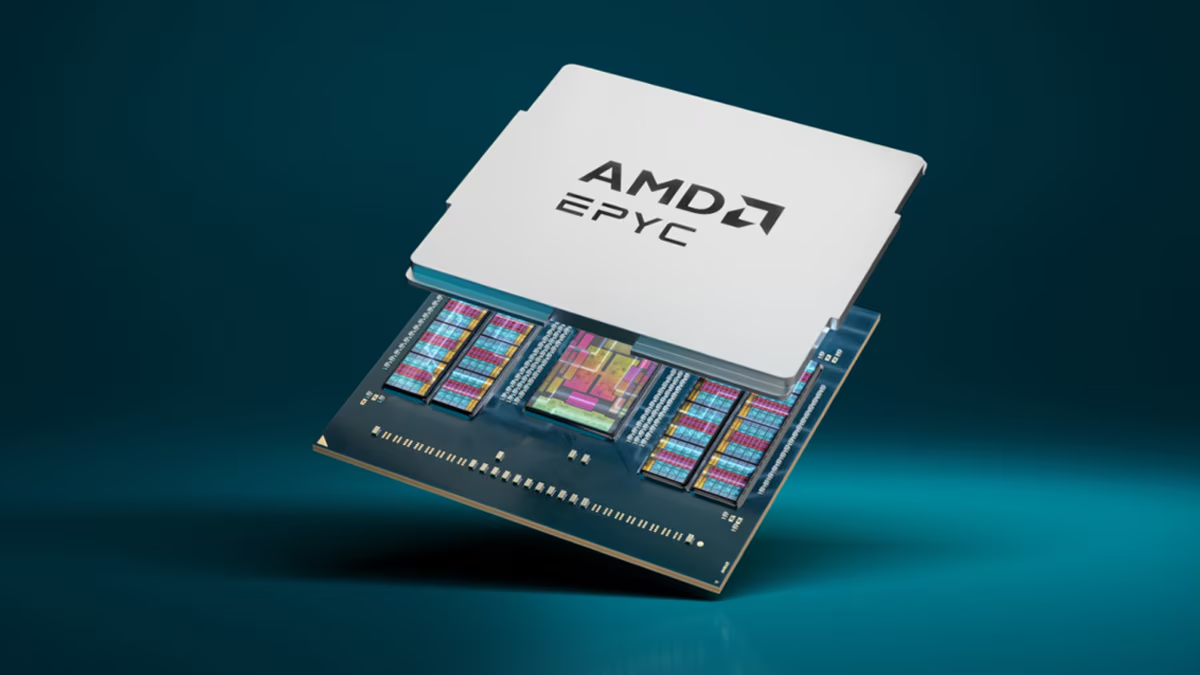
Amazon‘s (NASDAQ:AMZN) AWS, Google Cloud, Microsoft (NASDAQ:MSFT), and Tencent are all expanding deployments of fifth-generation EPYC processors. Meanwhile, Meta Platforms (NASDAQ:META) has become a lead customer for AMD’s upcoming sixth-generation EPYC “Venice” and “Verano” processors.
Those wins matter because hyperscalers increasingly need balanced computing systems, not just racks filled with accelerators. The investment case becomes even more interesting when comparing valuations and stock performance.
| Metric | Nvidia | AMD |
| Forward P/E | 19x | 59x |
| 2026 YTD Stock Performance | +4% | +141% |
| Primary AI Strength | GPUs | CPUs and GPUs |
The market is clearly paying a premium for AMD’s accelerating growth. The company landed major AI infrastructure commitments from Meta, Oracle (NYSE:ORCL), and OpenAI, helping investors view AMD as more than simply Nvidia’s GPU challenger.
Surprisingly, the bigger catalyst may have been CPUs. As EPYC processors gain pricing power amid tighter supply, AMD has begun benefiting from what many now call the CPU bottleneck trade.
Does That Make Nvidia Cheap?
Granted, AMD’s premium valuation isn’t difficult to justify if its forecast proves accurate. A market expanding at more than 35% annually deserves a higher earnings multiple than a mature business. That said, a 59-times forward earnings multiple already assumes years of exceptional execution.
Nvidia, meanwhile, trades at just 19 times forward earnings, despite remaining the dominant supplier of AI accelerators and generating enormous free cash flow. If AI spending continues rising across hyperscalers, Nvidia still stands to capture a large share of those dollars.
In short, investors may not be choosing between an overvalued AMD and an undervalued Nvidia. The market could simply be assigning different valuations to two companies benefiting from different phases of the AI buildout.
Key Takeaway
The AI investment story is broadening. Nvidia remains the cornerstone of AI infrastructure, but AMD is becoming a compelling second act as server CPUs emerge as an equally critical piece of next-generation AI systems.
Ultimately, AMD deserves a premium because its growth rate is accelerating, but a 59x forward P/E leaves little room for disappointment. Nvidia’s 19x forward multiple, by contrast, looks surprisingly restrained for a company that still dominates AI computing.
For long-term investors, that suggests an unexpected conclusion: AMD may deserve its higher valuation, but Nvidia increasingly looks like the better value. Rather than choosing one over the other, savvy investors may find that owning both offers exposure to the two technologies powering AI’s next chapter.
Contact [email protected] for any questions or corrections.
After two decades of patrolling the dark corners of suburbia as a police officer, Rich Duprey hung up his badge and gun to begin writing full time about stocks and investing. For the past 20 years, he’s been cruising the markets looking for companies to lock up as long-term holdings in a portfolio while writing extensively on the broad sectors of consumer goods, technology, and industrials. Because his experience isn’t from the typical financial analyst track, Rich is able to break down complex topics into understandable and useful action points for the average investor. His writings have appeared on The Motley Fool, InvestorPlace, Yahoo! Finance, Money Morning, and, of course, 24/7 Wall St. He has been featured in both U.S. and international publications, including MarketWatch, Financial Times, Forbes, Fast Company, and USA Today.