The Case for Holding SCHF in Your Roth IRA
Parking an international equity ETF in a taxable account quietly hands the IRS thousands of dollars a year, but moving it into a Roth creates a complication that most investors never see coming.


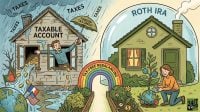
At the 24% federal bracket, a $500,000 position in a broad international equity exchange-traded fund (ETF) offering roughly 3% in annual distributions sends about $1,800 a year to the IRS at qualified rates, and closer to $3,600 if any portion is taxed as ordinary income. Multiply that across a decade and the leakage from a taxable account adds up to the entire price of a mid-sized car. A Roth IRA placement closes that gap and shelters every dollar of appreciation on top.
Schwab International Equity ETF (NYSEARCA:SCHF) is the fund in question. It closed at $27.47 on July 2, 2026, and has since climbed further as international equities extended their strong run. The fund’s two most recent semi-annual distributions were $0.165 on June 29, 2026, and $0.678 on December 16, 2025, putting the trailing 12-month payout near $0.84 per share. That works out to a distribution yield near 3% at current prices, which is the figure used throughout the tables below. Note that SCHF underwent a 2-for-1 share split effective October 10, 2024, so pre-split price histories will show roughly double today’s per-share figures. The fund has grown to approximately $67.2 billion in net assets, making it one of the largest developed-market equity ETFs available to U.S. investors.
The Tax Delta: Roth Versus Taxable
Assume a $500,000 SCHF position generating $15,000 in annual dividend income at the roughly 3% distribution rate. SCHF holds developed-market equities, so the bulk of its dividends generally meet the qualified-dividend holding-period test and are taxed at long-term capital gains rates, though a portion is typically non-qualified. The table below applies the qualified rate at each bracket to keep the comparison conservative.
| Scenario (24% bracket) | Gross Income | Tax | Net Income |
|---|---|---|---|
| Taxable account (15% qualified rate) | $15,000 | $2,250 | $12,750 |
| Roth IRA | $15,000 | $0 | $15,000 |
| Annual Roth advantage | $2,250 | ||
| 10-year Roth advantage (no reinvestment) | $22,500 |
That is only the dividend line. The appreciation shelter is where SCHF earns its Roth seat. Through July 31, 2026, the fund was up 15.3% year to date and 30.6% over the trailing 12 months. The 10-year total return (with dividends reinvested) stood at approximately 162%, reflecting a 10.1% annualized pace. Every dollar of that price gain represents a future capital-gains bill in a taxable account, and nothing inside a Roth.
The Bracket Multiplier
Same $500,000 position, same $15,000 in gross dividends, different brackets. Qualified rates apply.
| Bracket | Qualified Div Rate | Tax in Taxable | Net in Taxable | Annual Roth Advantage |
|---|---|---|---|---|
| 22% | 15% | $2,250 | $12,750 | $2,250 |
| 24% | 15% | $2,250 | $12,750 | $2,250 |
| 32% | 15% | $2,250 | $12,750 | $2,250 |
| 37% | 20% | $3,000 | $12,000 | $3,000 |
The dividend delta stays modest because qualified rates compress the spread across most brackets. The real bracket multiplier shows up on the capital-gains side. A 37% earner selling a decade of SCHF appreciation pays 20% plus the 3.8% net investment income tax. A Roth holder pays nothing on either count.
The Foreign Tax Credit Caveat
SCHF is 100% ex-U.S., and its underlying dividends face foreign withholding at the fund level, typically in the mid-teens on a weighted basis. When held in a taxable account, U.S. investors can generally recover that withholding through the foreign tax credit on Form 1116 or as a direct credit. Inside a Roth or traditional IRA, that credit is permanently lost. This is a genuine cost, and it is the one legitimate argument against Roth placement for internationally focused funds.
Weigh it against what the Roth actually shelters: the full qualified-dividend tax at 15% or 20%, plus every dollar of long-term appreciation on a fund whose 10-year total return has exceeded 160%. On a $500,000 position, the lost foreign credit amounts to a few hundred dollars a year. The sheltered capital gain on roughly 162% in cumulative 10-year appreciation is a six-figure number. The math still favors the Roth, and by a substantial margin.
The Insight Most Readers Miss
The Roth advantage extends well beyond the $2,250 annual dividend delta at the 24% bracket. It is that delta reinvested at SCHF’s current yield every year, combined with the parallel shelter on price appreciation that never triggers a taxable event. Compounded at a conservative 3% reinvestment rate over 20 years, the dividend delta alone approaches $60,000 of permanent tax savings on a single $500,000 lot. Add the capital-gains shelter, and the total moves into territory that dwarfs the foreign-tax-credit giveback several times over. For a fund now tracking over $67 billion in assets, the institutional validation of this trade-off is hard to ignore.
What to Do
- If SCHF or any other ex-U.S. equity fund sits in your taxable account, quantify your foreign tax credit recovery on last year’s return before assuming it is large enough to justify staying put.
- Run the Roth conversion math on international positions with the largest embedded gains first, since the multi-decade capital-gains shelter is where the Roth pays for itself.
- For new contributions, default the international equity allocation to the Roth and hold U.S. total-market or municipal-bond exposure in the taxable account, where the tax treatment is already more efficient.
Editor’s note: This article has been updated to reflect SCHF’s performance through July 31, 2026, including a revised YTD return of 15.3%, a trailing 12-month total return of 30.6%, and a 10-year cumulative total return of approximately 162% (10.1% annualized), all sourced from Schwab Asset Management’s official fund report. The article also adds the fund’s current net assets of approximately $67.2 billion and notes the 2-for-1 share split that took effect in October 2024.
Contact [email protected] for any questions or corrections.
Trey has been an editor and author at 24/7 Wall St. for more than a decade, where he has published thousands of articles analyzing corporate earnings, dividend stocks, short interest, insider buying, private equity, and market trends. His comprehensive coverage spans the full spectrum of financial markets, from blue-chip stalwarts to emerging growth companies.
Beyond 24/7 Wall St., Trey has created and edited financial content for Benzinga and AOL's BloggingStocks, contributing additional hundreds of articles to the investment community.
Trey's editorial expertise extends across multiple publishing environments. He served as production editor at Dearborn Financial Publishing and development editor at Kaplan, where he helped shape financial education materials. Earlier in his career, he worked as a writer-producer at SVE. His freelance editing portfolio includes work for prestigious clients such as Sage Publications, Rand McNally, the Institute for Supply Management, the American Library Association, Eggplant Literary Productions, and Spiegel.
Outside of financial journalism, Trey writes fiction and has been an active member of the writing community for years, moderating workshop sessions at regional conventions.