The 5 Smartphone Chip Stocks Poised for the Next Handset Upgrade Wave
Silicon content per handset is quietly repricing as on-device AI and RF complexity collide with the next refresh cycle, and five chip names are already splitting into winners and losers before most investors notice the gap.

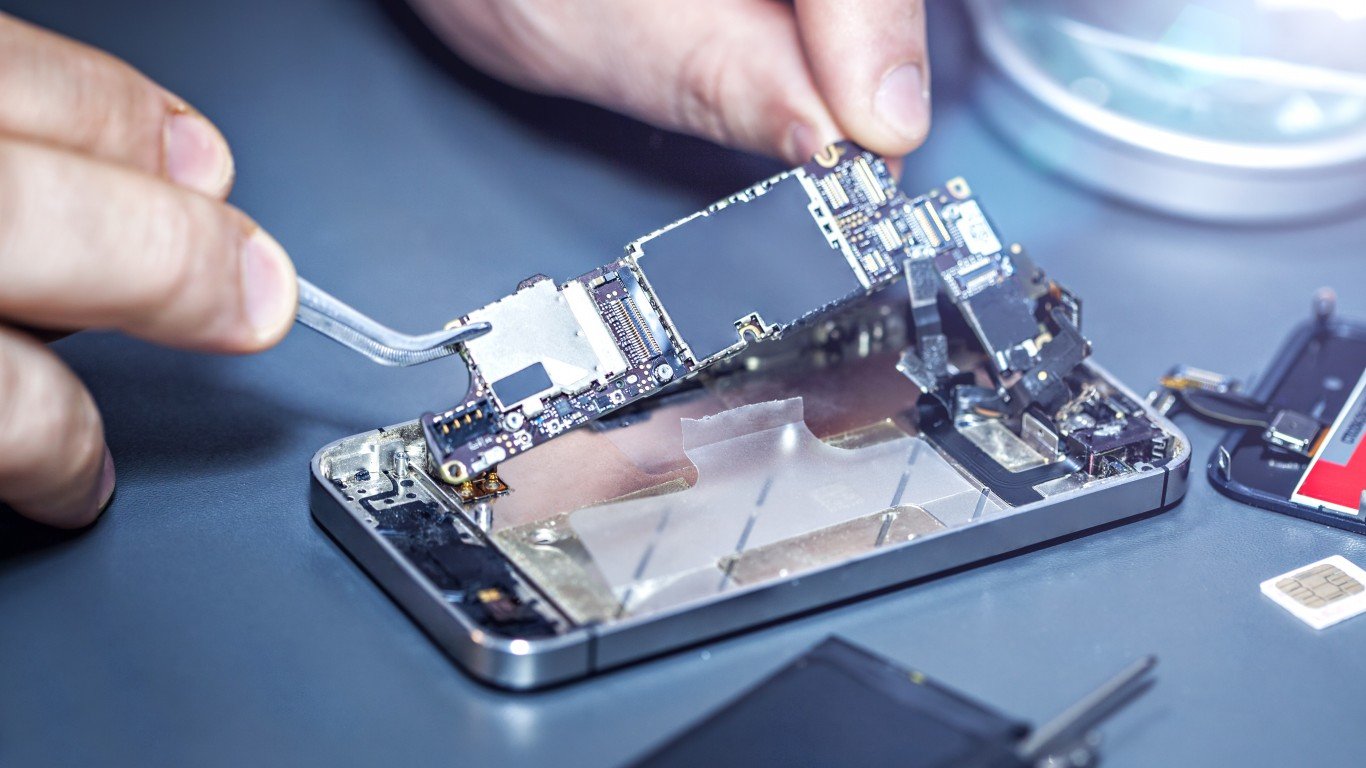
Smartphone silicon content is quietly repricing. On-device AI, camera stacks and RF complexity are lifting chip dollars per handset just as the next refresh cycle arrives, and the market has already begun pricing the winners. One name in this basket is up 74.95% year to date. Another is down 19.55% over the past year. That gap is the trade.
1. Synaptics (NASDAQ:SYNA | SYNA Price Prediction): The Surprise Lead
Nobody puts Synaptics on a smartphone-chip list first. They should. The company still ships touch controllers, display drivers, and wireless connectivity silicon into handsets, but the real story is the Edge AI pivot that is bleeding straight back into the phone. CEO Rahul Patel is explicit: “We are seeing accelerating activity in Physical AI and Edge AI, with increasing design wins and customer engagements.” That is exactly the content-per-device story that reprices a sleeper.
The fiscal Q3 2026 earnings report backs it up. Revenue hit $294.20 million, an 8.17% beat on non-GAAP EPS of $1.09, and management now expects full-year fiscal 2026 Core IoT revenue to grow more than 40% year over year (YoY) to over $385 million. Analysts have a $145.33 average price target against a current price near $127, with a forward P/E of 23.
If Synaptics is the surprise, the next name is the anchor of the entire on-device AI thesis. It just came off its worst handset quarter of the cycle, which is precisely why it matters.
2. Qualcomm (NASDAQ:QCOM): The Heavyweight Reset
Qualcomm is the direct pipe. Snapdragon SoCs, RF and modems sit in the flagship tier of nearly every non-Apple premium phone, and the on-device AI narrative runs through this silicon. The Q2 fiscal 2026 handset report was ugly on purpose: $6.024 billion in handset revenue, down 13% YoY, hammered by memory supply constraints and Chinese OEM softness. That is the setup phase before the thesis takes hold.
Management’s own words matter here. CEO Cristiano Amon said Chinese handset revenues are expected to bottom in Q3 FY26 and return to sequential growth the quarter after. Automotive hit a record $1.326 billion, up 38% YoY, and the company authorized a $20 billion share repurchase program. Three things line up: a handset trough already telegraphed, a diversification cushion, and a buyback the size of a small semi peer.
Shares are up 9.35% year to date (YTD), trading at a forward P/E in the low double digits with a 1.89%-adjacent dividend. But the cleanest content-per-device story on this list sits in a $150 iPhone bill of materials that nobody notices until it grows.
3. Cirrus Logic (NASDAQ:CRUS): The Apple Content Escalator
Cirrus Logic is a pure Apple content bet. About 92% of Q4 fiscal 2026 revenue came from a single customer, and that concentration is the feature by design. Every new controller, codec, or power IC that gets designed into an iPhone drops straight to the top line. CEO John Forsyth said the company is “developing next-generation camera controllers and a smart power IC, which represents an exciting new application space for the company.” Translation: more silicon per iPhone in the next cycle.
The numbers are already reflecting it. Q4 FY26 delivered a 59.84% EPS beat at $1.95, full-year free cash flow surged to $635.76 million (up 52.97%) and Q1 FY27 guidance of $430 million to $490 million implies roughly 13% YoY growth at the midpoint. The stock is up 25.65% YTD and trades at a forward P/E of 15 against an analyst target of $184.25.
Apple content is the escalator. The next name is the elevator: same building, faster ride and every quarter the margin numbers get louder.
4. Qorvo (NASDAQ:QRVO): RF Front-End Leverage
Qorvo is the RF front-end play in its most concentrated form. Every 5G/6G-capable handset needs more filters, more amplifiers, more tuning, and Qorvo’s silicon is embedded across flagship stacks. The pending merger with Skyworks has forced management to suspend guidance calls, but the standalone margin data is doing the talking.
Fiscal Q4 2026 non-GAAP gross margin expanded 670 basis points year over year to 52.6%, EPS beat consensus by 39.48% at $1.69, and management still expects fiscal 2027 non-GAAP diluted EPS approaching $7.00. CEO Bob Bruggeworth framed it plainly: “For full-year fiscal 2027, we continue to expect non-GAAP gross margin above 50% and non-GAAP diluted earnings per share approaching $7.00.”
Shares trade near $86 against a forward P/E of 13, essentially flat YTD at -0.53%. Analysts sit at $91.46 with the crowd still cautious. That is exactly the setup investors want heading into the payoff slot, because the other side of this merger has the punchline nobody is pricing.
5. Skyworks Solutions (NASDAQ:SWKS): The Payoff
Skyworks is the beaten-down contrarian. Shares are down 6.24% YTD, 22.29% over the past year and 68.15% over five years, and the entire Street knows the Apple concentration story. What the Street is still underwriting is the landmark. A multi-generational design win with a leading Android OEM is expected to generate over $1.00 billion in revenue through 2030, directly attacking the customer concentration that has anchored the discount. That is the punchline.
The Q2 fiscal 2026 earnings report already shows the turn: revenue of $943.70 million beat consensus by 4.65%, non-GAAP EPS of $1.15 beat by 10.10%, and Broad Markets is expected to hit roughly 43% of Q3 sales on double-digit growth. CEO Phil Brace said “Mobile outperformed expectations on healthy demand, while Broad Markets continues to accelerate, delivering double-digit year-over-year growth driven by Wi-Fi, data center, and automotive.”
Shares trade near $60 with a forward P/E of 11 and a 4.70% dividend yield. With the pending Qorvo merger already at 81% shareholder approval, the setup combines a stated $1B Android revenue ramp, a broad markets acceleration, and a combined RF footprint the market has yet to price coherently. That is the highest-torque handset chip trade in this basket.
The Setup
The upgrade cycle works as a content-per-device escalator that pays across five different silicon layers: Edge AI (SYNA), on-device compute and modem (QCOM), audio and power (CRUS), RF front-end (QRVO) and the combined RF platform after the Skyworks-Qorvo close (SWKS). One name is already up 74.95% YTD. Two are still trading below their 200-day moving averages. The gap closes when the refresh volume shows up in the September and December earnings reports.
Contact [email protected] for any questions or corrections.
Joel South covers large-cap stocks, dividend investing, and major market trends, with a focus on earnings analysis, valuation, and turning complex data into actionable insights for investors.
He brings more than 15 years of experience as an investor and financial journalist, including 12 years at The Motley Fool, where he served as an investment analyst, Bureau Chief, and later led the Fool.com investing news desk. He has also co-hosted an investing podcast and appeared across TV and radio discussing market trends.