3 Stocks to Own When the Market Gets Ugly in July
The VIX is spiking, consumer sentiment is cratering, and the yield curve is flashing warnings it has not shown in over a year. Three defensive stocks are quietly building the kind of cash flow that holds up when the rest…

This post may contain links from our sponsors and affiliates, and Flywheel Publishing may receive compensation for actions taken through them.
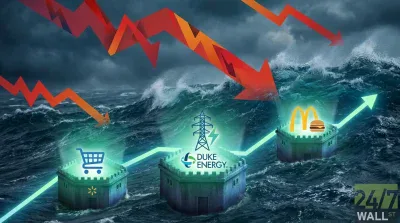
July is off to a jittery start. The VIX closed at 17.16 on July 13, up 14.2% in a single session and 10.2% for the week. The 10-year to 2-year Treasury spread sits at just 0.36%, in the 5.6th percentile of the past 12 months. University of Michigan Consumer Sentiment printed 44.8 in May, down from 61.7 last July and approaching the sub-60 recessionary zone.
The Sahm Rule is not flashing red and was sitting at 0.07 in June, well below the 0.50 recession trigger, so this is a positioning trade rather than a crisis hedge. Three U.S.-listed defensives fit the moment: Walmart (NYSE:WMT | WMT Price Prediction) in staples retail, Duke Energy (NYSE:DUK) in regulated power and McDonald’s (NYSE:MCD) in global quick-service restaurants. Each carries a coherent bull case and a risk investors should not overlook.
Walmart (WMT)
Walmart is the cleanest way to play trade-down behavior when household budgets tighten. Q1 FY27 delivered Adj EPS of $0.66 on revenue of $175.68B, up 6.1% year over year, with global eCommerce sales up 26% and U.S. comps up 4.1% ex-fuel. Management is taking share across income tiers, including upper-income households. Higher-margin ancillaries are compounding fast: global advertising rose 37% and membership fees rose 17.4%.
The capital return story is stiffening. Walmart raised its quarterly payout to 24 cents for 2026, up from 23 cents in 2025 and 20 cents in 2024, and authorized a new $30 billion buyback in February with $28.2 billion remaining. As of July 15, shares are up 19.58% over the past year despite a 5.59% one-month pullback, which has created a cleaner entry.
Risk: valuation is not cheap at a P/E of 42, and fuel costs are running as a ~250bps operating income headwind with inventory up 8.9%. Tariff and IEEPA uncertainty can compress guidance in a hurry.
Duke Energy (DUK)
Duke Energy is the least correlated name on this list to the AI hype cycle, yet it is a direct beneficiary of it through power demand. Q1 2026 marked a fourth consecutive earnings beat, with adjusted EPS of $1.93 topping the $1.7951 estimate by 7.51% and revenue of $9.18 billion up 11.3%. Management reaffirmed 2026 Adj EPS guidance of $6.55 to $6.80 and pointed to long-term growth of 5% to 7% through 2030, with confidence in the top half beginning 2028.
The setup rests on a $103 billion five-year capital plan driving 9.6% earnings base growth and 7.6 GW of economic development projects secured under Electric Service Agreements tied to data center and advanced manufacturing demand. As of July 15, shares are up 7.89% year to date. The trailing 12-month dividend of $4.6116 reflects a payer that has never skipped a quarterly distribution in the dataset.
Risk: rising interest expense weighs on capital-intensive utilities, and industrial electric sales fell 2.1% year over year. If contracted data center load ramps slower than the capex schedule assumes, the earnings algorithm gets stress-tested.
McDonald’s (MCD)
McDonald’s is the contrarian pick. As of July 15, shares are down 11.14% year to date and 10.06% over the past year, sitting well below the 52-week high of $337.56 and the analyst target of $328.87. That is the setup, not the thesis.
The fundamentals turned in Q1. Global comparable sales rose 3.8% versus -1.0% a year ago, with U.S. comps up 3.9% and all segments positive. Loyalty is now a genuine moat: systemwide sales to members exceeded $9 billion in the quarter and topped $38B on a trailing 12-month basis across 70 markets. Revenue of $6.52B was up 9.4%, and management guided to operating margin in the mid-to-high 40% range.
Income investors get paid to wait. The quarterly dividend was raised to $1.86 in Q4 2025, up from $1.77, extending a growth streak that has taken the annual payout from $0.77 quarterly in 2013 to $1.86 in 2026. Beta of 0.418 means the name should hold up if the VIX pushes higher. Analyst positioning skews constructive with 14 Buy ratings and five Strong Buy ratings against one Sell rating.
Risk: the effective tax rate rose to 22.0% from 19.8%, restructuring charges run through 2027, and international markets carry geopolitical and anti-American sentiment exposure that a value menu cannot fix.
What to Watch Next
The through-line is cash flow that shows up whether the S&P is green or red. Walmart is the trade-down lever, Duke Energy is the rate-base compounder with an AI kicker and McDonald’s is the loyalty-driven dividend grower trading at a discount to its own history. If July gets ugly, keep an eye on Walmart’s Q2 report and the next VIX reading above 20 as signals that defensives are being priced correctly rather than as a crowded trade.
Contact [email protected] for any questions or corrections.
Joel South covers large-cap stocks, dividend investing, and major market trends, with a focus on earnings analysis, valuation, and turning complex data into actionable insights for investors.
He brings more than 15 years of experience as an investor and financial journalist, including 12 years at The Motley Fool, where he served as an investment analyst, Bureau Chief, and later led the Fool.com investing news desk. He has also co-hosted an investing podcast and appeared across TV and radio discussing market trends.