If You Invest $1,000 in Microsoft Today, Here’s What It Could Be Worth by 2029
Microsoft is racing to turn a $677 billion contracted backlog and explosive Azure growth into shareholder returns, but massive capital spending and margin pressure could derail the story before 2029 arrives.

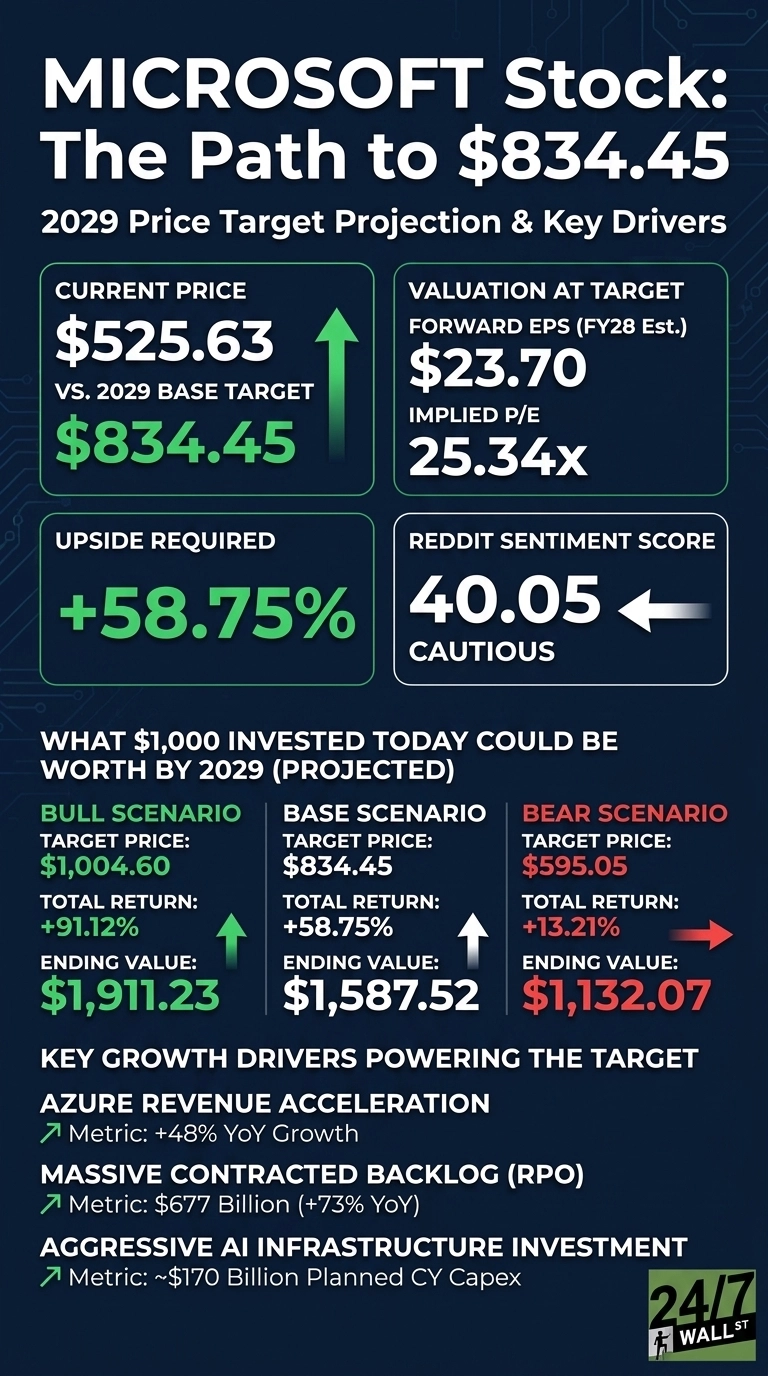
Microsoft (NASDAQ:MSFT | MSFT Price Prediction) is one of the biggest stocks you can own to get exposure to enterprise AI, so it makes sense to ask what $1,000 put in today could grow into by 2029. Our price-prediction model uses a reference price of $525.63 per share.
The latest delayed quote is $522.35. The model’s five-year forecast has a checkpoint on October 29, 2029, so every 2029 number below comes straight from that projected checkpoint.

What $1,000 in Microsoft Could Become by 2029
Under the model’s central scenario, a $1,000 investment in Microsoft could be worth about $1,587.52 by 2029. That amounts to a return of 58.75%. The figure rests on a projected base-case share price of $834.45 at the 2029 checkpoint, measured against the model’s reference price.
The one-year forecast offers a closer checkpoint. Its base-case target is $642.67, or 22.27% upside, which would turn the same $1,000 into $1,222.67 within a year.
Bull, Base, and Bear Outcomes for Your $1,000
| Scenario | Target Share Price (2029) | Total Return | $1,000 Stake Value |
|---|---|---|---|
| Bull | $1,004.60 | 91.12% | $1,911.23 |
| Base | $834.45 | 58.75% | $1,587.52 |
| Bear | $595.05 | 13.21% | $1,132.07 |
These figures count share price gains only. Microsoft’s dividend yield of 0.67% would add a small amount of income on top.
The model rates its confidence at 0.9, which it labels high. Wall Street generally agrees on the direction.
The consensus analyst target is $605.12, with 14 Strong Buy ratings, 39 Buy ratings, 2 Holds, and no Sells. That consensus target is lower than the model’s one-year base case. Analysts are positive, but they are more conservative than the model about how far the stock can run in the closer term.

Three Drivers Powering the 2029 Target
Azure Is Accelerating at Scale
In the most recent quarter, Azure revenue rose 48%, and Microsoft Cloud revenue reached $63.9 billion, up 30%. Total revenue came in at $92.28 billion, ahead of the $90.75 billion estimate.
For next quarter, CFO Amy Hood guided to Azure growth of 49 to 50% in constant currency. She also said “customer demand continues to exceed available supply.”
A $677 Billion Contracted Backlog
Commercial remaining performance obligation, which is revenue customers have already signed up for but Microsoft has not yet booked, rose 73% to $677 billion.
Its weighted average duration is 2.3 years, so much of that backlog should turn into revenue before the 2029 checkpoint. Copilot is adding to that pipeline: daily users are “up nearly 50% quarter over quarter and over 5x year over year.”
Earnings Estimates Keep Climbing
Non-GAAP EPS of $4.89 beat the $4.72 estimate, Microsoft’s sixth consecutive EPS beat. The consensus EPS estimate for fiscal 2028 is $23.7024, up from $22.6103 90 days ago.
The stock trades at a trailing P/E of 29 and a forward P/E of 25, so earnings growth can push the share price higher without investors having to pay a richer multiple.
Risks That Could Shrink Your Ending Balance
The biggest swing factor is spending. Quarterly capital expenditures reached $45.2 billion, with calendar-year spending of about $170 billion planned for the data-center expansion (we highlighted seven suppliers quietly driving that spend, from grid to cooling, in a free AI infrastructure report).
If AI returns lag that expansion, free cash flow and profit margins could come under pressure. Microsoft Cloud gross margin already slid to 66% as the sales mix moved toward Azure. Some third-party GPU contracts “have been delayed to H2,” and limited capacity could hold back Azure growth.
Gains and losses on Microsoft’s OpenAI stake can swing GAAP earnings. Windows OEM and Devices revenue fell 22%. The stock is also down 2.75% over the past year, a reminder that a strong business can still deliver a flat stock.
Even the bearish outlook allows for slower growth, but still assumes Microsoft keeps performing. A sharp drop in valuations across tech could leave your $1,000 below even that scenario.
What This Could Mean for Your $1,000
The model’s scenarios show $1,000 invested in Microsoft today could be worth between $1,132.07 and $1,911.23 by 2029, with a base case of $1,587.52. Each of those figures is a scenario, and none of them is guaranteed.
Over the coming quarters, the numbers to track are Azure capacity additions, how quickly the backlog turns to revenue, and returns on capital spending. Consider it a projection, not investment advice.
Contact [email protected] for any questions or corrections.
Vandita Jadeja is a financial publisher with over a decade of experience writing about financial topics, including investment, savings, retirement, insurance and banking. Vandita is a Chartered Accountant who loves to debunk financial concepts for readers.
Her work has appeared on sites that include The Motley Fool, InvestorPlace, and Benzinga. She covers investing and focuses on stock picks and price prediction for 24/7 Wall St.
When not looking for the next stock investment opportunity, she can be found traveling, reading, chasing sunsets and enjoying her iced latte.