Jensen Huang Just Revealed Nvidia’s Real Endgame — And the Risk It Creates for U.S. AI Leadership
Jensen Huang is publicly championing open AI models, and his argument sounds principled until you follow the money to see exactly who profits when AI spreads to every corner of the globe, including America's rivals.

The battle over artificial intelligence is often framed as a race between OpenAI, Anthropic, Google, Meta Platforms (NASDAQ:META | META Price Prediction), and a growing list of Chinese challengers. Investors naturally focus on which company has the smartest chatbot or the most advanced reasoning model. But that may be asking the wrong question.
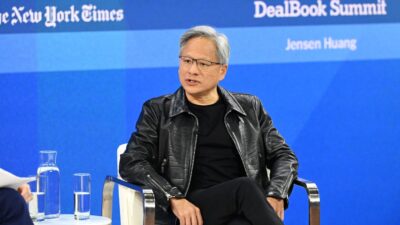
In a recent open letter advocating for open-weight AI models, Nvidia (NASDAQ:NVDA) CEO Jensen Huang offered a different vision for the industry’s future. Read closely, and his comments reveal something more important than a philosophical argument about open source — they expose the business model that has turned Nvidia into the most valuable infrastructure company in AI.
Nvidia Doesn’t Need to Win the AI Race
Huang’s central argument is that America’s AI leadership depends on building an open ecosystem rather than concentrating advanced models in the hands of a few companies. In the letter, backed by organizations including Meta, Microsoft (NASDAQ:MSFT), IBM (NASDAQ:IBM), Hugging Face, Mistral, Mozilla, and the Linux Foundation, he argues that open-weight models expand competition, lower costs, improve customer control, and speed AI adoption across industries.
Granted, that sounds like a policy position. It is also remarkably aligned with Nvidia’s financial interests.
Unlike OpenAI or Anthropic, Nvidia doesn’t sell AI models. It sells the computing infrastructure needed to train, fine-tune, and deploy them. Whether a company uses Meta’s Llama, DeepSeek‘s R1, Mistral’s latest release, or OpenAI’s next frontier model, there’s a good chance Nvidia hardware is powering the workload.
Nvidia doesn’t need one company to dominate AI. It benefits most when everyone builds AI.
Open Models Create Winners — And New Rivals
Closed AI models concentrate computing demand among a handful of hyperscalers that operate enormous data centers. Open-weight models spread that demand across startups, universities, governments, manufacturers, healthcare providers, and enterprises that want to run models on their own infrastructure. That’s exactly the kind of diffusion Huang champions.
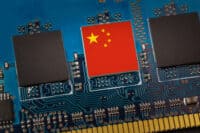
Recent leaked comments from DeepSeek founder Liang Wenfeng reinforce the point. According to the transcript, DeepSeek remains constrained by compute availability despite operating roughly 20,000 H100-equivalent GPUs. Liang also said Huawei’s production capacity remains limited and that DeepSeek expects to receive “large batches” of Nvidia-powered systems in the coming months following the Trump administration’s decision to permit certain Nvidia AI chip sales into China.
Surprisingly, one of China’s most capable open-model developers may still depend on Nvidia hardware for its next phase of growth.
That also exposes the biggest tension in Huang’s argument. Nvidia benefits when AI spreads as broadly as possible because every new model, whether developed in Silicon Valley or Beijing, creates demand for GPUs. But that isn’t necessarily good news for every American AI company. Giving DeepSeek more computing power could help it build stronger open models that compete directly with OpenAI, Anthropic, and other U.S. developers. What’s good for Nvidia shareholders isn’t always perfectly aligned with the interests of U.S. frontier-model companies — or policymakers focused on preserving America’s technological lead.
That said, investors shouldn’t assume open models will replace proprietary AI. History suggests markets often support both approaches. Linux became the backbone of cloud computing without eliminating Microsoft Windows, while PostgreSQL expanded without replacing Oracle Database.
AI is likely to follow a similar path, with closed models retaining an edge in frontier reasoning and regulated industries while open models dominate customized deployments, sovereign AI projects, and enterprise fine-tuning. Nvidia is positioned to supply both ecosystems.
Key Takeaway
In short, Huang’s recent comments shouldn’t be viewed simply as an endorsement of open-source AI. They’re better understood as an explanation of Nvidia’s long-term strategy.
The company’s real competitive advantage isn’t building the best chatbot. It ensures that every company, government, researcher, and startup that wants to build AI needs Nvidia’s hardware to do it.
Granted, that strategy creates an uncomfortable tradeoff. Broader access to Nvidia’s chips can strengthen overseas competitors like DeepSeek even as it expands Nvidia’s addressable market. Investors, AI developers, and policymakers won’t always reach the same conclusion because they’re optimizing for different outcomes.
Ultimately, Nvidia wins if AI becomes ubiquitous. Regardless of whether OpenAI, DeepSeek, Meta, Anthropic, or another lab develops the world’s best model, widespread AI adoption creates more demand for the infrastructure Nvidia sells. For long-term shareholders, that’s the real message hidden inside Huang’s letter.
Contact [email protected] for any questions or corrections.
After two decades of patrolling the dark corners of suburbia as a police officer, Rich Duprey hung up his badge and gun to begin writing full time about stocks and investing. For the past 20 years he’s been cruising the markets looking for companies to lock up as long-term holdings in a portfolio while writing extensively on the broad sectors of consumer goods, technology, and industrials. Because his experience isn’t from the typical financial analyst track, Rich is able to break down complex topics into understandable and useful action points for the average investor. His writings have appeared on The Motley Fool, InvestorPlace, Yahoo! Finance, and Money Morning. He has been featured in both U.S. and international publications, including MarketWatch, Financial Times, Forbes, Fast Company, and USA Today.