NextEra Energy vs Brookfield Renewable: The Better Dividend Stock
NextEra and Brookfield both crushed Q1 2026 with clean-power tailwinds, but one saddles you with tax headaches and GAAP losses while the other quietly hands you a faster-growing check and a beta that lets you sleep.

NextEra Energy (NYSE:NEE | NEE Price Prediction) and Brookfield Renewable Partners (NYSE:BEP) both posted Q1 2026 results that sharpen a long-running income debate.
NextEra leaned on its Florida utility and a swelling renewables backlog. Brookfield leaned on hydro cash flow and a Westinghouse-driven nuclear push, while a derivatives mark dragged GAAP earnings. For dividend investors, the two now offer very different flavors of the same clean-power thesis.

Florida Utility Cash vs. Global Hydro Cash
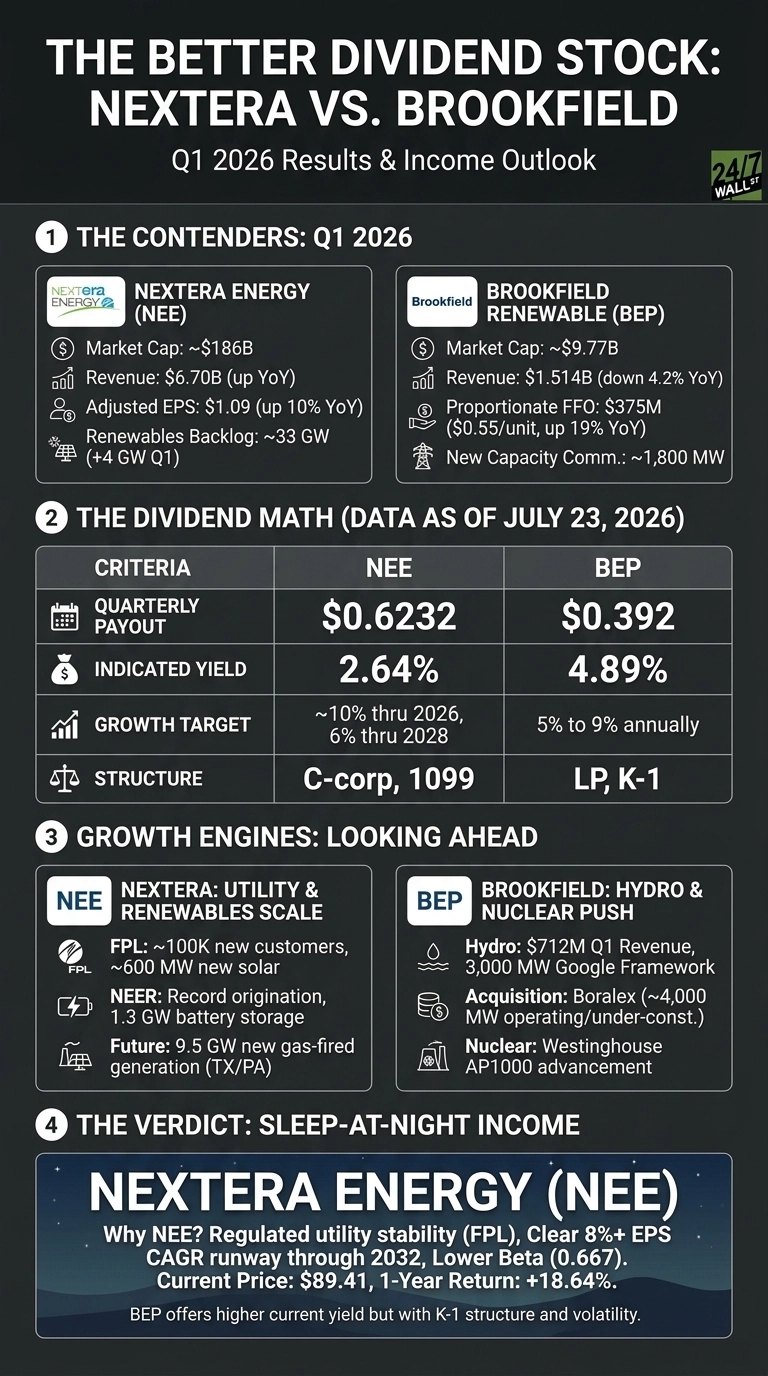
NextEra’s Q1 was clean. Adjusted EPS came in at $1.09, up 10% YoY, on revenue of $6.70B. Florida Power & Light added roughly 100,000 customers and brought about 600 MW of new solar online, while NextEra Energy Resources booked a record origination quarter with 4 GW added to a backlog now near 33 GW.
CEO John Ketchum told investors NextEra expects “to grow adjusted earnings per share at a compound annual growth rate of 8%+ through 2032″. That is the kind of visibility income buyers pay up for.
Brookfield’s quarter looked messier on the surface. GAAP net loss hit $295M, weighed by a $193M mark-to-market hit on long-term power derivatives. Underneath, proportionate FFO reached $375M, or $0.55 per unit, up 19% YoY, and the business commissioned roughly 1,800 MW of new capacity.
Connor Teskey framed the tone plainly, citing “the multi-decade trends of reindustrialization and electrification” amplified by data centers. Hydroelectric alone contributed $712M in revenue, the closest thing in renewables to a utility annuity.
The Dividend Math Is Not Close
| Dividend Lens | NEE | BEP |
| Quarterly payout | $0.6232 | $0.392 |
| Indicated yield | 2.64% | 4.89% |
| Growth target | ~10% through 2026, then 6% through 2028 | 5% to 9% annually |
| Structure | C-corp, 1099 | LP, K-1 |
Brookfield pays you more today. NextEra grows the check faster and does not saddle you with a K-1. The current quarterly step from $0.5665 in 2025 to $0.6232 in 2026 shows NextEra still walking that 10% path.
Brookfield moved from $0.373 to $0.392, a solid mid-single-digit bump backed by a 12-year weighted-average contract duration and 92% contracted revenue for the rest of 2026.
What I Am Watching Into 2027
For NextEra, I want to see the 9.5 GW of new gas-fired generation tied to the U.S.-Japan trade deal move from press release to concrete, and the Duane Arnold nuclear restart deliver its expected $0.16 in annual adjusted EPS.
For Brookfield, the Boralex acquisition, the 3,000 MW Google hydro framework, and Westinghouse’s AP1000 push will determine whether that 12% to 15% long-term total return target holds. Rising corporate borrowings, now $4.8B versus $3.7B, deserve attention too.

Why I Lean NEE for Sleep-at-Night Income
If I am building a core dividend position and I want to stop thinking about it, I take NextEra. The regulated FPL earnings base, a beta of 0.667, and a clear 8%-plus EPS runway through 2032 give me a rare mix of yield growth and stability. The 18.64% one-year return is a welcome tailwind on top of the thesis.
If I already own steady utilities and I want a higher current payout with more upside variance, Brookfield fits, especially given its 22.14% YTD move and Westinghouse optionality. I would not own it in a taxable account without accepting the K-1 friction. For most income investors I talk to, NextEra remains the cleaner dividend stock today.
Contact [email protected] for any questions or corrections.
Vandita Jadeja is a financial publisher with over a decade of experience writing about financial topics, including investment, savings, retirement, insurance and banking. Vandita is a Chartered Accountant who loves to debunk financial concepts for readers.
Her work has appeared on sites that include The Motley Fool, InvestorPlace, and Benzinga. She covers investing and focuses on stock picks and price prediction for 24/7 Wall St.
When not looking for the next stock investment opportunity, she can be found traveling, reading, chasing sunsets and enjoying her iced latte.