AI Energy Bottleneck: Buy GE Vernova or NextEra Energy on AI Pivot?
GE Vernova sells the equipment that generates every hyperscaler megawatt while NextEra owns the megawatts themselves, and right now both stocks are pricing in the same AI power crunch through very different lenses.

GE Vernova (NYSE:GEV | GEV Price Prediction) and NextEra Energy (NYSE:NEE) reported June-quarter results within 48 hours of each other. GEV sells the turbines, transformers, and grid gear every hyperscaler needs. NextEra owns the megawatts, the interconnects, and a Florida utility that hyperscalers want to plug into. Two ways to buy the same AI power bottleneck.
Turbines Roar, Renewables Grind
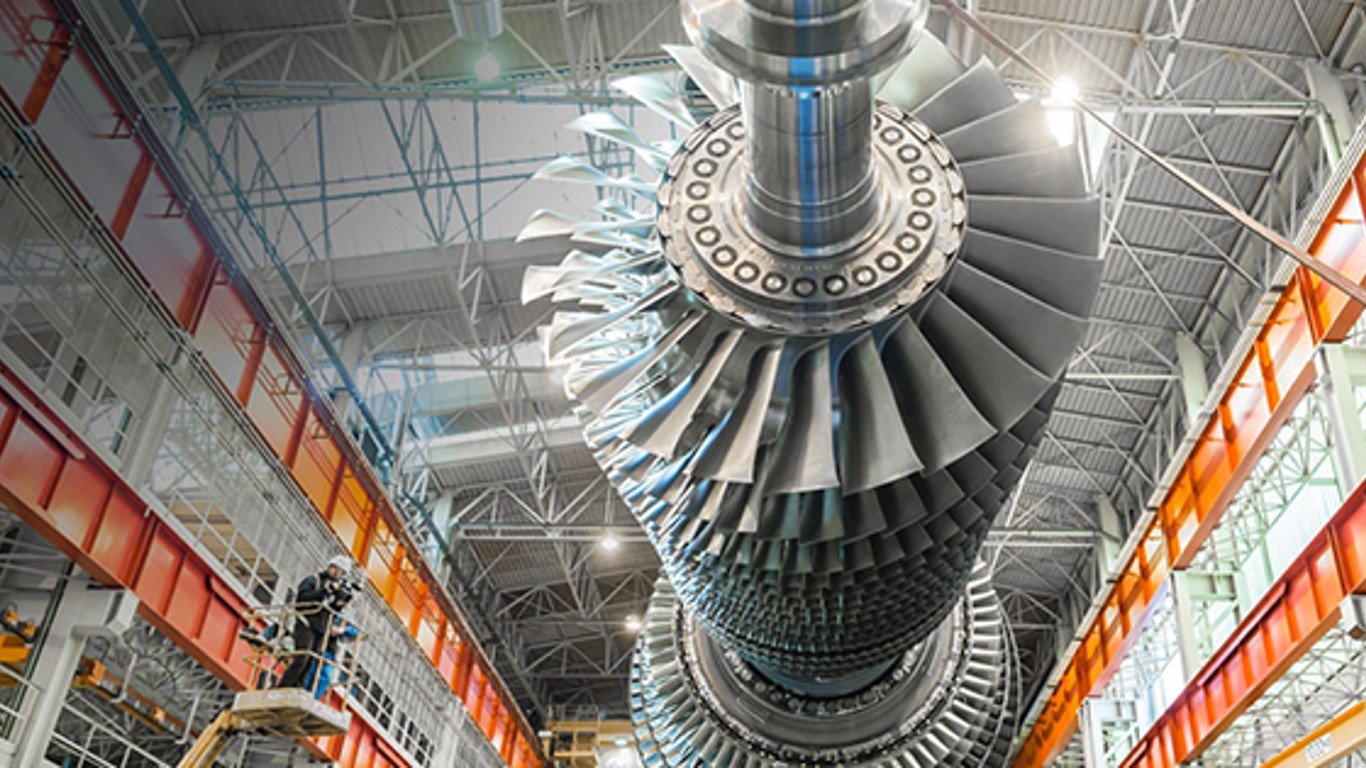
GE Vernova posted Q2 revenue of $11.10 billion, up 21.8% year over year, with bookings of $24.2 billion and a $176 billion backlog. Electrification revenue jumped 68%, and $2.7 billion of that came from data center orders in the quarter alone. CEO Scott Strazik told investors GEV is “on track to deliver 20 GW of annual gas turbine output in the third quarter of 2026, with 24 GW in 2028” and 30 GW by 2030. Wind guidance includes roughly $400 million in EBITDA losses.
NextEra countered with adjusted EPS of $1.15, up 9.5%, its fifth straight beat. Revenue of $7.53 billion missed the $8.15 billion consensus by 7.58%, though net income climbed 55% to $3.14 billion. Florida Power & Light added 90,000+ customers, and NEER pushed its renewables backlog to roughly 35.1 GW. Ketchum flagged ~21 GW of large-load data center interest at FPL, with 12 GW in advanced discussions.
Equipment Maker vs. Megawatt Owner
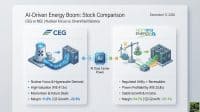
| Lens | GE Vernova | NextEra |
| Core Bet | Gas turbines + grid gear | Regulated utility + renewables + nuclear restart |
| Key Catalyst | Ramp from 20 to 30 GW/yr output | Dominion merger, close H2 2027 |
| Forward P/E | 36x | 22x |
| YTD Stock | +55.55% | +13.39% |
GEV raised 2026 free cash flow guidance to $11.5 to $12.5 billion, nearly double the prior range. NextEra reiterated 8%+ EPS CAGR through 2032 and its Duane Arnold nuclear restart, backed by a 25-year Google PPA, targeted for Q1 2029.
Execution Is the Next Test
Execution is the debate now. Watch whether GEV can hold pricing as it lifts Greenville output from 3 GW to 5 GW per quarter and whether wind losses shrink. For NextEra, the Dominion regulatory review across Virginia, the Carolinas, FERC and NRC is the swing factor, alongside that first large-load FPL deal Ketchum promised by year-end.
Why I Would Split the Ticket
For pure upside, GEV is the cleaner AI infrastructure asset. It sits upstream of every megawatt, whether gas, nuclear, or solar, and the $176 billion backlog gives visibility few industrials can match. Valuation looks stretched after a 55.55% YTD run.
NextEra fits differently. At 22x forward earnings with a 1.26% yield and ~10% dividend growth guided through 2026, it suits investors who want AI exposure without paying an industrial-growth multiple. For torque, lean GEV. For compounding through a digestion phase, NEE earns the slot.
Contact [email protected] for any questions or corrections.
Alex Sirois is a financial writer with experience spanning both retail and institutional investing. He has written for InvestorPlace and held roles at BNY Mellon and Bernstein, giving him a perspective that bridges Main Street portfolios and Wall Street analysis.
Alex holds an MBA from George Washington University and has built his career across multiple industries, including e-commerce, education, and translation — a breadth of experience that informs how he breaks down complex financial topics for everyday investors. His writing is conversational, actionable, and grounded in long-term, buy-and-hold investing principles.
At 247 Wall St., Alex focuses on delivering analysis that is both accessible and useful, with a clear emphasis on helping readers make more informed decisions with their money.