5 Biggest Earnings Reports to Watch This Week
With 751 companies reporting Q2 results and AI infrastructure spending dominating the narrative, five earnings reports this week will reveal whether the most powerful capex cycle in a generation is still accelerating or quietly starting to crack.


Earnings season hits a crescendo the week of July 27, 2026, and the calendar reads like a macro stress test. Roughly 751 companies report Q2 results, and the mix leans heavily on the two themes driving markets right now: AI infrastructure buildout and energy capex. Five names stand out as the clearest windows into where the economy is heading as we enter August. GDP just accelerated to 2.1% in Q1 2026 from 0.5% in Q4 2025, and corporate profits are growing at a 12.8% year-over-year clip. These five reports will tell us whether that momentum holds.
1. AstraZeneca (AZN)
AstraZeneca (NASDAQ:AZN | AZN Price Prediction) reports pre-market on July 27 with a consensus estimate of $2.50. The $261B pharma giant enters the earnings report with the stock down 6.56% year-to-date, despite Q1 revenue of $15.29B (+13% YoY) and oncology revenue of $6.80B (+20%). Investors will focus on whether CEO Pascal Soriot reaffirms mid-to-high single-digit revenue growth and low double-digit core EPS growth guidance. Watch Enhertu (last quarter: $831M, +40%), China VBP pressure on Farxiga, and any Phase III readout commentary. With 20+ Phase III readouts due this year, the pipeline update matters more than the earnings report.
2. Baker Hughes (BKR)
Baker Hughes (NASDAQ:BKR) reports post-market on July 26, kicking off the week with the cleanest read on global energy capex. The $55.6B services bellwether has posted 8+ consecutive EPS beats, and Q1 delivered a 17.5% EPS beat. The IET segment is the real story: $4.89B in record orders, a $33.10B backlog, and $1.4B in Power Systems orders tied to data center demand. WTI at $84.38, up 6.5% on the week, supports the upstream capex thesis. Shares are up 24.06% YTD, with analysts targeting $70.32. Key catalyst: the 60 NovaLT turbines and 1 GW data center power pipeline.
3. Celestica (CLS)
Celestica (NYSE:CLS) reports post-market on July 27, and this is the AI infrastructure earnings report that matters. Q1 revenue jumped 52.8% YoY to $4.05B, with the CCS segment up 76% and Hardware Platform Solutions up 63%. Management already raised FY2026 revenue guidance to $19.0B from $17.0B and adj EPS to $10.15 from $8.75. Q2 guidance sits at $4.15B-$4.45B revenue with adj EPS of $2.14-$2.34. Shares are up 98.32% over one year. The risk sits in customer concentration: three customers represent 36%/15%/12% of revenue. Any hyperscaler order commentary or update on the 1.6T Ethernet CPO program will move the stock.
4. Applied Digital (APLD)
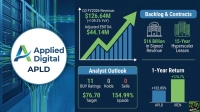
Applied Digital (NASDAQ:APLD) reports post-market on July 27, with the consensus at -$0.20. Fiscal Q3 delivered revenue of $126.64M (+139.3% YoY) and a stunning 142.86% EPS beat. The story is Polaris Forge: 100 MW live for CoreWeave, a new 15-year, 200 MW hyperscaler lease worth ~$5B, and Delta Forge 1 (300 MW) breaking ground. Management targets $1B in NOI within 5 years against a 600 MW contracted pipeline representing ~$16B in prospective lease revenue. Watch the balance sheet: $2.7B in debt against $2.1B in cash after the $2.15B senior notes issuance. Shares crashed 33.97% in the past month, suggesting expectations have reset lower going in.
5. Navitas Semiconductor (NVTS)
Navitas Semiconductor (NASDAQ:NVTS) reports post-market on July 27. This is the smallest name on the list at $2.74B market cap, but arguably the highest-beta AI play. Q1 revenue of $8.60M was down 38.7% YoY as management deliberately wound down mobile/consumer to focus on the $3.5B SAM by 2030 with 60%+ CAGR in AI, grid, and industrial. Q2 guidance sits at $10.0M ± $0.5M, roughly 16% sequential growth. The 800V HVDC architecture tailwind and the GlobalFoundries US GaN partnership ramping late 2026 are the bull case. Shares are up 68.49% YTD but down 43.79% in the past month. Beta of 3.815 tells you what to expect after the earnings report.
Conclusion
Four of these five names are direct plays on the same thesis: hyperscaler capex, reportedly running near $700B annually, is powering everything from server assembly to gas turbines to GaN power chips. AstraZeneca is the outlier and the defensive read on consumer-facing demand as personal consumption growth cooled to 0.5% in Q1. The core question this week: does the AI capex cycle keep compounding, or are early cracks (APLD and NVTS both down sharply in the past month) signaling that expectations have outrun deliverable results? Keep an eye on guidance more than the headline number.
Contact [email protected] for any questions or corrections.
Joel South covers large-cap stocks, dividend investing, and major market trends, with a focus on earnings analysis, valuation, and turning complex data into actionable insights for investors.
He brings more than 15 years of experience as an investor and financial journalist, including 12 years at The Motley Fool, where he served as an investment analyst, Bureau Chief, and later led the Fool.com investing news desk. He has also co-hosted an investing podcast and appeared across TV and radio discussing market trends.