AI Needs Power: 5 Dividend Stocks Quietly Funding the Datacenter Boom
The Department of Energy now projects data centers will account for up to 12% of U.S. electrical demand by 2028, and somebody has to actually build the power plants, transformers, and transmission lines to feed that monster. The hyperscalers get…


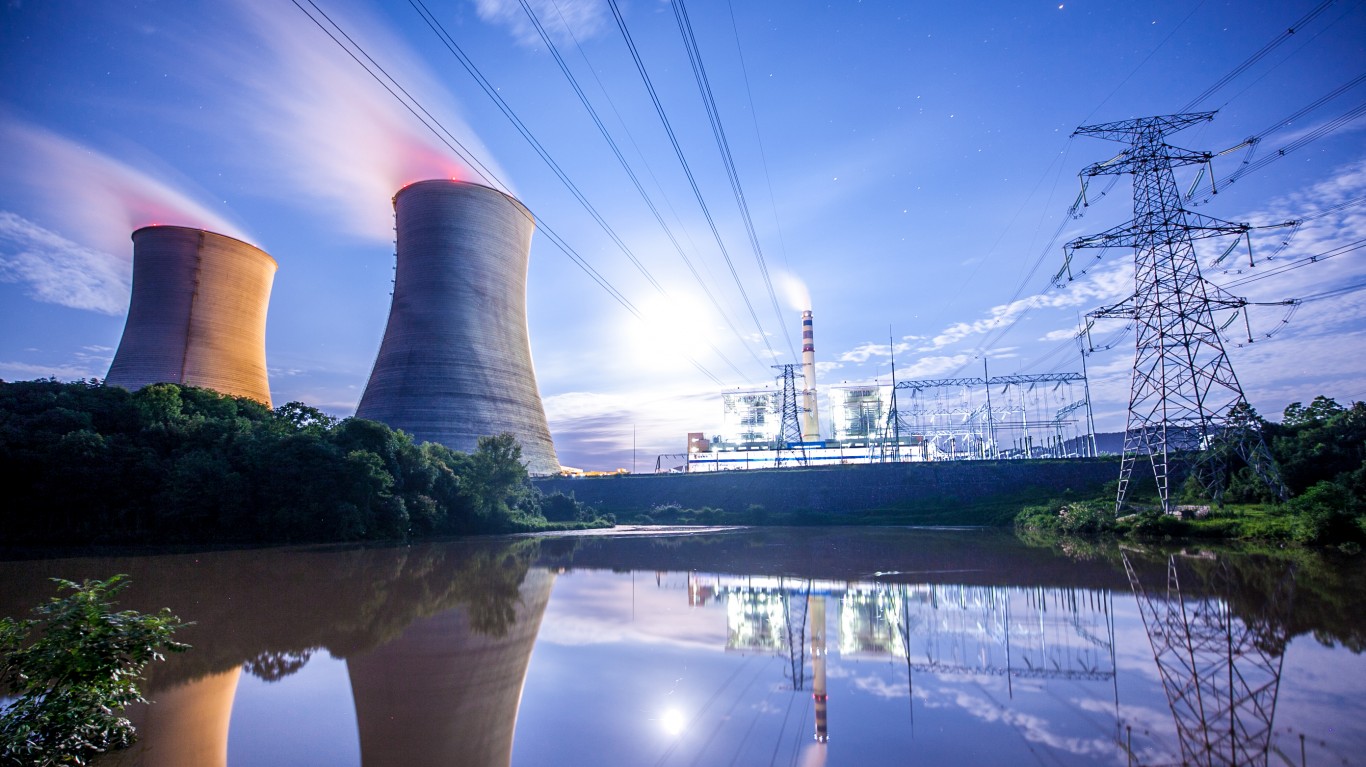
The Department of Energy now projects data centers will account for up to 12% of U.S. electrical demand by 2028, and somebody has to actually build the power plants, transformers, and transmission lines to feed that monster. The hyperscalers get the headlines. The utilities get the contracts, the rate base, and the 27-year dividend streaks. I’ve been reading every PJM capacity auction filing and utility 10-K for the better part of a year now, and the disconnect between what these companies are quietly signing and where their stocks are trading is the cleanest setup in the income market right now. Five names are positioned directly under the firehose.
1. Public Service Enterprise Group (PEG): The Nuclear Hedge Nobody’s Pricing In
Public Service Enterprise Group (NYSE:PEG | PEG Price Prediction) deserves to be the first name that comes up when people talk AI power. PSEG runs the largest regulated utility in New Jersey and operates a nuclear fleet sitting inside the PJM grid, which is where the data center boom is literally melting the capacity market. PJM capacity prices cleared at $329/MW-Day for the June 2026 to May 2027 delivery year and $333/MW-Day for June 2027 to May 2028, after rising from $61/MW-Day in prior periods. PSEG owns the megawatts those auctions are clearing.
Q1 2026 came in at non-GAAP operating EPS of $1.55 versus the $1.43 consensus, an 8% beat, with nuclear running at a 95.5% capacity factor and roughly 95% of 2026 output already hedged. Management guided 2026 EPS to $4.28 to $4.40, on top of a $24 billion to $28 billion five-year capital program that does not require equity issuance.
Shares closed at $78.08 on June 4, 2026, down 2% year to date, sitting near the 52-week low of $76.05. PSEG just announced its 15th consecutive annual dividend increase to an indicative $2.68 annualized rate. Trading at 17x trailing earnings with an analyst target of $89.75, this is the quietest setup on the list. The loudest one is next.
2. Duke Energy (DUK): The Largest Regulated Capex Plan in America
Duke Energy (NYSE:DUK) sits at the center of the Southeast AI corridor, the regulatory sweet spot where the Carolinas, Florida, and Indiana are racing each other to attract hyperscaler buildouts. Duke’s pitch to investors is almost embarrassingly simple: own the toll bridge between AI workloads and the grid.
CEO Harry Sideris laid it out: “With the largest regulated capital plan in the industry, a balance sheet prepared for growth, and contracted demand from AI and advanced manufacturing, we are well-positioned to deliver 5% to 7% EPS growth through 2030.” The numbers backing him up: a $103 billion five-year capital plan supporting 9.6% earnings base growth through 2030, and Duke has already broken ground on 5 gigawatts of new dispatchable generation. Full-year 2025 adjusted EPS landed at $6.31, with 2026 guidance set at $6.55 to $6.80.
Shares are at $121.82, up 6% year to date and 9% over the past year. The Q1 2026 dividend ticked up to $1.065 per quarter, extending a payment record that has run uninterrupted since 1999. The next name is even bigger, and it’s sitting on Georgia.
3. Southern Company (SO): Georgia Power Is the Data Center Magnet
Southern Company (NYSE:SO) runs Georgia Power, and Georgia has quietly become one of the most aggressive data center recruiting states in the country. Plant Vogtle Units 3 and 4, the only new American nuclear builds in a generation, are now operating. Site demobilization is complete. The fixed cost is sunk, and the megawatts are billable.
Q1 2026 told the story: adjusted EPS of $1.32 versus $1.23 in Q1 2025 on revenue of $8.40 billion, up 8% year over year. Three numbers from that release matter for the AI thesis: weather-adjusted retail kWh sales up 2.3%, commercial sales up 4.6%, and wholesale volumes up 12.9%. CEO Chris Womack named the driver directly, citing “projected significant growth in electricity demand driven primarily by data centers and other large load customers.”
SO trades at $91.62, up 7% year to date, with the quarterly dividend lifted to $0.76 effective the May 18, 2026 ex-date. Southern has paid a dividend for 78 consecutive years. The next stock owns the zip code where the global cloud actually lives.
4. Dominion Energy (D): The Loudoun County Toll Booth
Dominion Energy (NYSE:D) serves Loudoun County, Virginia, the dense fiber and power corridor known as Data Center Alley that already routes a disproportionate share of global internet traffic. Dominion’s own filings describe the tailwind in plain language: “increased energy demand from new data centers, primarily concentrated in Loudoun County, Virginia.” If you want pure exposure to the physical location where AI capacity is being stood up, this is it.
Q1 2026 delivered operating EPS of $0.95 versus the $0.91 estimate, a 4% beat, on revenue of $5.02 billion, up 23% year over year. Dominion Energy Virginia operating earnings jumped to $670 million from $561 million, with the 2025 Biennial Review contributing $106 million and rider equity returns adding $84 million. Management affirmed 2026 operating EPS guidance of $3.45 to $3.69.
The market is starting to notice. Shares closed at $66.50, up 16% year to date and 24% over the past year. The conviction signal: 11 Dominion directors bought stock at $62.95 in a coordinated cluster on May 5 and May 7, 2026. When the entire board steps in at the same price on the same week, that signals genuine conviction. The next name is the payoff.
5. NextEra Energy (NEE): Google’s Nuclear Partner and Japan’s Gas Builder
NextEra Energy (NYSE:NEE) is where the AI power thesis stops being theoretical. NextEra Energy Resources signed a 25-year PPA with Google to recommission the 615 MW Duane Arnold nuclear plant in Iowa, expected back online no later than Q1 2029 and contributing up to $0.16 of annual adjusted EPS. Then the U.S. Department of Commerce picked NEER to build 9.5 GW of new gas-fired generation in Texas and Pennsylvania under the U.S.-Japan trade deal. There is no other utility holding contracts of this caliber.
Q1 2026 results: adjusted EPS of $1.09, up 10% year over year, on revenue of $6.70 billion. NEER added a record 4 GW to its renewables and storage backlog, including 1.3 GW of battery storage, bringing total backlog to roughly 33 GW. Management is targeting the high end of 2026 EPS guidance of $3.92 to $4.02 and committing to 8%+ adjusted EPS CAGR through 2032 and again through 2035 off the 2025 base. CEO John Ketchum: “NextEra Energy was built for this seminal moment.”
Shares pulled back to $85.68, down 11% in the past month but still up 25% year over year. That month-long drawdown is the entry window the prior four names don’t offer. The Q1 2026 dividend stepped up to $0.6232 per share from $0.5665, with management guiding roughly 10% dividend growth through 2026.
The Bottom Line
Every one of these five companies is sitting on a regulated rate base that grows when megawatts get built, and AI is forcing those megawatts to be built right now. PJM capacity prices have already moved. Duke’s $103 billion capex is approved. Vogtle is running. Loudoun County boards are buying their own stock. NextEra is the nuclear partner of choice for Google. The dividend checks are funded by capital plans that were locked in before the AI capex super-cycle even started. The window where these still trade like sleepy utilities is closing.
Contact [email protected] for any questions or corrections.
I've been writing about stocks and personal finance for 20+ years. I believe all great companies are tech companies in the long run, and I invest accordingly.