





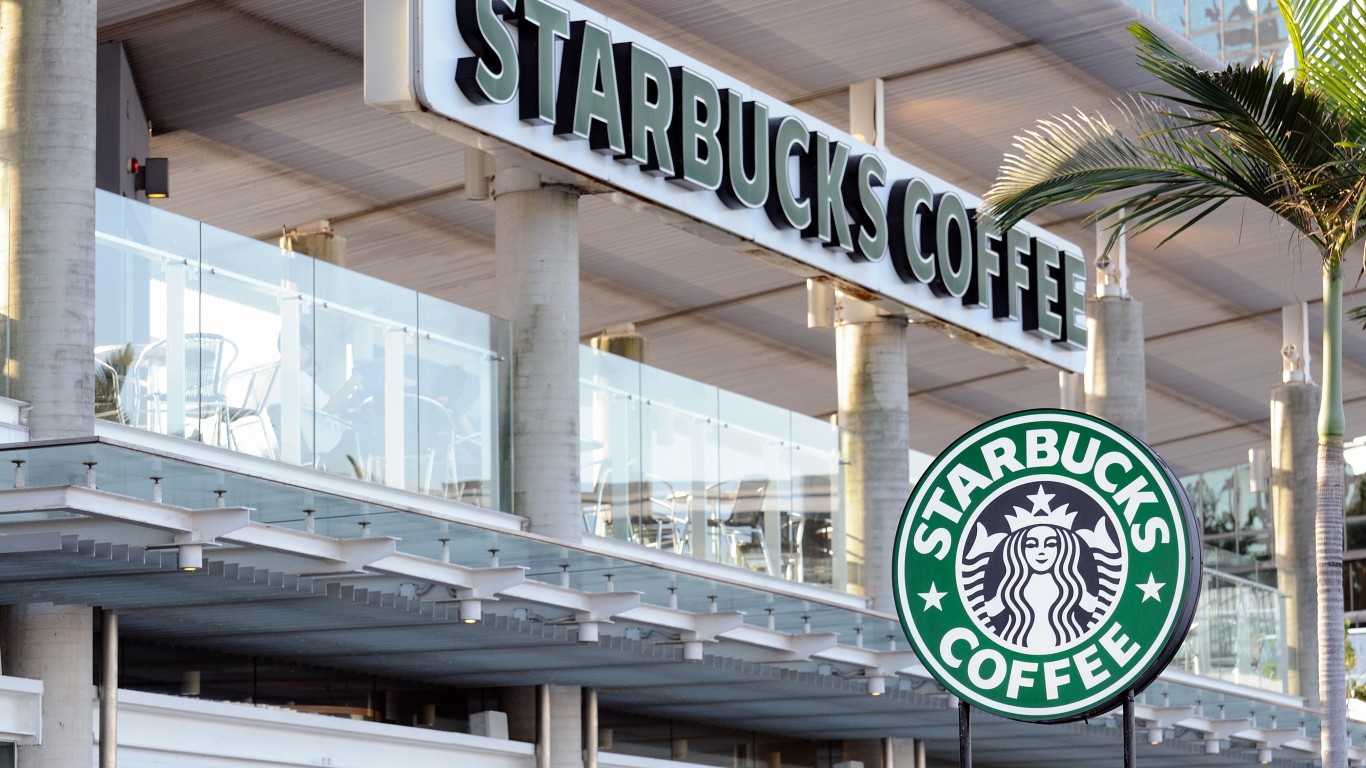
Starbucks (NASDAQ:SBUX | SBUX Price Prediction) is finally showing signs that CEO Brian Niccol’s “Back to Starbucks” plan is landing with customers. The question for income investors is whether the coffee giant’s long dividend-growth streak can survive the cost of the fix.
The Turnaround Finds a Pulse
Fiscal Q2 2026 was the cleanest data point yet. Revenue climbed to $9.531 billion, up 8.79% year over year, with global comparable-store sales up 6.2% on 3.8% transaction growth. North America comps rose 7.1%, while China was essentially flat at +0.5% comparable-store sales growth, with a 1.6% decline in average ticket size. Non-GAAP EPS came in at $0.50 versus the $0.4054 consensus estimate, a 23.3% beat.
Niccol was direct on the call: “Our second quarter marked the turn in our turnaround as our Back to Starbucks plan drove both top and bottom line growth.”

Management raised its full-year outlook, guiding for comparable-store sales growth of 5.0% or more and non-GAAP EPS of $2.25 to $2.45. Meanwhile, Starbucks closed a China joint venture with Boyu Capital, retaining a 40% stake plus brand licensing, and slowed net new openings to just 11 stores in Q2, with 62 closures under its restructuring plan.
Watch for Starbucks Q3 fiscal year 2026 report on Wednesday, July 29, 2026, after the stock market closes.

The Dividend: A Streak Under Pressure
Starbucks pays a quarterly dividend of $0.62, with the next ex-date on August 14, 2026, and payment on August 28, 2026. The yield is near 2.4%, on shares at $103.65. That is 64 consecutive quarters of payouts with a historical CAGR of roughly 17%.
Coverage is the concern. Free cash flow covered the dividend at 0.88x in FY2025, down from 1.28x in FY2024. Quarterly EPS has been below the payout in every recent quarter, and shareholders’ equity stands at negative $8.458 billion. On a valuation basis, the trailing P/E is a rich 79x, with a forward P/E of 35x.
One positive signal: management suspended buybacks in FY2025 (repurchases of $0) after $1.27 billion in FY2024, effectively prioritizing the dividend.
What Income Investors Should Watch
Wall Street is measured. The consensus analyst price target is $106.45, only modestly above the current share price. Polymarket traders assign a 92.5% probability to a Q3 earnings beat, though no prediction market for a dividend cut currently exists.
For retirement investors, the dividend looks safe in the near term because management is choosing it over buybacks, and Q2 momentum is genuine. The item to monitor is payout coverage. If free cash flow does not recover toward historical norms as remodeling and labor costs normalize, the 17% dividend-growth cadence will slow long before the dividend payment itself is at risk.


Contact [email protected] for any questions or corrections.










 Top Gaining Stocks
 Top Losing Stocks