Does Amazon or MercadoLibre Offer The Superior Growth Vs Profitability Story Into 2027?
Amazon prints cash at hyperscale while MercadoLibre burns it to conquer Latin America, and the gap between their 2026 strategies sets up a fascinating fork in the road heading into 2027.


Amazon (NASDAQ:AMZN | AMZN Price Prediction) and MercadoLibre (NASDAQ:MELI) both posted Q1 2026 results that crystallize an old debate. Amazon delivered $181.52 billion in revenue with expanding operating leverage, while MercadoLibre grew sales 49.03% to $8.845 billion and let margins compress on purpose. Two very different bets on what wins into 2027.
AWS Prints Cash. MELI Spends to Own Latin America.
Andy Jassy leaned hard into infrastructure monetization. AWS grew 28% YoY to $37.59 billion at a 37.7% operating margin, its fastest growth in 15 quarters. Advertising crossed $70 billion in trailing revenue, and the custom chips unit (Trainium, Graviton, Nitro) cleared a $20 billion run rate with triple-digit growth. Group operating income expanded 29.6% YoY.
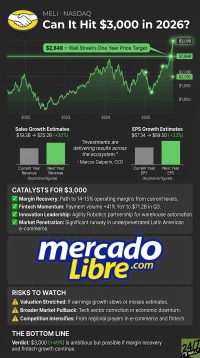
MercadoLibre went the other direction. Commerce revenue climbed 47% and Fintech 51%, yet operating income fell 19.92% as margin compressed roughly 600 basis points to 6.9%. The credit card book more than doubled to $6.6 billion, and lower Brazilian free-shipping thresholds drove 56% items-sold growth. Impressive, but adjusted free cash flow was negative $56 million.
One Harvests Scale. The Other Plants Seeds.
| Lens | Amazon | MercadoLibre |
| Revenue growth | 16.6% | 49% |
| Operating margin | 13.1% | 6.91% |
| Forward P/E | 30 | 36 |
| Core Bet | AI infrastructure at hyperscale | LatAm commerce plus fintech flywheel |
Jassy told investors Amazon will spend roughly $200 billion in 2026 capex, with committed capacity for OpenAI, Anthropic, and Meta. Polymarket traders assign a 89% probability that figure clears $200 billion. New CEO Ariel Szarfsztejn took over MercadoLibre in January and confirmed management does not anticipate the current margin dial changing materially in the near term.
The Next Test Is Whether MELI’s Investments Actually Mature
I will be watching AWS margin durability against that capex wave, plus whether Amazon’s ad business keeps compounding above 20%. For MercadoLibre, provisions for doubtful accounts already ballooned to $1.244 billion from $603 million a year earlier. Credit quality in Brazil will decide the 2027 story. MELI shares are down 10.68% YTD; AMZN is up 6.08%.
Why I Lean Toward Amazon Into 2027
For me, Amazon offers the cleaner growth-versus-profitability story right now. You get 16.6% top-line growth converting into 29.6% operating income growth, which is real operating leverage at a $700 billion revenue base. MercadoLibre remains the more explosive top-line story, and if you invest for turnarounds and secular penetration in emerging markets, the 24.55% one-year drawdown resets the entry multiple meaningfully. I would still want to see credit provisions stabilize before adding aggressively. Amazon’s flaw is the free cash flow hole from $44.2 billion in Q1 capex, and I take that risk seriously. But scale plus pricing power plus AWS margins is a rare combination at this size.
Contact [email protected] for any questions or corrections.
Alex Sirois is a financial writer with experience spanning both retail and institutional investing. He has written for InvestorPlace and held roles at BNY Mellon and Bernstein, giving him a perspective that bridges Main Street portfolios and Wall Street analysis.
Alex holds an MBA from George Washington University and has built his career across multiple industries, including e-commerce, education, and translation — a breadth of experience that informs how he breaks down complex financial topics for everyday investors. His writing is conversational, actionable, and grounded in long-term, buy-and-hold investing principles.
At 247 Wall St., Alex focuses on delivering analysis that is both accessible and useful, with a clear emphasis on helping readers make more informed decisions with their money.