Suze Orman Warns Married Couples: Don’t Let One Spouse Handle All the Money
Most couples split the financial workload without realizing they have created a hidden vulnerability that only surfaces at the worst possible moment. Suze Orman says the danger is not how much money a family has, but who truly understands it.


One of the biggest financial risks inside a marriage has nothing to do with picking the wrong stock or carrying too much debt. It is having one spouse understand the family’s financial life while the other is largely along for the ride.
Suze Orman has been especially blunt about that imbalance. In May 2024, she pointed to a New York Life Wealth Watch survey showing that 61% of married men said they made all or most of the financial decisions in their household, compared with 38% of married women. Another 43% of married women said they wished they played a larger role.
That matters because the split is not simply about who pays the electric bill. New York Life found that married women were more likely to handle day-to-day jobs such as paying bills and budgeting, while married men were more likely to report managing investments, retirement savings, insurance, mortgages, and the relationship with a financial advisor.
Orman’s point is not that one spouse can never take the lead. It is that both people need to understand the decisions being made, where the money is, and what happens if one partner suddenly has to manage everything alone. The research behind that warning gets more uncomfortable the deeper you go.
61% of Married Men Say They Make Most Financial Decisions

New York Life’s Wealth Watch survey, conducted from Feb. 23 through Feb. 25, 2024, asked 2,227 U.S. adults about their financial knowledge and household responsibilities. Among married respondents, 61% of men said they made all or most of their household’s financial decisions. Only 38% of married women said the same.
The gap showed up from the other direction too. Married women were more likely to say financial decisions were split with their partner, at 53%, compared with 32% of married men. That suggests husbands and wives do not always see the division of financial responsibility the same way.
Orman highlighted the survey shortly after it was released and argued that allowing one partner to remain disconnected from major financial decisions creates vulnerability, even when the spouse taking the lead is perfectly capable with money.
Women Are More Likely to Handle the Bills, Men the Long-Term Decisions

The type of financial work each spouse reported doing may be more important than the headline numbers. Married women most commonly said they handled paying bills and monthly budgeting, both at 48%, followed by managing bank accounts at 46%.
Married men were more likely to report handling decisions with much longer consequences. New York Life found that 66% primarily handled the relationship with a financial advisor, 62% managed household investments, another 62% managed retirement savings, and 61% handled purchases of financial products such as insurance, annuities, and mortgages.
That is the part Orman considers dangerous. Knowing what is due this month is important. So is knowing why the retirement portfolio is invested the way it is, what insurance policies exist, where the accounts are held, and what a mortgage or estate decision means years down the road.
Both Spouses Spend About Six Hours a Week on the Finances

There is an interesting wrinkle in the New York Life data. Despite the difference in who reported making the decisions, married men and married women both said they spent an average of six hours per week managing household finances.
So this is not simply a case of one spouse doing the financial work while the other ignores it. Both may be putting in substantial time, but that time can be spent on very different jobs. One partner may be balancing the monthly budget while the other is deciding how the retirement accounts are invested.
That distinction helps explain why someone can be deeply involved with household money and still be unprepared to take over the entire financial picture. Paying bills every month does not automatically tell you how a 401(k), life insurance policy, brokerage account, or estate plan is structured.
Women Live Nearly Five Years Longer Than Men on Average

The possibility that one spouse will eventually have to manage the finances alone is not theoretical. Final 2024 mortality data from the CDC’s National Center for Health Statistics put U.S. life expectancy at birth at 81.4 years for women and 76.5 years for men, a gap of 4.9 years.
Those averages do not mean every wife will outlive her husband, and life expectancy at birth is not a forecast for any individual marriage. They do show why planning for a surviving spouse deserves to be treated as a normal part of financial planning rather than something couples can deal with later.
Orman’s concern is straightforward: even if one spouse has made excellent financial decisions and kept detailed records, the surviving partner is in a much tougher position if grief is also the first time he or she has had to understand the accounts, investments, insurance, advisors, and estate documents.
UBS Found Only 1 in 5 Couples Shared Long-Term Decisions Equally
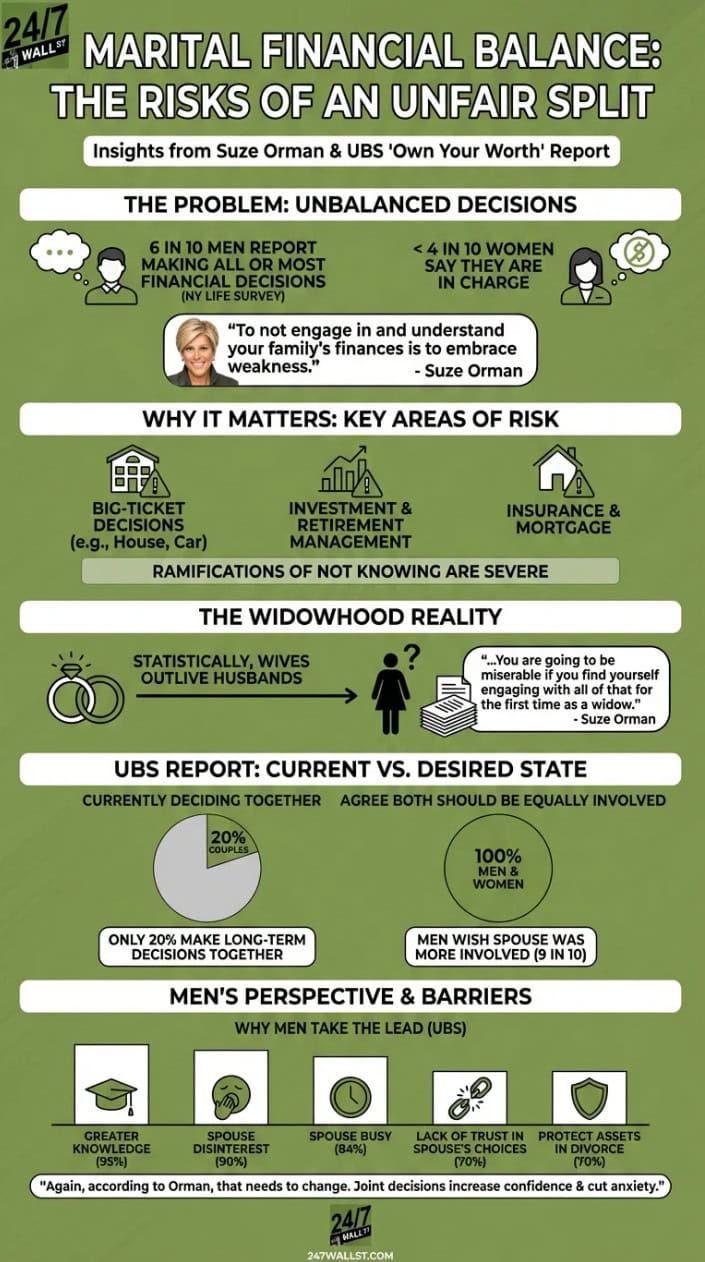
New York Life is not the only research group to find this divide. UBS surveyed 1,500 men and women in marriages or partnerships for its 2021 Own Your Worth report and found that only about 20% said they shared long-term financial decisions equally.
Nearly seven in 10 men said they took the lead. Among men who did, 95% said they believed they knew more about long-term finances than their spouse, 90% described their spouse as having little or no interest in the subject, and 84% said their spouse had other responsibilities such as household work or childcare.
There was one encouraging finding buried in there. Nine in 10 men who took the lead said they wanted their spouse to be more involved. In other words, the problem is not necessarily that couples want one person shut out. In many cases, they have simply settled into a system that leaves one partner with far more financial knowledge than the other.
The Problem Often Becomes Obvious After a Spouse Dies

UBS returned to the issue in its 2025 Own Your Worth report, this time surveying 2,000 women who had at least $1 million in investable assets. The research included women who had inherited from parents, women expecting an inheritance, and widows who had taken sole control of household wealth.
Among the widows in that high-net-worth sample, 83% said they encountered at least one challenge when taking control of household wealth. Forty percent said their partner had not established a wealth transfer or estate plan, 34% discovered a financial surprise after their partner’s death, and 30% said their partner did not have an up-to-date will.
Another 26% said they had not known where all of their partner’s wealth was before he died. That is a particularly stark version of the problem Orman is warning about. You do not want the first complete inventory of your family’s assets to happen after one spouse is gone.
$54 Trillion Is Expected to Pass to Spouses Through 2048

The amount of money involved over the next two decades is enormous. Cerulli Associates projects that roughly $124 trillion will transfer through 2048, including about $105 trillion going to heirs and $18 trillion to charity.
Before much of that wealth reaches the next generation, Cerulli expects approximately $54 trillion to move through transfers between spouses. More than 95% of those inter-spousal transfers are projected to go to women, largely because women are more likely to outlive their husbands.
Cerulli estimates that nearly $40 trillion will shift first to widowed women in the Baby Boomer and older generations between 2024 and 2048. That helps explain why financial firms are paying so much attention to whether both spouses are involved before a wealth transfer happens. This is not a small corner of the financial system. It is one of the largest movements of household wealth the country has ever faced.
Widows Have a Clear Message for Married Couples

The women in UBS’s 2025 study who had already taken sole control of their household wealth were remarkably consistent about what they wished couples would do earlier.
Ninety-one percent recommended taking an active role in understanding household finances. Another 88% said women should proactively meet with the family’s financial advisor while still married, and 87% recommended developing a plan with a spouse ahead of time for what happens after a death.
Those are not especially complicated ideas. Both spouses should know where the accounts are, understand the broad investment and retirement strategy, know what insurance and estate documents exist, and have a relationship with the professionals involved. Nobody has to become the household’s full-time portfolio manager.
The goal is simpler than that: if either spouse suddenly has to take over, he or she should not be starting at zero. That is ultimately the risk Orman is talking about. Letting one person handle everything may feel efficient today. It can become a serious liability when the person who was never involved is suddenly the only one left to make the decisions.
Contact [email protected] for any questions or corrections.