Why I Keep Buying NVIDIA Confidently
Every dollar hyperscalers spend building AI factories has to pass through someone's hands first, and one fabless chipmaker keeps collecting a toll that grows faster than the spending itself. Here is why that calculus keeps pulling capital toward a single…

I keep buying NVIDIA (NASDAQ:NVDA | NVDA Price Prediction) because it turns the world’s largest capital spending cycle into cash faster than I can decide where to redeploy the dividend. Every dollar hyperscalers pour into AI factories flows across NVIDIA’s fabless model as top-line revenue without dragging concrete, power, or square footage onto its balance sheet. That is the machine I keep funding.
The receipts back the story. Free cash flow went from $27.0B in fiscal 2024 to $60.9B in fiscal 2025 to $96.7B in fiscal 2026. Then Q1 FY2027 landed $48.55B in free cash flow in a single quarter, on revenue of $81.61B, up 85.2% year over year. Data Center revenue alone hit $75.25B, a gain of 92%, with the networking piece rising 199%. That is operational leverage doing exactly what a fabless architect is supposed to do: capture customer capex as revenue while research and administrative overhead stays comparatively fixed.
Balance Sheet Math That Lets Me Sleep
The second reason I keep adding is the shape of the returns under the cash. Operating margin sits at 60.4%, return on invested capital at 92.2%, gross margin at 71.1%, and net margin at 55.6%. Debt-to-equity is 0.073 and interest coverage is 503x. A company earning those returns on that little leverage funds its growth from cash flow alone, which is what I want compounding inside a long-term account.
The third reason is what management now does with the money. In May 2026 the board lifted the quarterly dividend from $0.01 to $0.25, a 25x step-up, and authorized an additional $80B buyback on top of $38.5B remaining. NVIDIA returned roughly $20.0B to shareholders in Q1 FY27 alone, after returning $41.1B across fiscal 2026. The yield is still nominal at about 0.02%, so I own this for compounding book value rather than income.
Why This One Over the Obvious Alternatives
Friends ask why I keep choosing this over Advanced Micro Devices (NASDAQ:AMD) or Broadcom (NASDAQ:AVGO). My answer lives in the margin structure. NVIDIA’s 55.6% net profit margin and 92.2% ROIC reflect pricing power over the full accelerator stack, from silicon to NVLink to CUDA-X, that merchant GPU and custom silicon businesses have not replicated at scale. When one company throws off $96.58B of free cash in a year on a fabless cost base, the alternative has to clear a very tall bar to earn the same dollar of my capital.
The Real Risk, Named Plainly
The risk I respect is China. Guidance already assumes zero Data Center compute revenue from China, and the company absorbed a $4.5 billion H20 inventory charge earlier in the cycle. That is real money and a real ceiling on the addressable market. My thesis survives because FY2026 free cash flow still grew 58.7% with that door effectively closed. Any workable reopening becomes upside I am paying nothing for at today’s P/E near 41 and P/FCF near 51.
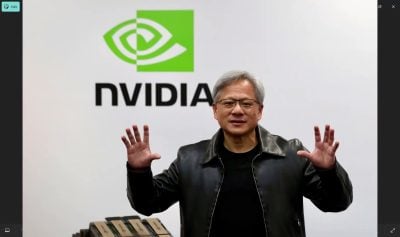
What keeps the buy button live is the forward runway. CEO Jensen Huang framed it directly: “The buildout of AI factories, the largest infrastructure expansion in human history, is accelerating at extraordinary speed.” Q2 FY27 guidance calls for $91.0B in revenue at a 75.0% non-GAAP gross margin, and management has committed to an annual product cadence extending through 2028, with the Vera Rubin platform already announced behind Blackwell. As long as NVIDIA keeps converting hyperscaler capex into free cash on this trajectory, my order gets refilled.
Contact [email protected] for any questions or corrections.
Alex Sirois is a financial writer with experience spanning both retail and institutional investing. He has written for InvestorPlace and held roles at BNY Mellon and Bernstein, giving him a perspective that bridges Main Street portfolios and Wall Street analysis.
Alex holds an MBA from George Washington University and has built his career across multiple industries, including e-commerce, education, and translation — a breadth of experience that informs how he breaks down complex financial topics for everyday investors. His writing is conversational, actionable, and grounded in long-term, buy-and-hold investing principles.
At 247 Wall St., Alex focuses on delivering analysis that is both accessible and useful, with a clear emphasis on helping readers make more informed decisions with their money.