NVIDIA Robs All of Big Tech. Except Apple
Here is the trade of the decade: hyperscalers are spending hundreds of billions on AI infrastructure, and almost all of that money lands on one company’s income statement. NVIDIA (NASDAQ:NVDA | NVDA Price Prediction) just guided fiscal first quarter 2027…

This post may contain links from our sponsors and affiliates, and Flywheel Publishing may receive compensation for actions taken through them.

Here is the trade of the decade: hyperscalers are spending hundreds of billions on AI infrastructure, and almost all of that money lands on one company’s income statement. NVIDIA (NASDAQ:NVDA | NVDA Price Prediction) just guided fiscal first quarter 2027 revenue to roughly $78 billion, on top of full year fiscal 2026 revenue of $215.94 billion, all delivered at non-GAAP gross margins of 75%. Every dollar of hyperscaler capex routed through Jensen Huang’s company converts to outsized profit. Big Tech’s earnings used to define the high water mark of corporate America. They are now being rerouted to Santa Clara.
Look at 2026 capex commitments. Amazon (NASDAQ:AMZN) plans about $200 billion in capex this year, with Q1 alone hitting $44.2 billion, up 77% year over year. Alphabet (NASDAQ:GOOGL) raised its 2026 guidance to $175 to $185 billion, with Q1 capex of $35.7 billion, more than double last year. Meta Platforms (NASDAQ:META) raised its range to $125 to $145 billion. That is more than half a trillion dollars in 2026 spending from three companies, with the dominant destination being NVIDIA silicon and systems built around it.

The Visible Win
NVIDIA’s shareholders are getting paid. The stock is up 21% year to date and 74% over one year, on a market cap near $5.63 trillion. Q4 fiscal 2026 free cash flow alone hit $34.9 billion. Street estimates project NVIDIA will generate roughly $421 billion in free cash flow across 2026 and 2027 combined, exceeding the FCF of Apple, Alphabet, Meta, and Amazon combined.
The Hidden Cost
That math only works if you understand what happens on the other side. Alphabet’s Q1 free cash flow fell 47% year over year to $10.1 billion as capex doubled. Amazon’s trailing twelve month FCF collapsed 95% to $1.2 billion. Forward projections put Alphabet’s 2026 to 2027 FCF at around $50 billion, with Amazon and Meta each under $20 billion. Revenue keeps growing. The cash that used to belong to hyperscaler shareholders now lands in NVIDIA’s bank account at a 75% gross margin. Call it what it is: a tax on every AI deployment, paid to a single supplier.
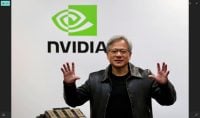
Jensen Huang said the quiet part out loud on the last call: “On average, major hyperscalers are each deploying nearly 1,000 NBL72 racks, or 72,000 Blackwell GPUs per week.” Colette Kress added, “Our customers’ commitments are firm.” They are.
Except Apple
Apple (NASDAQ:AAPL) is the control group that proves the thesis. Tim Cook’s company posted a record March quarter at $111.2 billion in revenue, up 17%, while running Q1 capex of $2.37 billion, down 19% year over year. That is a rounding error against the hyperscaler trio. Apple runs AI on device through its own silicon, skips the data center buildout entirely, and returns capital to shareholders, with a fresh $100 billion buyback authorization and $32 billion returned in a single quarter. Apple’s projected $290 billion of 2026 to 2027 free cash flow is intact precisely because it refused to enter the arms race.
What To Watch
The unwind risk is asymmetric. If AMD’s MI series, Amazon’s Trainium (already at a $20 billion run rate, growing triple digits), or Google’s TPUs erode NVIDIA’s pricing power, hyperscalers reclaim their margins and NVIDIA’s multiple compresses fast. If they do not, Big Tech becomes a pass-through. Watch August earnings calls for one number from Alphabet and Meta: 2027 capex guidance. That figure tells you whether the buyers have noticed who is actually getting rich.
Contact [email protected] for any questions or corrections.
Joel South covers large-cap stocks, dividend investing, and major market trends, with a focus on earnings analysis, valuation, and turning complex data into actionable insights for investors.
He brings more than 15 years of experience as an investor and financial journalist, including 12 years at The Motley Fool, where he served as an investment analyst, Bureau Chief, and later led the Fool.com investing news desk. He has also co-hosted an investing podcast and appeared across TV and radio discussing market trends.