Microsoft’s Earnings Could Decide the Fate of a $700 Billion AI Spending Boom
A single capital spending number from Microsoft could either rescue a $700 billion AI trade from its worst selloff in months or confirm that the boom is finally running out of steam. Every chipmaker on five continents is watching.

The AI trade has spent the past several weeks unraveling, but the selling has spread far beyond Silicon Valley. Chip designers in the U.S., foundries in Taiwan, memory manufacturers in South Korea, equipment suppliers in Europe, materials companies in Japan, and advanced packaging firms across Southeast Asia have all moved lower together.
That broad decline reflects something bigger than one disappointing earnings report — it highlights how tightly connected the global AI supply chain has become. Investors now have one event that could determine whether this downturn marks the start of a semiconductor bust or simply a pause before the next leg higher: Microsoft’s (NASDAQ:MSFT | MSFT Price Prediction) fiscal fourth-quarter earnings release.
Microsoft’s Spending Drives the Entire AI Ecosystem
Microsoft’s June quarter carries more weight than a typical earnings report because it closes the company’s fiscal year. More importantly, management’s guidance will offer one of the first detailed roadmaps for AI infrastructure spending during the first half of calendar 2027.
Here’s what investors will be watching in Microsoft’s earnings release and conference call:
| Category | Why It Matters |
| Capital expenditures | Indicates whether AI infrastructure investment continues accelerating |
| Azure growth | Measures enterprise demand for AI services |
| AI capacity commentary | Reveals whether demand still exceeds available compute |
| Infrastructure outlook | Signals future purchases across the semiconductor supply chain |
The reason is simple. Microsoft sits near the center of the AI economy. Its capital spending determines demand for Nvidia‘s (NASDAQ:NVDA) AI accelerators, Advanced Micro Devices‘ (NASDAQ:AMD) CPUs, networking equipment from Broadcom (NASDAQ:AVGO) and Marvell Technology (NASDAQ:MRVL), high-bandwidth memory from SK hynix (NASDAQ:SKHY) and Micron Technology (NASDAQ:MU), optical components from Coherent (NASDAQ:COHR), advanced packaging at Taiwan Semiconductor Manufacturing (NYSE:TSM), and semiconductor manufacturing equipment from ASML Holdings (NASDAQ:ASML) and Applied Materials (NASDAQ:AMAT).
That makes Microsoft’s capital budget one of the most closely watched figures in global technology investing.
One Capex Number Could Change the Entire Narrative
Many semiconductor stocks have retreated not because demand has collapsed, but because investors questioned whether hyperscale cloud providers could continue increasing spending after two years of record investment.
According to Microsoft’s prior earnings release, capital expenditures have already climbed at one of the fastest rates in company history as it races to build AI data centers. If management now projects another 30% to 40% increase in AI infrastructure spending while reiterating that customer demand still exceeds available capacity, the recent decline may look less like the beginning of a semiconductor downturn and more like a temporary risk-off reset.
Ironically, that’s exactly what many investors may have overlooked. The AI supply chain isn’t weakening because one company missed expectations. Instead, fears have centered on financing conditions, elevated valuations, and whether cloud providers would eventually slow spending after committing hundreds of billions of dollars to AI infrastructure.
Microsoft has the opportunity to answer that question today.
Why Concentration Is Becoming the Market’s Biggest Risk
One surprising lesson from this earnings season is how dependent the global semiconductor industry has become on a handful of cloud companies.
Microsoft’s capital spending doesn’t just influence its own growth — it helps determine production schedules for factories spanning five continents.
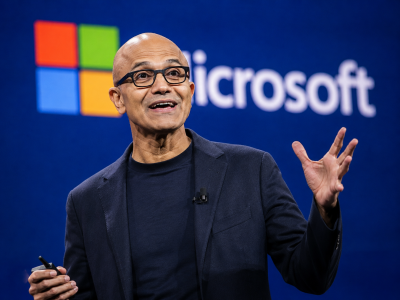
If CEO Satya Nadella confirms AI demand remains constrained by available capacity rather than weakening customer interest, suppliers throughout the chain could regain investor confidence. If Microsoft instead signals that spending is leveling off, the pressure could extend from Nvidia to Taiwan Semiconductor, SK hynix, ASML, Tokyo Electron, and dozens of smaller suppliers.
Granted, that level of concentration creates risk. A single management team’s investment decisions now influence billions of dollars in manufacturing plans across multiple countries. Yet that’s also the reality of today’s AI economy.
Key Takeaway
In short, Microsoft’s earnings are about much more than Azure growth or quarterly profits. They’re a referendum on whether the AI investment cycle remains intact.
Management’s guidance will provide the clearest evidence yet on whether hyperscale AI spending is still expanding fast enough to support the industry’s next growth phase. If capital expenditures continue rising by roughly 30% to 40% and management says demand still exceeds available computing capacity, the semiconductor selloff may prove to be a valuation reset rather than the end of the AI boom.
Ultimately, one capital spending figure from Microsoft now has the power to influence chipmakers across the United States, Taiwan, South Korea, Japan, Europe, and Southeast Asia. That’s an extraordinary level of concentration — and for investors, it’s exactly why today’s earnings report could become the most important AI event of the quarter.
Contact [email protected] for any questions or corrections.
After two decades of patrolling the dark corners of suburbia as a police officer, Rich Duprey hung up his badge and gun to begin writing full time about stocks and investing. For the past 20 years, he’s been cruising the markets looking for companies to lock up as long-term holdings in a portfolio while writing extensively on the broad sectors of consumer goods, technology, and industrials. Because his experience isn’t from the typical financial analyst track, Rich is able to break down complex topics into understandable and useful action points for the average investor. His writings have appeared on The Motley Fool, InvestorPlace, Yahoo! Finance, Money Morning, and, of course, 24/7 Wall St. He has been featured in both U.S. and international publications, including MarketWatch, Financial Times, Forbes, Fast Company, and USA Today.