SK Hynix’s Profits Explode 550%, but Its $31 Billion Spending Plan Sends Investors Running
SK Hynix just posted one of the most explosive profit surges in semiconductor history, yet investors punished the stock anyway. The reason comes down to a spending commitment so aggressive it raises a question the entire memory sector now has…

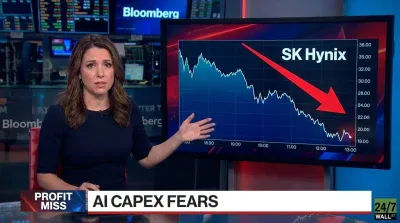
SK Hynix delivered a blockbuster earnings report on Wednesday, only to watch its stock crater. On Bloomberg Daybreak Europe, host Lizzy framed the paradox: “A sixfold surge in profits just isn’t enough. SK Hynix slumps as the chip giant says capital spending will rise around 50% this year.“
The Korean memory maker’s operating profit jumped more than 550%, yet missed analyst estimates by 6%. Reporter Winnie Hsu described the damage bluntly: “Mainly it’s the earnings missing by 6% compared to analyst estimates, but on top of that, the rise in capex spending as well as the lack of details when it comes to earnings.”
Record Market Stress Exposes Cracks in the Memory Boom
The reaction moved the whole market. Hsu noted that “The South Korean market has fallen by about 40% from its June peak, [taking] monthly losses to the biggest on record.” The Kospi tripped circuit breakers twice on back-to-back days for the first time on record and fell more than 8% early in the session. MSCI Asia extended losses more than 2% and entered a technical correction.
An analyst relayed on the segment pointed to execution timing: “If we had a seven percentage point better increase, SK Hynix might have achieved profit… probably the culprit could be the second quarter. The reason SK Hynix was [seeing] some kind of product delay.” The number was extraordinary in absolute terms, yet still fell short because HBM’s shipment cadence appears to have slipped even as demand held up.
SK Hynix’s $31 Billion Spending Plan Sends Investors Running
What unsettled investors more than the headline miss was the spending plan. SK Hynix earmarked at least $31 billion in capital spending, roughly a 50% year-over-year increase. In a market already questioning AI infrastructure returns, guiding capex sharply higher without a clean revenue beat crystallized the fear of overbuild.
Micron Technology (NASDAQ:MU | MU Price Prediction) is down 15.48% over the past week and 27.53% over the past month, closing Tuesday at $820.53. The Roundhill Memory ETF (CBOE:DRAM), which holds Samsung at 24.99%, SK Hynix at 24.22%, and Micron at 23.83%, was flagged by Morgan Stanley’s Mike Wilson as down almost 12% during the selloff.
Micron Faces the Same Capex Question
Micron’s own numbers frame why memory stocks had run so hot. Fiscal Q3 revenue was $41.456 billion, up 345.7% year over year, with GAAP gross margin of 84.6% and Q3 capex of $7.826 billion, up 166.37% year over year.
CEO Sanjay Mehrotra told investors, “Micron is investing at record levels in technology, products and supply to address our customers’ rapidly growing demand.” Micron’s capex trajectory now looks structurally similar to SK Hynix’s.

Big Tech Earnings Could Decide the Memory Trade Today
The SK Hynix reaction leaves one question heading into a big earnings week: will the hyperscalers underwrite the memory industry’s capex plans? Microsoft (NASDAQ:MSFT), Meta Platforms (NASDAQ:META), and other mega-cap tech names report later today, and any softening in AI infrastructure commentary would validate the repricing already underway. The VIX at 18.67 suggests the broader US market is not yet in panic mode. That gap between calm US volatility and record Korean stress is the setup to watch when Wall Street opens.
Contact [email protected] for any questions or corrections.
Thomas Richmond is a financial writer and content strategist with 5+ years of experience covering stocks and financial markets. He has published over 500 articles focused on individual stock analysis, helping investors better understand business fundamentals, stock valuations, and long-term opportunities.
Thomas previously served as a Content Lead at TIKR, a stock research platform, where he helped scale the company’s blog to hundreds of articles per month and contributed to a weekly newsletter reaching more than 100,000 investors.
Outside of work, Thomas enjoys weight lifting and soccer.