Micron Has Jumped Back Above $1,000: Here’s What I’m Doing
Micron just reclaimed four figures after a brutal pullback, and the bull case at this price rests on a structural shift in memory markets that most investors have not priced in yet.

Micron Technology (NASDAQ:MU | MU Price Prediction) at $1,043.96 looks constructively positioned, and the setup after its reclaim of the $1,000 line still leaves room to run. The story right now is simple: Micron has become the cleanest US-listed vehicle for the memory shortage that AI infrastructure has created.
Micron is the only U.S.-based memory manufacturer, selling DRAM, NAND, and high-bandwidth memory across four segments: Cloud Memory, Core Data Center, Mobile and Client, and Automotive and Embedded. HBM4 12-high is ramping twice as fast as HBM3E 12-high, and next-generation nodes are on track for volume production in the second half of calendar 2027.
Shares have moved from roughly $162.47 a year ago to four figures, powered by seven straight EPS beats and a string of record quarters. A recent pullback took MU below the $1,000 mark before this week’s rebound.
Why the Setup Still Favors Buyers
Fiscal Q3 revenue hit $41.46 billion, up 345.7% year over year, with gross margin of 84.9% and free cash flow of $18.3 billion. Guidance calls for Q4 revenue of $50 billion and EPS near $31.
The Strategic Customer Agreement framework is the unlock. Management has signed 16 SCAs covering roughly 20% of DRAM volume and a third of NAND volume, with $100 billion in cumulative minimum revenue and take-or-pay commitments. Floor pricing supports margins “significantly above prior peak margins.” On forward earnings of 7x, that visibility is not priced in.
Where the Bear Case Gets Traction
Memory is cyclical, and MU has run 542.57% in one year. Fiscal 2026 capex is set at roughly $27 billion, pressuring free cash flow if pricing rolls over. Q4 gross-margin guidance flags “a meaningful moderation in the rate of price increases.”
Concentration risk is real: a handful of lead HBM buyers dominate the customer roster, and with a beta of 2.222, any hiccup in hyperscaler capex plans hits MU harder than the average chip name.
What Could Justify Sitting on Your Hands
After a run of this magnitude, patient investors could argue for waiting on the fiscal Q4 report to confirm the $50 billion revenue figure and see whether SCA deposits ($18 billion in cash) show up in the financing lines as promised. A single quarter of soft DRAM pricing or a delayed ID2 Idaho fab milestone could open a better entry.
Ratings, Targets, and Market Reality
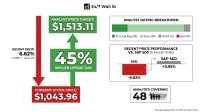
MU trades at $1,043.96 against a mean analyst target of $1,513.11, implying meaningful upside. The book skews sharply constructive:
- Strong Buy: 9
- Buy: 35
- Hold: 4
- Sell: 0
Valuation sits at 23x trailing earnings and roughly 7x forward. MU is up 266% year to date versus 13.43% for the S&P 500. Over one year, MU returned 542.57% versus 16.55% for the index.
Bull Case on Micron at Four Figures
At $1,043.96, Micron screens as fundamentally attractive on the numbers below.
The path to further appreciation runs through the fiscal Q4 report and calendar 2027 HBM4E ramp. If Micron delivers on $50 billion in revenue and $31 in EPS, forward multiples compress even without a higher share price, which is the definition of a fundamentally cheap AI beneficiary.
The SCA framework is the real thesis. With roughly half of company revenue eventually contracted at floor prices above prior peak margins, the traditional memory cycle gets partially decoupled from spot pricing. That is a structural change the market has not fully digested at 7x forward earnings.
What invalidates the call: a Q4 miss on revenue or margin, a walk-back on SCA economics, or a hyperscaler capex reset. Watch quarterly DRAM inventory days, HBM4 revenue disclosures, and any change in the $100 billion RPO figure.
With supply tight beyond calendar 2027, contracted floor pricing, and a forward multiple that still assumes the cycle rolls over, buying MU above $1,000 remains a bet grounded in math. It is also the kind of early-innings AI compounder we reverse-engineered in a free playbook on spotting the next Nvidia before the headlines catch up.
Contact [email protected] for any questions or corrections.
Alex Sirois is a financial writer with experience spanning both retail and institutional investing. He has written for InvestorPlace and held roles at BNY Mellon and Bernstein, giving him a perspective that bridges Main Street portfolios and Wall Street analysis.
Alex holds an MBA from George Washington University and has built his career across multiple industries, including e-commerce, education, and translation — a breadth of experience that informs how he breaks down complex financial topics for everyday investors. His writing is conversational, actionable, and grounded in long-term, buy-and-hold investing principles.
At 247 Wall St., Alex focuses on delivering analysis that is both accessible and useful, with a clear emphasis on helping readers make more informed decisions with their money.