Corning Dropped 25% Over a Month: A Major U.S. Bank Expects 66% Gains Over The Near Term
Corning just handed investors one of the steepest single-stock declines in its peer group, yet at least one major Wall Street bank is responding by raising its price target to levels that would shock most bears right now.

Corning (NYSE:GLW | GLW Price Prediction) currently trades at $146.64, while the average Wall Street price target sits at $193.40. That leaves a consensus-implied upside of roughly 32%, and one major U.S. bank sees far more room than that.
Corning is a 175-year-old materials science company that has become one of the most important suppliers to the AI infrastructure buildout. Its Optical Communications business sells fiber and connectivity to hyperscalers standing up AI factories, including multiyear, multibillion-dollar agreements with Amazon and NVIDIA. Wall Street has been paying attention because that segment is now the growth engine, and the recent selloff has opened one of the widest gaps between price and analyst target the stock has seen in years.
A Guidance-Driven Air Pocket After a Beat
The core cause of the drop was a soft third-quarter sales outlook alongside otherwise strong Q2 numbers. Corning reported core EPS of $0.78 against a $0.7538 estimate, but revenue of $4.505 billion came in 2.69% below the $4.63 billion consensus. Q3 sales guidance of $4.9 billion to $5.0 billion struck investors as conservative given the AI narrative priced into the shares.
Shares are down 25.48% over the past month, dropping from $196.79 to current levels. That decline came against an S&P 500 that gained 1.73% over the same stretch, marking a company-specific unwind.
Underlying the shock was a valuation reset. With a PE of 64, Corning was priced for accelerating optical growth, and any hint of deceleration hurt. Barclays cut its target and flagged “high implied AI valuation” concerns. Insider activity has skewed toward selling, which did not help sentiment.
Why the Bulls Are Doubling Down
Analysts have not moved off the growth thesis. BofA Securities analyst Wamsi Mohan actually raised his price target to $243 from $223 while maintaining a Buy rating, implying roughly 66% upside. Mohan’s math applies a 37x multiple to his calendar 2028 EPS estimate of $6.50, up from $5.95.
The bull case rests on three pillars:
First, AI optical interconnect demand: Optical Communications revenue grew 32% to $2.072 billion with Enterprise Networks surging 65%, and Corning is expanding U.S. fiber capacity by more than 50% to serve NVIDIA. Second, the upgraded Springboard plan targets $40 billion in annualized sales by end of 2030 at a 19% sales CAGR. Third, glass substrates for advanced chiplets and GlassBridge technology for co-packaged optics offer optionality not in the current model.
Per Alpha Vantage’s compilation, 11 analysts rate GLW a Buy, 4 rate it Hold, and 1 rates it Sell. Recent revisions have been mixed, with Truist upgrading to Buy at a $175 target calling the pullback an “attractive entry point,” while Barclays trimmed to $129.
Optical Peers Held Up Better
Corning fell alone. The optical AI cohort sold off modestly, but nothing close to GLW’s drawdown.
Ciena (NYSE:CIEN) trades at $390.76, down 7.5% over the past month. Its average analyst target of $565.71 implies roughly 45% upside, with 13 Buy or Strong Buy ratings against 6 Holds and 1 Sell. Wall Street sees larger percentage upside here than in the GLW consensus target.
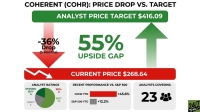
Coherent (NYSE:COHR) sits at $288.14, off 13.56% in the past month. Its $391.45 target implies about 36% upside, backed by 17 Buy-side ratings and 5 Holds with no sells. Recent revisions have trended higher on the NVIDIA partnership.
The largest bank-specific upside in the group belongs to Corning through the BofA call. GLW fell hardest and carries the widest single-analyst target gap.
What the Data Says Now
Corning trades at $146.64 against a consensus target of $193.40 from 16 covering analysts, an implied upside of roughly 32%. Analyst targets are one data point among many.
Despite the recent drop, GLW is up 68.04% year to date and 138.93% over the past year, against an S&P 500 that has returned 11.11% year to date. The forward PE of 43 is demanding but well below the trailing multiple.
Weighing the AI Fiber Story Against the Multiple Reset
The bull case works if Optical Communications keeps compounding at a 30%-plus clip through 2028 and management delivers on Springboard 2030 targets. The path back to $193 runs through Q3 execution, further hyperscaler wins beyond Amazon and NVIDIA, and margin expansion from manufacturing automation. Hit those, and Mohan’s $6.50 EPS by 2028 becomes credible.
The bear case holds if this is a classic multiple-reset trap. A forward PE of 43 bakes in flawless execution, solar remains a net loss during ramp, Life Sciences fell 15% YoY, and tariffs plus FX volatility remain live risks. If AI capex slows, the fiber growth story cools quickly.
The optical demand backdrop is real, the free cash flow inflection (up 255.75% YoY) reflects real fundamentals, and the selloff looks disproportionate to the actual guidance signal. BofA’s 66% call is aggressive, but even the consensus 32% gap is worth respecting at these levels.
Contact [email protected] for any questions or corrections.
Alex Sirois is a financial writer with experience spanning both retail and institutional investing. He has written for InvestorPlace and held roles at BNY Mellon and Bernstein, giving him a perspective that bridges Main Street portfolios and Wall Street analysis.
Alex holds an MBA from George Washington University and has built his career across multiple industries, including e-commerce, education, and translation — a breadth of experience that informs how he breaks down complex financial topics for everyday investors. His writing is conversational, actionable, and grounded in long-term, buy-and-hold investing principles.
At 247 Wall St., Alex focuses on delivering analysis that is both accessible and useful, with a clear emphasis on helping readers make more informed decisions with their money.