Lockheed Martin is Down 8% in 6 Months: Wall Street Pro Expects 30% Growth Within a Year
Lockheed Martin just delivered a blowout quarter with a record-breaking backlog, yet the stock sits near a six-month low while one Wall Street analyst sees nearly 30% upside. The real question is whether a single ugly quarter buried a defense…

Lockheed Martin (NYSE:LMT | LMT Price Prediction) closed the most recent session at $586.29, while the average Wall Street price target sits at $628.21. That leaves an implied upside of roughly 7%, but one Wall Street pro thinks the stock is worth $756.
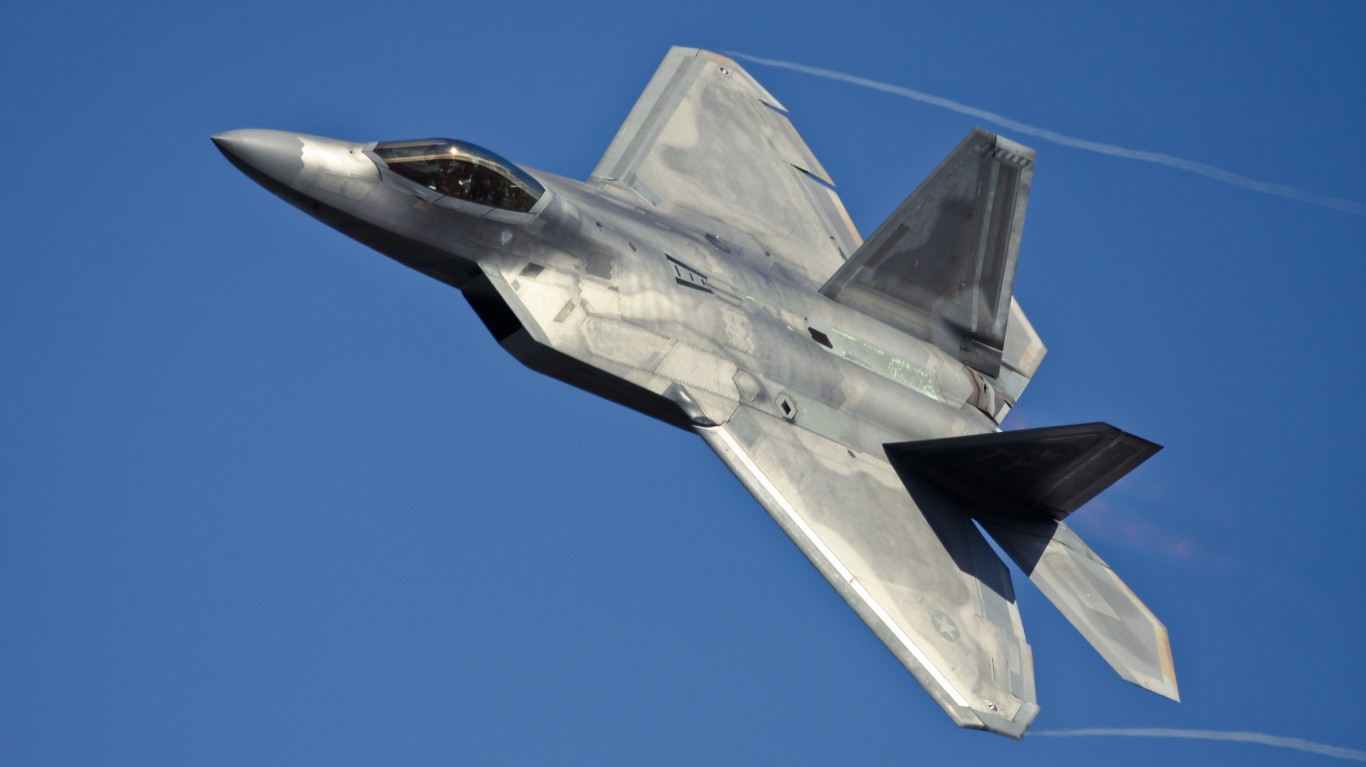
Lockheed Martin builds the F-35 fighter, PAC-3 and THAAD interceptors, Sikorsky helicopters, and much of the classified missile-defense architecture the Pentagon is scaling right now. Global rearmament, the FY 2027 budget request, and multi-year munitions contracts have created unprecedented demand.
Yet the stock has gone essentially nowhere over the last six months while the backlog exploded to a record. That is the disconnect Seaport Global is now betting against.
How Q1 Blew a Hole in the Story
The pullback traces to Q1 2026, when Lockheed reported EPS of $6.44 versus $6.70 consensus and posted free cash flow of -$291 million. Operating cash flow collapsed from $1.41 billion to $220 million, and segment operating margin compressed from 11.6% to 10.1% on $125 million unfavorable F-16 adjustment, plus charges on C-130, CH-53K, and Seahawk programs.
That reopened scar tissue from prior classified-program reach-forward losses that hit Aeronautics for $950 million in 2025 and $1.7 billion in Q4 2024. Investors began treating fixed-price execution risk as structural. F-35 deliveries falling to 19 in Q2 2026 from 50 a year earlier hardened that view.
The stock is down about 6.5% from the $626.83 level at the Q4 filing in late January, and off close to 15% from its 52-week high of $687.50.
Why the Bulls Are Not Blinking
Q2 2026 handed the bull case fresh ammunition. Lockheed reported EPS of $7.94 against $7.20 consensus, revenue of $20.06 billion up 10.5% YoY, free cash flow of $2.92 billion, and a record backlog of $230.42 billion built on $65 billion of new orders. Management raised full-year guidance to sales of $79.75 billion to $81.75 billion and EPS of $29.95 to $30.65, with segment operating profit expected 28% higher.
Seaport Global’s Richard Safran lifted his target to $756 from $664 while maintaining a Buy. That implies roughly 29% upside. Safran’s thesis rests on re-acceleration in international procurement across PAC-3, HIMARS, and Javelin franchises, F-35 Block 4 normalization unlocking working capital, and free cash flow conversion supporting aggressive buybacks and dividend growth.
Consensus is more cautious. Alpha Vantage compiles 2 Strong Buy, 4 Buy, 14 Hold, and 1 Sell ratings, weighted toward Hold. Analysts are watching the $35 billion multi-year THAAD contract and the 7-year PAC-3 framework as metrics that could turn Holds into Buys through 2027.
How the Rest of the Prime Field Looks
RTX Corporation (NYSE:RTX) trades at $216.65 against a $229.82 consensus target for roughly 6% upside. Shares are up 10.94% over six months and 19.01% YTD. Analyst posture skews bullish with 15 Buy or Strong Buy against 8 Holds and no Sells.
Northrop Grumman (NYSE:NOC) trades at $548.47 versus a $643.62 target, roughly 17% upside. Shares are down 19.86% over six months and 3.06% YTD, the weakest in the group. Analysts remain constructive with 14 Buy or Strong Buy against 9 Holds.
General Dynamics (NYSE:GD) sits at $382.43 against a $414.17 target for about 8% upside. Shares are up 15.09% YTD, with 13 Buy or Strong Buy, 10 Holds, and 1 Sell.
The largest consensus upside belongs to Northrop. Add Safran’s outlier target for Lockheed and Lockheed jumps to the top. Analyst targets revise every quarter, as Safran’s own $664-to-$756 lift illustrates.
What the Setup Actually Looks Like
Lockheed trades at $586.29, up 22.65% YTD against roughly 12% for the S&P 500. Over six months, the stock is down 1.58% while the index has climbed. The forward P/E of 19 lines up cleanly with the guided EPS midpoint near $30.30.
The consensus target of $628.21 implies about 7% upside. Safran’s $756 target implies close to 30%. Ratings distribution:
- Strong Buy: 2
- Buy: 4
- Hold: 14
- Sell: 1
- Strong Sell: 0
My Take on Whether the Gap Is Worth Playing
The bull case works if Q1 proves to be a one-off, F-35 Block 4 deliveries normalize into 2027, and the $230 billion backlog converts at the segment margin management is guiding. That would push EPS toward the top of the $30.65 range and give Safran’s $756 a realistic path.
The bear case dominates if the classified reach-forward loss cycle is unfinished. Another $500 million-plus Aeronautics charge would erase the 28% segment profit growth thesis and turn the consensus target into a ceiling.
I lean cautiously constructive. The consensus 7% upside is uninteresting on its own, but a record backlog, raised guidance, a $9.1 billion buyback authorization, and 23 straight years of dividend hikes give the setup an asymmetric look for investors willing to sit through another lumpy quarter.
Contact [email protected] for any questions or corrections.
Alex Sirois is a financial writer with experience spanning both retail and institutional investing. He has written for InvestorPlace and held roles at BNY Mellon and Bernstein, giving him a perspective that bridges Main Street portfolios and Wall Street analysis.
Alex holds an MBA from George Washington University and has built his career across multiple industries, including e-commerce, education, and translation — a breadth of experience that informs how he breaks down complex financial topics for everyday investors. His writing is conversational, actionable, and grounded in long-term, buy-and-hold investing principles.
At 247 Wall St., Alex focuses on delivering analysis that is both accessible and useful, with a clear emphasis on helping readers make more informed decisions with their money.