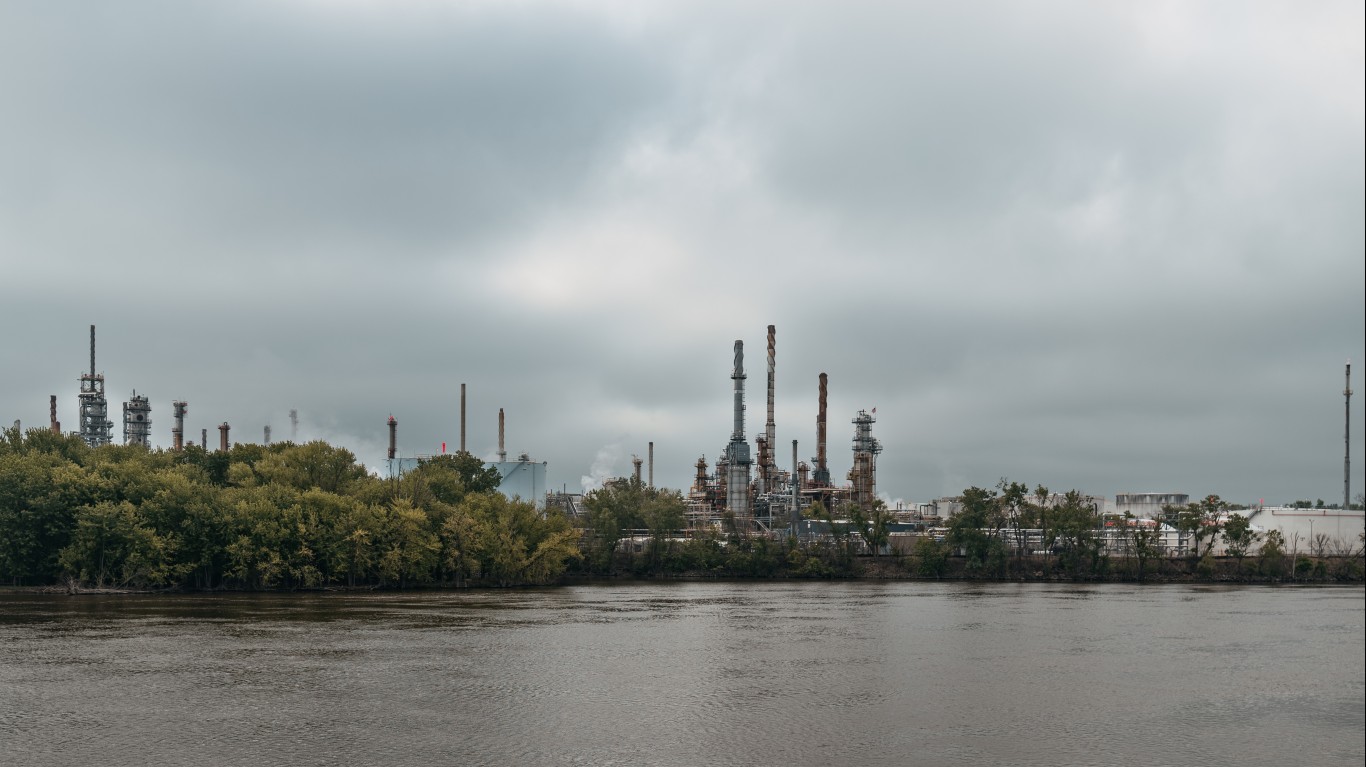
Oil Refiners Are Quietly Printing Money. This Company’s Earnings Jumped 975%
Gasoline prices are punishing drivers at the pump while a handful of companies are posting the most profitable quarters in their histories, and the structural reason this keeps happening has nothing to do with luck or crude oil prices.

Marathon Petroleum (NYSE:MPC | MPC Price Prediction) reported $17.73 in quarterly earnings per share against a $13.95 estimate, and its stock is up 90.47% year to date. If you have been grumbling at the pump about $4.08 gasoline, congratulations, you found the party. However, you were not invited unless you were invested here.
The Blowout Nobody Was Modeling
CNBC’s Pippa Stevens laid out the setup on air Tuesday. “Fuel prices are high and crude has pulled back, creating a perfect situation for the refiners. EPS up 975% quarter over quarter and nearly 350% year over year.” That is the whole thesis in two sentences. Marathon booked $5.14 billion in net income, up from $1.22 billion a year earlier, and returned over $2.80 billion to shareholders in a single quarter. Revenue landed at $51.99 billion. That cleared the $41.44 billion consensus.
The engine is the crack spread, which is refinery-speak for the gap between what a barrel of crude costs and what the gasoline, diesel, and jet fuel refined from it sells for. Think of it as the margin between raw ingredient and finished plate at a restaurant. The industry benchmark, the 3-2-1 spread, has topped $70 per barrel. Marathon’s Refining and Marketing margin went from $17.58 per barrel a year ago to $36.33 per barrel. Nearly doubled. R&M adjusted EBITDA went from $1.89 billion to $6.66 billion.
WTI crude has been jumpy but soft, sitting at $84.25 per barrel after a $7.49 single-day drop. Pump prices did not follow crude down, and refiners pocket the difference.
Why The Party Is Not Ending Next Week
Stevens’s second observation is the one that should keep bears up at night. “One person describing it to me as a golden period for the industry. Traditionally, when cracks start to rise, either supply catches up or demand takes a hit. But right now, demand is holding up.”
Supply cannot catch up because there is no supply to add. U.S. refineries have run above 95% utilization for 15 straight weeks. Middle East capacity is constrained, and Russia has extended its diesel export ban. The structural piece is the killer.
“We haven’t had a new refinery come online in the U.S. since 1976,” Stevens noted, with incremental capacity trickling in only through debottlenecking at existing sites like ExxonMobil (NYSE:XOM)’s Beaumont facility.
Marathon itself is doing the same and funnels 65% of its $1.5 billion capex into value-enhancing projects like the 90 mbpd Galveston Bay distillate hydrotreater due at year-end 2027. The EIA’s own forecast keeps refinery utilization above 84% through 2050. The bottleneck is the business model.
The Counterintuitive Bit For Everyone With A Car
Stevens again. “If they weren’t running flat out and raking in the profits right now, then it would be even worse for the consumer. There would be less product on the market. The gasoline prices would be even higher.” The refiners running flat out are also the reason gasoline is not $5.50. Max output is the pressure valve.
Now the investor question. Is this a durable trade or a cyclical top? Marathon trades at a forward P/E of 11x, which is either an obvious bargain or the market telling you 2027 earnings will not look like 2026.
Valero (NYSE:VLO)’s own commentary points to a 27.7% earnings decline in 2027 as margins normalize. CEO Maryann Mannen framed the current run as execution rather than luck, saying “Our results reflect the differentiated capabilities of our value chains and the execution of our optimization strategies.” The 8-K filing shows $6.1 billion in buyback authorization still on the shelf, so management is voting with the checkbook.
What to watch. Weekly EIA utilization data. Any hint of demand destruction from sustained $4-plus gasoline. And the calendar. Every quarter Russia’s export ban holds, and the Strait of Hormuz stays tense, is another quarter Marathon prints at these margins. The golden period ends when one of those things breaks. Until then, refiners are the loudest quiet money in the S&P.
Contact [email protected] for any questions or corrections.
Omor Ibne Ehsan is a writer at 24/7 Wall St. He is a self-taught investor with a focus on growth, cyclical, and dividend equities that have strong fundamentals, value, and long-term potential. He also has an interest in high-risk, high-reward investments such as penny stocks.