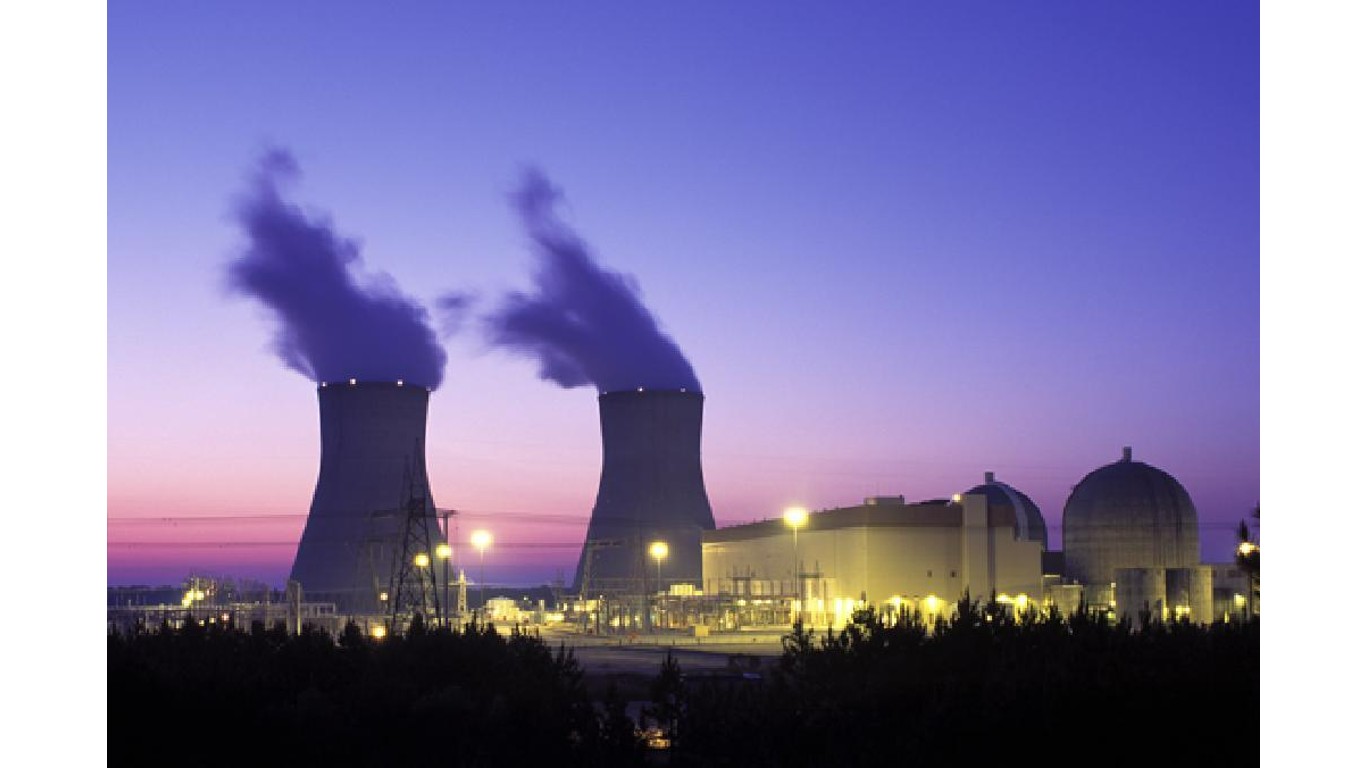
3 Nuclear Energy Stocks Powering the AI Boom in August
Hyperscalers are signing decade-long power deals that would have seemed absurd three years ago, and three nuclear stocks sit at the center of that shift as an operator, a fuel producer, and a components maker each tell a very different…


Artificial intelligence has an electricity problem, and nuclear is the answer investors keep circling back to. Hyperscaler capital expenditure is running at $710 billion combined in 2026, and the always-on baseload profile of nuclear reactors is the only clean generation source that can realistically underwrite 24/7 data center loads. That structural setup is why nuclear generated roughly 73.3 billion kilowatthours in January 2026 at a 100.0% capacity factor, and why hyperscalers are locking in decade-plus power purchase agreements at prices utilities would have scoffed at three years ago.
Here are three US-listed nuclear names worth studying this August, each hitting the theme from a different angle: the operator, the fuel supplier, and the components manufacturer.
Constellation Energy (NASDAQ: CEG)
Constellation Energy (NASDAQ:CEG | CEG Price Prediction) runs the largest US nuclear fleet and, after closing the Calpine acquisition on January 7, 2026, is now the largest private US power producer at 55 GW of combined capacity. Shares closed at $265.12 on August 5, 2026, up 7.83% over the past month but still down 24.73% year to date. That drawdown makes the current setup interesting.

Q1 2026 was a statement quarter. Revenue hit $11.12 billion, up 63.9% year over year and beating consensus by 27.69%, while adjusted EPS came in at $2.74 versus a $2.61 estimate. Management reaffirmed 2026 adjusted operating EPS guidance of $11.00 to $12.00 and is targeting base EPS growth above 20% through 2029. The AI catalyst list is deep: the 20-year Microsoft PPA supporting the Crane Clean Energy Center restart, a 380 MW CyrusOne deal at Freestone signed February 2026 with an option for another 380 MW, and 780 MW signed at Thad Hill. Constellation estimates each 1,000 MW of powered land deals adds $0.20 to $0.50 in EPS.
Forward P/E sits at 22x, with an analyst target of $352.86 and aggregated prediction sentiment scoring 72.8 (bullish, medium confidence). Risk: Calpine integration execution and roughly $17.5 billion in long-term debt post-deal leave less room for operational stumbles.
Cameco (NYSE: CCJ)
If Constellation sells the electrons, Cameco (NYSE:CCJ) sells the fuel. It is the world’s largest publicly traded uranium producer and owns 49% of Westinghouse alongside Brookfield. Shares closed at $94.27 on August 5, up 11.47% in the past week and 26.63% over the past year. The move tracks a uranium market where spot prices sit at US$88.49/lb, up 34% year over year, and long-term prices at US$91.50/lb are near 2012 highs.

Q1 2026 was messy on the top line, with revenue of $606.3 million missing consensus of $815.1 million by 25.62%, though EPS of $0.34 matched estimates and adjusted net earnings jumped to $145.6 million from $50.2 million a year earlier. Guidance for 2026 remains intact: revenue of $3.13 billion to $3.37 billion and Westinghouse adjusted EBITDA of $370 million to $430 million (Cameco share). The bull case rests on visibility: roughly 230 million pounds committed under long-term contracts, a Westinghouse AP1000 US Government strategic partnership targeting $80 billion-plus in aggregate investment, and 38 countries pledged to triple nuclear capacity by 2050. Analysts carry a $129.15 target, with prediction sentiment at 60.74, bullish.
Risk: The Key Lake mill maintenance shutdown extending into Q3 2026, potential US uranium tariffs, and a CRA transfer pricing dispute with $559 million held are real overhangs. Valuation is stretched at a forward P/E of 77x, so this pick works only if uranium prices stay elevated.
BWX Technologies (NYSE: BWXT)
BWX Technologies (NYSE:BWXT) is the pick-and-shovel play: it manufactures nuclear components for naval reactors, commercial reactors, and small modular reactor programs. Shares closed at $168.28 on August 5, off 14.53% over the past month but up 6.89% in the past week after a strong earnings report.

Q2 2026 delivered revenue of $901.6 million, up 18.0% year over year, and non-GAAP EPS of $1.07 versus $1.042 expected, the fifth consecutive EPS beat. Commercial Operations revenue of $302.5 million, up 72% was the eye-opener. Management raised full-year guidance: revenue to approximately $3.80 billion, non-GAAP EPS to $4.70 to $4.80, and free cash flow to $345 million to $360 million.
CEO Rex D. Geveden said, "Demand for new nuclear solutions is remarkably deep and broad, complementing our strong and growing base of highly predictable revenue streams in our Government and Commercial segments." The Precision Components Group acquisition closed July 1, 2026, expanding US commercial nuclear manufacturing capacity, and the company is divesting its medical business to concentrate on defense and commercial nuclear. Backlog stands at $8.65 billion, including over $1.4 billion in naval propulsion contracts. A $0.27 quarterly dividend pays September 4, 2026. Analyst target: $235.16; forward P/E of 38x.
Risk: Federal budget uncertainty and potential government shutdowns weigh on the Government Ops segment, which still contributes the majority of revenue.
What to Watch Next
The through-line: hyperscalers writing multi-decade PPAs, uranium spot prices holding near multi-year highs, and component manufacturers raising guidance. Keep an eye on PJM’s Reliability Backstop Procurement framework, set to enable bilateral contracting from March 2027, and any DOE loan guarantee announcements against the $26.5 billion nuclear authorization. Each of these three names offers a different way to underwrite the same thesis: AI needs power that never sleeps.
Contact [email protected] for any questions or corrections.
Joel South covers large-cap stocks, dividend investing, and major market trends, with a focus on earnings analysis, valuation, and turning complex data into actionable insights for investors.
He brings more than 15 years of experience as an investor and financial journalist, including 12 years at The Motley Fool, where he served as an investment analyst, Bureau Chief, and later led the Fool.com investing news desk. He has also co-hosted an investing podcast and appeared across TV and radio discussing market trends.