Intel Is Up 176% This Year. Is It Time to Take Profits on INTC, AMD, Broadcom, and NVIDIA?
Intel's stunning 176% run has the semiconductor sector buzzing, but with AMD trading at a jaw-dropping 123x earnings and a fresh dilution event on the table, figuring out where to hold and where to fold across chip stocks has never…

This post may contain links from our sponsors and affiliates, and Flywheel Publishing may receive compensation for actions taken through them.
Shares of Intel (NASDAQ:INTC | INTC Price Prediction) are climbing 5% to $102 in midday trading Wednesday, extending a run that has Intel stock up 176% year to date (YTD). The catalyst is a fresh $20 billion equity raise, upsized from an initial $15 billion goal after being oversubscribed five times.
The offering is priced at $95 per share for $19.7 billion in net proceeds, with a 30-day underwriter option for up to $3 billion more. Traders are treating the capital raise as a net positive despite the potential for shareholder dilution.
The rally has been the semiconductor sector’s biggest laggard-to-leader story of the year. That leaves investors weighing whether it’s time to take profits on chip stocks like Intel, Advanced Micro Devices (NASDAQ:AMD), Broadcom (NASDAQ:AVGO), and NVIDIA (NASDAQ:NVDA).
A selective, valuation-aware trim looks more defensible than a wholesale exit from the AI-chip trade. Different valuations and YTD gains argue for a nuanced approach across the group.
The Intel Catalyst
Intel said proceeds will support AI-compute opportunities including physical AI, purpose-built silicon, advanced packaging, and external wafers, while maintaining an investment-grade rating. The U.S. government, which held a 9.9% stake, didn’t participate, though Commerce Secretary Howard Lutnick approved the offering.
Wall Street responded quickly. One major firm reiterated its Buy rating on Intel stock while lowering the price target to $145 from $160, estimating that the raise dilutes EPS by 4% to 5% and arguing that scaling Intel Foundry and winning external customers can offset the near-term impact.
The oversubscription signals institutional appetite for the Intel turnaround and cushions the dilution narrative. Existing shareholders take a hit on share count, but the balance sheet is now equipped to fund the foundry ambition without stretching leverage.
Retail sentiment tells a more cautious story, however. Reddit’s r/stocks discussion of the Intel offering peaked at 350 upvotes and 103 comments, with the most bearish sentiment reading of the week landing on announcement day.
Peers Riding the AI Wave
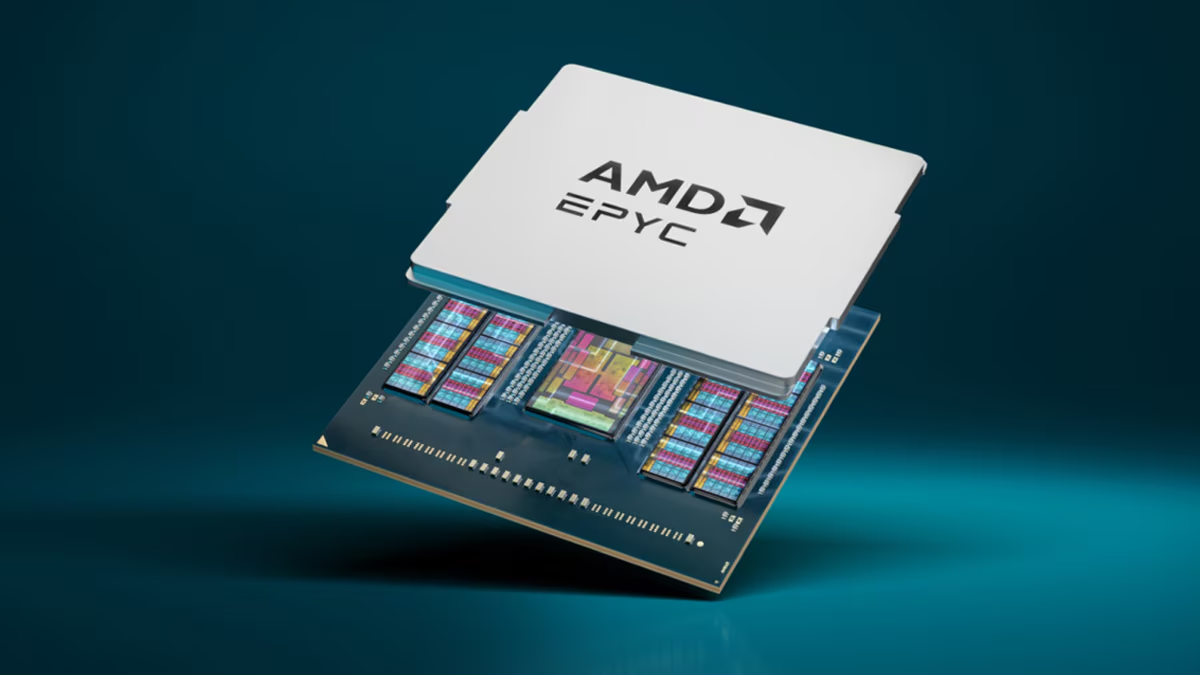
AMD stock is up 127% YTD to $487 and trades at a 123.46x trailing 12-month P/E ratio, the richest multiple in this group. AMD’s data center momentum has been remarkable, but the valuation bakes in aggressive execution on the MI400 launch and its Anthropic partnership.
Broadcom stock is up 21% YTD to $419, trading at a 69.96x P/E ratio. AI semiconductor revenue is powering Broadcom’s story, and while the multiple is elevated, the YTD price move is far less stretched than Intel’s or AMD’s.
NVIDIA stock is up 20% YTD to $224 at a 34.34x P/E ratio, the most reasonable multiple of the four despite carrying a $5.43 trillion market cap. That relative discount has become a talking point on Reddit, where a thread titled “Major tech investors say Nvidia is still cheap. Is it really?” drew 129 upvotes and 95 comments.
Sector Context for Chip Stocks
The iShares Semiconductor ETF (NASDAQ:SOXX) is up 81% YTD to $552, trading at a 44.22x P/E ratio with a 0.33% net expense ratio. As a broad semiconductor basket, SOXX frames the group’s valuation: rich, but supported by the AI capex cycle.
The sector has cooled recently. SOXX shares are down 5% over the past month as investors digest extended multiples. That pullback is exactly the backdrop where selective profit-taking makes sense.
Where Profit-Taking Makes Sense
The most defensible trims are in the most extended names. Intel is up 176% YTD with no trailing P/E to anchor the valuation and near-term EPS dilution from the equity raise. AMD stock sits at a rich 123.46x P/E ratio after a 127% YTD run.
NVIDIA stock looks comparatively reasonable at a 34.34x P/E ratio on a 20% YTD gain, while Broadcom shares are elevated but less stretched at a 69.96x P/E ratio on a 21% YTD move. Investors could consider reducing exposure at the top of their allocation bands rather than exiting outright, keeping full positions in names where fundamentals still lead the price.
Momentum can persist even in richly valued names. Position sizing and risk management should do the heavy lifting here, not an all-or-nothing call on the AI trade.
What to Watch
Investors can watch for whether Intel stock holds its 4% gain into the close and whether the revised $145 price target draws follow-through from other analysts. The dilution math has already been absorbed, so any pullback in coming sessions may tell investors more than today’s rally does.
The bigger question is whether the semiconductor group can absorb another leg of AI capex without stretching multiples further. The SOXX ETF at a 44.22x P/E ratio sets the bar, and every name above that mark carries a heavier burden of proof. For investors sitting on outsized gains in Intel and AMD shares, trimming into strength while holding core positions in Broadcom and NVIDIA looks like a balanced strategy.
Contact [email protected] for any questions or corrections.
David Moadel is financial writer specializing in stocks, ETFs, options, precious metals, and Bitcoin. David has written well over 1,000 articles for leading online publications, helping investors understand markets, income strategies, and risk.His work has appeared in The Motley Fool, InvestorPlace, U.S. News & World Report, TipRanks, ValueWalk, Benzinga, Market Realist, TalkMarkets, Finmasters, 24/7 Wall St., and others.With a master’s degree in education, David has taught at the elementary, high school, and college levels. That teaching background shapes his writing style: clear, educational, and practical. David has also built a loyal social-media audience by providing trustworthy financial content on YouTube, X/Twitter, and StockTwits.