Oracle vs SMCI: Two AI Buildout Bets, One Big Catch
Oracle and Supermicro both crushed earnings on the back of the AI infrastructure boom, but both companies share a problem that could derail the whole story before FY2027 guidance ever gets tested.


Oracle (NYSE:ORCL | ORCL Price Prediction) and Super Micro Computer (NASDAQ:SMCI) both just closed the books on fiscal 2026, and both are riding the same AI infrastructure wave from very different seats.
Oracle is a software incumbent renting AI capacity through OCI. Supermicro is a hardware builder shipping the racks that power those datacenters. The results tell two AI stories with one shared weakness: cash going out faster than it comes in.

OCI Lifts Oracle. Margin Recovery Lifts Supermicro.
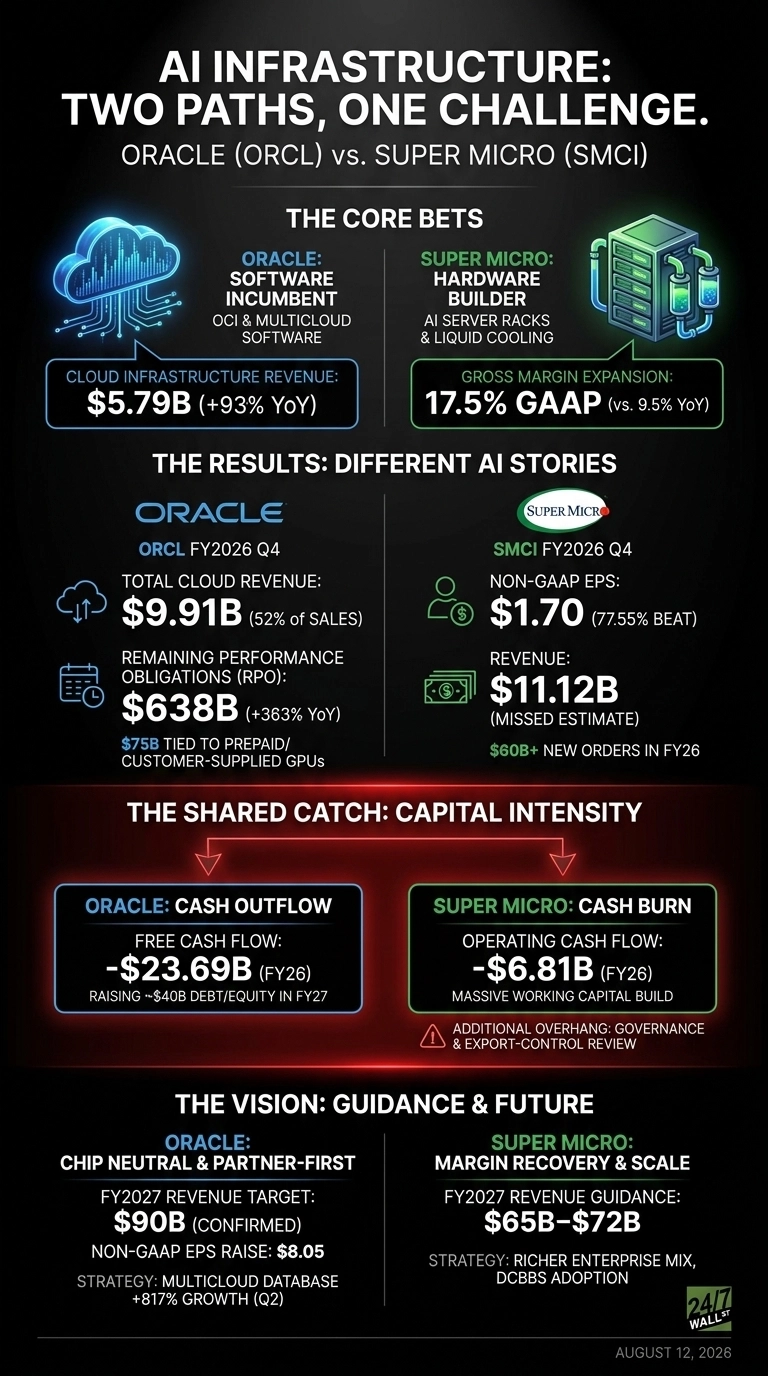
Oracle’s Q4 was carried by cloud. Cloud Infrastructure revenue hit $5.79 billion, up 93% year over year, and total cloud reached $9.91 billion, or 52% of quarterly sales. The eye-popper is the backlog.
Remaining performance obligations landed at $638 billion, up 363% year over year, with $75 billion tied to customer prepaid or customer-supplied GPUs. That backlog is the reason management confirmed a $90 billion FY2027 revenue target and raised non-GAAP EPS to $8.05.
Supermicro’s story is all about profitability. Q4 non-GAAP EPS came in at $1.70 against a $0.96 consensus, a 77.55% beat, even though revenue of $11.12 billion missed the $11.56 billion estimate. Gross margin landed at 17.5% GAAP, up from 9.5% a year earlier.
CEO Charles Liang credited a “richer enterprise customer mix and broader adoption of our optimized Data Center Building Block Solutions (DCBBS) architecture” and pointed to “more than $60 billion in new orders” during the year.
Software Compounder vs. Hardware Cycle Play
Oracle’s chip-neutral strategy is doing real work. Co-CEO Clay Magouyrk noted the “Multicloud database business is our fastest growing business, up 817% in Q2“, with 72 Oracle Multicloud datacenters being embedded inside AWS, Google and Microsoft. That partner-first approach is the opposite of the hyperscaler wars, and it is working.
| Business Lens | Oracle | Supermicro |
| Core Bet | OCI capacity and Multicloud database | AI server racks and liquid cooling |
| Backlog Signal | $638B RPO | $60B+ new orders in FY26 |
| Key Vulnerability | -$23.69B free cash flow | Governance review, thin hardware margins |
Supermicro is more exposed to the raw AI capex cycle. Manufacturing sits in Silicon Valley, Taiwan, and the Netherlands, with liquid-cooling leadership and a Blackwell Ultra order book previously flagged at $13 billion+.
The catch is real: the board is still conducting an independent review tied to export-control transactions, and FY2026 operating cash flow was negative $6.81 billion on a massive working-capital build.
The Cash Question Decides the Next Six Months
Both companies need capital. Oracle plans to raise roughly $40 billion in FY2027 through debt and equity to fund its buildout.
Supermicro pulled in $9.48 billion from financing in FY2026 to keep inventory flowing. I will be watching whether Oracle’s RPO converts into cash-generative revenue fast enough to shrink that free-cash-flow hole, and whether Supermicro can sustain a mid-teens gross margin once the enterprise mix normalizes.
Wall Street is bullish on the stock with several upgrades. Barclays raised the firm’s price target on the stock to $39 from $38 and keeps an Equal Weight while Citi analyst Asiya Merchant raised the firm’s price target to $39 from $33 and keeps a Neutral rating on the shares.
Guidance sets the bar high: Supermicro projected $65 billion to $72 billion in FY2027 revenue.
Why I Lean Oracle for Quality, Supermicro for Torque
If you want durable AI exposure, I lean Oracle. The software franchise, 36.2% operating margin, and multicloud footprint feel like a compounder, even after a 24.63% YTD drawdown.
If you want torque and can stomach the governance overhang, Supermicro offers more variance. Shares trade near $31.81 with an analyst target of consensus estimates.
The export-control review is the key overhang to monitor for Supermicro. Until that closes, Oracle screens as the cleaner AI infrastructure exposure, catch and all.
Contact [email protected] for any questions or corrections.
Vandita Jadeja is a financial publisher with over a decade of experience writing about financial topics, including investment, savings, retirement, insurance and banking. Vandita is a Chartered Accountant who loves to debunk financial concepts for readers.
Her work has appeared on sites that include The Motley Fool, InvestorPlace, and Benzinga. She covers investing and focuses on stock picks and price prediction for 24/7 Wall St.
When not looking for the next stock investment opportunity, she can be found traveling, reading, chasing sunsets and enjoying her iced latte.