Vanguard’s VTIAX Is the Fund Everyone Loves to Hate, and That Might Be the Whole Point
For years, VTIAX sat at the bottom of American portfolios, a drag that cost some investors six figures in foregone gains. Now the fund everyone quietly resented is doing something very few predicted, and the reasons behind its turn matter…

Over the past decade, U.S. stocks returned roughly 240.8% while Vanguard Total International Stock Index Fund Admiral Shares (NASDAQ:VTIAX) delivered 147.62%. That gap, measured through August 12, 2026, is why VTIAX is the most quietly resented fund in a lot of 401(k)s. It is also why the fund is now, unexpectedly, on a tear.
Year to date, VTIAX is up 16.46% against 13.89% for Vanguard Total Stock Market ETF (NYSEARCA:VTI). Over the trailing year it has returned 26.71% versus 20.78% for VTI. After years of trailing, the least loved allocation in American portfolios is finally pulling its weight.
What VTIAX Actually Owns
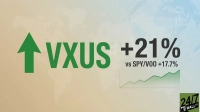
VTIAX is Vanguard’s flagship international index fund, the Admiral share class of the Total International Stock Index Fund. It tracks a broad market-cap-weighted basket of developed and emerging market equities outside the United States: European large caps, Japanese exporters, Taiwanese and Korean semiconductor names, Chinese and Indian consumer plays, plus Canadian, Australian, and Latin American holdings. The ETF twin, Vanguard Total International Stock ETF (NASDAQ:VXUS), owns the same portfolio and carries an expense ratio of 0.05% as of March 18, 2026. Investors holding VTIAX in a brokerage that charges to trade VXUS often stick with the mutual fund; investors who can buy VXUS commission-free may prefer the ETF for its lower cost and intraday liquidity.
The Decade That Made Everyone Resent It
Over five years, VTIAX returned 54.9% while VTI returned 65.9%. Over ten years, the gap is wider still. The iShares MSCI EAFE ETF (NYSEARCA:EFA), the standard developed-markets proxy, returned 147.98% over the same ten-year window, essentially matching VTIAX. This is an asset-class problem: international stocks, as a group, spent a decade losing to the S&P 500’s tech engine.
On a $100,000 balance, that ten-year gap between VTI and VTIAX is roughly $93,000 in foregone gains. That is a real cost, and it is why every three-fund portfolio thread on Reddit eventually turns into an argument about whether international allocation is worth keeping.
The Case for Owning It Anyway
J.P. Morgan’s 2026 outlook notes that international equities returned 31% in U.S. dollar terms in 2025, outperforming U.S. equities by 1,520 basis points, the biggest outperformance since 1993. Their strategists argue the U.S. dollar is still 10% overvalued versus fair value and that the U.S. equity premium over international equities is still at 34% versus its 19% long-run average. Morningstar’s 2026 outlook makes a similar point: foreign markets offer better value and diversification after years of dollar strength.
Concentration is the other half of the argument. U.S. equity benchmarks now carry over 40% concentration in 10 companies, most tied to the AI theme. VTIAX owns thousands of stocks with no single-country concentration above roughly a fifth of the portfolio. If you believe reversion happens eventually, VTIAX is the cheapest ticket to that trade at Vanguard.
The Income Nobody Talks About
International stocks pay more dividends than U.S. stocks, and VTIAX passes them through. The fund distributed $1.2753 per share across 2025 and has paid $1.16 over the trailing 12 months. Payouts are lumpy, with a large Q4 distribution ($0.729 in December 2025) that reflects how European and Asian companies pay. That yield profile makes VTIAX slightly less tax-efficient than VTI in a taxable account, an important footnote for high-bracket investors.
Who VTIAX Fits, and Who Should Skip It
Long-horizon investors building a globally diversified core, ideally inside a 401(k) or IRA where the higher dividend load is not taxed, may find VTIAX worth a serious look at its current valuation gap to the U.S. Investors chasing recent winners, who cannot stomach another five years of trailing the S&P 500 if the AI trade keeps compounding, have better options. This is not a fund that rewards impatience.
Related Funds Worth a Look
- Vanguard Total International Stock ETF (VXUS): The ETF twin of VTIAX with a 0.05% expense ratio, better for taxable accounts and intraday trading.
- iShares MSCI EAFE ETF (EFA): Developed markets only, no emerging market exposure, a more conservative slice of the international trade.
- Vanguard Total Stock Market ETF (VTI): The U.S. counterweight most VTIAX holders already own; the pairing is the classic two-fund global equity core.
Contact [email protected] for any questions or corrections.
Austin Smith is a financial publisher with over two decades of experience as an investor, analyst, and advisor. He covers stocks, ETFs, Artificial intelligence and personal finance for 24/7 Wall St. Previously, he spent over a decade at The Motley Fool as a senior editor for Fool.com, portfolio advisor for Millionacres, and launched The Ascent to help reader take control of their personal finances.
His work has been featured on Fool.com, NPR, CNBC, USA Today, Yahoo Finance, MSN, AOL, Marketwatch, and many other publications. He is as an advisor to private companies, and co-hosts The AI Investor Podcast with Eric Bleeker.
When not looking for investment opportunities, he can be found skiing, running, or playing soccer with his children. Learn more about Austin's investment approach here.