AMD’s Massive Upside: Why One Analyst Sees 160% Price Appreciation Ahead Following a Tough Month
AMD just posted blowout earnings and still cratered 9% after hours, but one Wall Street analyst sees that selloff as the setup for a gain most investors would dismiss as fantasy.

This post may contain links from our sponsors and affiliates, and Flywheel Publishing may receive compensation for actions taken through them.
Shares of Advanced Micro Devices (NASDAQ:AMD | AMD Price Prediction) currently trade around $483.01, while the average Wall Street price target sits at $613.33, leaving an implied upside of roughly 27% between current levels and consensus. The Street-high call from Baird expands that gap dramatically.
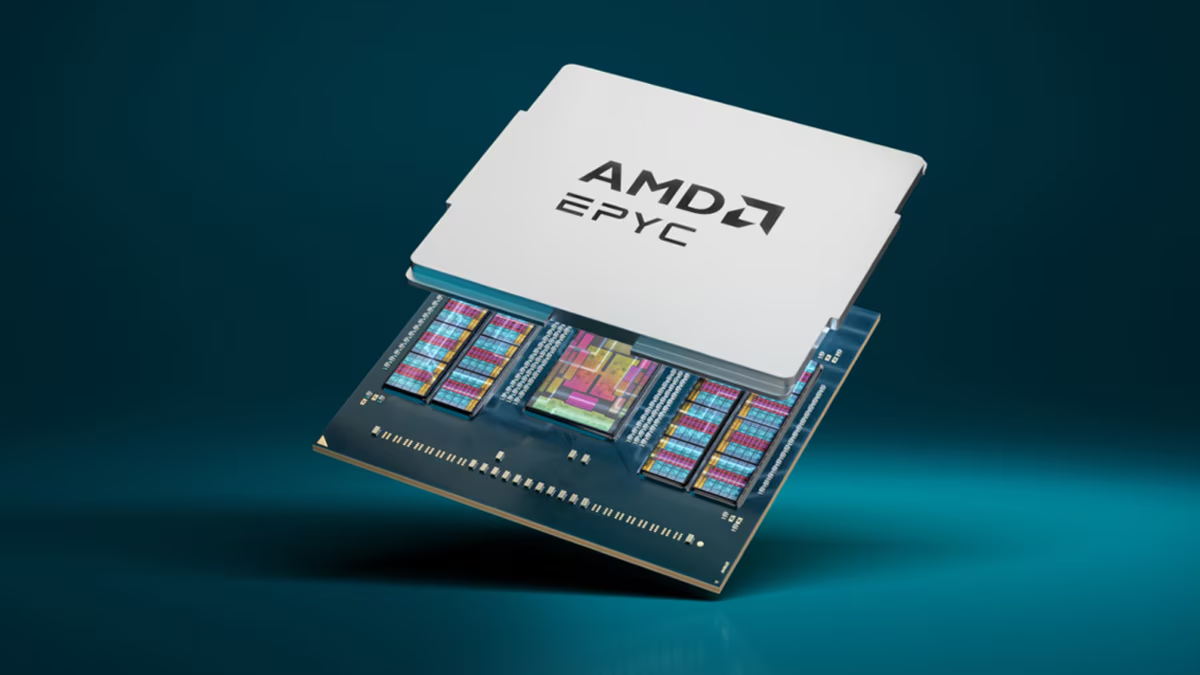
AMD is the second-largest merchant designer of data center CPUs and GPUs and has emerged as the primary alternative to NVIDIA in AI accelerators, with hyperscaler deployments anchored by Instinct GPUs, EPYC server chips, and the new Helios rack-scale platform. Wall Street focuses on whether the company can convert multi-gigawatt commitments from Anthropic, OpenAI, Meta, and Microsoft into durable revenue and margin expansion.
The recent pullback reflects a valuation reset in a stock that had already tripled from year-end levels.
Why the Stock Slid After a Blowout Quarter
AMD’s Q2 2026 earnings on August 4, 2026 showed revenue of $11.54 billion, up 50.1% year over year and ahead of the $11.31 billion consensus, with non-GAAP EPS of $1.66 beating by 3.06%. Data Center revenue more than doubled to $6.72 billion. Traders shrugged.
The issue was gross margin guidance. Management guided Q3 non-GAAP gross margin to roughly 56%, flat with the prior quarter despite the mix shift toward higher-priced Instinct GPUs and Helios racks. A widely upvoted Reddit post captured the sentiment: AMD “beat on revenue, beat on EPS, guided Q3 half a billion above the street, and still fell 9% after hours.”
AMD is off 11.88% over the past month, sharply underperforming peers despite climbing 161.91% year to date. The selloff is company-specific, tied to skepticism about whether AI accelerator margins can inflect higher into 2027.
The $1,250 Baird Call and What Analysts See
With implied upside to the Baird target running near 159%, the bull case merits attention. Baird analyst Tristan Gerra doubled his price target to $1,250 from $625 while maintaining an Outperform rating, setting the Street-high target across all sell-side analysts covering the stock.
Gerra’s thesis rests on three pillars: he models AMD’s AI GPU platform revenue reaching $147 billion by 2030, assuming roughly 15% share of the data center AI accelerator TAM; he views accelerating Instinct GPU adoption alongside next-generation EPYC server CPUs as materially underestimated; and he flags Helios rack-scale production as positioning AMD as a credible primary alternative to NVIDIA for tier-one hyperscaler builds.
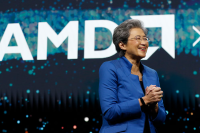
CEO Lisa Su reinforced this setup, telling investors that “customer pull for Helios is very strong and tracking ahead of our initial forecasts,” with initial shipments starting in Q3 and ramping through 2027. The company also expects the overall Data Center segment to more than double in 2027, off a much higher base.
Sentiment among the broader analyst pool remains constructive. Coverage includes 5 Strong Buy, 36 Buy, 10 Hold, and no Sell or Strong Sell ratings, with recent revisions leaning toward reiterations and upgrades rather than cuts.
How AMD Stacks Up Against NVIDIA and Intel
The peer group held up while AMD sold off.
NVIDIA (NASDAQ:NVDA) trades near $225.30, up 6.37% over the past month and 20.95% year to date. Against an average analyst target of $305.94, implied upside sits at roughly 36%. Consensus remains a Strong Buy.
Intel (NASDAQ:INTC) trades near $104.56, down 2.97% on the month but 183.36% higher year to date on turnaround optimism. Against an average target of $107.85, implied upside is roughly 3%. Ratings skew Hold.
The largest analyst-implied upside in the group sits with AMD. Wall Street sees AMD as the mispriced name inside a peer set that has otherwise held up.
Price, Target, and Performance
AMD currently trades at $483.01 with a consensus 12-month price target of $613.33 from 51 covering analysts, implying roughly 27% upside on the average call and near 159% on the Baird high of $1,250.
AMD is up 125.54% year to date and 161.91% over one year, versus the S&P 500’s YTD return of roughly 13.9%. Even after the recent 11.88% monthly pullback, this remains one of the strongest-performing megacaps of the year.
Ratings breakdown:
- Strong Buy: 5
- Buy: 36
- Hold: 10
- Sell: 0
- Strong Sell: 0
The Bottom Line
The bull case rests on Helios shipping on time and gross margins inflecting higher as Instinct volumes scale into 2027. The path back to consensus requires visible margin expansion above 56%, continued EPYC share gains, and confirmation that multi-gigawatt commitments from Anthropic, OpenAI, and Meta convert into recognized revenue on management’s outlined cadence.
The bear case argues the flat gross margin guide is structural rather than transitional, or that hyperscalers use AMD only as a NVIDIA hedge. The forward P/E of 63 becomes difficult to defend under those scenarios.
On balance, the consensus 27% gap looks reasonable, the Baird call requires strong execution but is credible, and the peer setup argues AMD is the dislocated name. Volatility remains elevated, and any position sizing should reflect that.
Contact [email protected] for any questions or corrections.
Alex Sirois is a financial writer with experience spanning both retail and institutional investing. He has written for InvestorPlace and held roles at BNY Mellon and Bernstein, giving him a perspective that bridges Main Street portfolios and Wall Street analysis.
Alex holds an MBA from George Washington University and has built his career across multiple industries, including e-commerce, education, and translation — a breadth of experience that informs how he breaks down complex financial topics for everyday investors. His writing is conversational, actionable, and grounded in long-term, buy-and-hold investing principles.
At 247 Wall St., Alex focuses on delivering analysis that is both accessible and useful, with a clear emphasis on helping readers make more informed decisions with their money.