AMD is Down 10% Over a Month: Did Microsoft’s Catalyst Just Spark the 155% Upside Expected By Wall Street Pro?
Baird just set the highest AMD price target on Wall Street after a brutal July selloff, and a surprise Microsoft announcement may have handed AMD the exact catalyst needed to justify it.

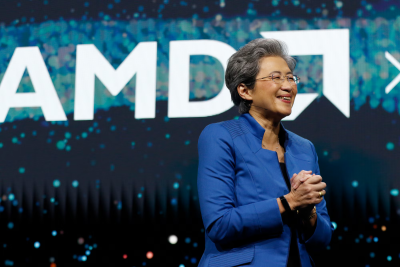
Shares of AMD (NASDAQ:AMD | AMD Price Prediction) are trading at $485.39, while the average analyst price target sits at $575.49, implying roughly 19% upside. The loudest bull on the Street is calling for something dramatically larger.
AMD designs the CPUs and GPUs powering hyperscale AI data centers. After Q1 revenue climbed 37.85% year over year on a 57% Data Center surge, the story centers on how much of the AI accelerator market Lisa Su can capture from NVIDIA. The recent pullback matters: the stock has cooled just as its most important customer, Microsoft (NASDAQ:MSFT), delivered results that reset the AI capex ceiling.
A July Slide Meets a Microsoft Reset
AMD entered July near record levels and gave back 10.26% across the month, with the sharpest damage in the final week at -10.06%. Fed uncertainty, softer GDP prints, and broader AI trade concerns drove the decline.
On July 30, AMD rallied 13% as Microsoft’s July 29 report landed. Azure grew 43% and full-year FY2026 capex reached $115.95 billion, validating accelerating hyperscaler spend. Two days earlier, Synopsys, AMD, and Microsoft announced an expanded agentic-AI EDA collaboration on Microsoft Discovery, cutting debug cycle time by 40%. For AMD’s Data Center segment selling directly into Azure’s buildout, that is the catalyst.
Why Baird Doubled Its Target to $1,250
Baird’s Tristan Gerra just doubled his AMD price target from $625 to $1,250, reiterating Outperform and setting the Street high. Against the current print, that implies roughly 155% upside, well beyond the consensus $575.49 figure.
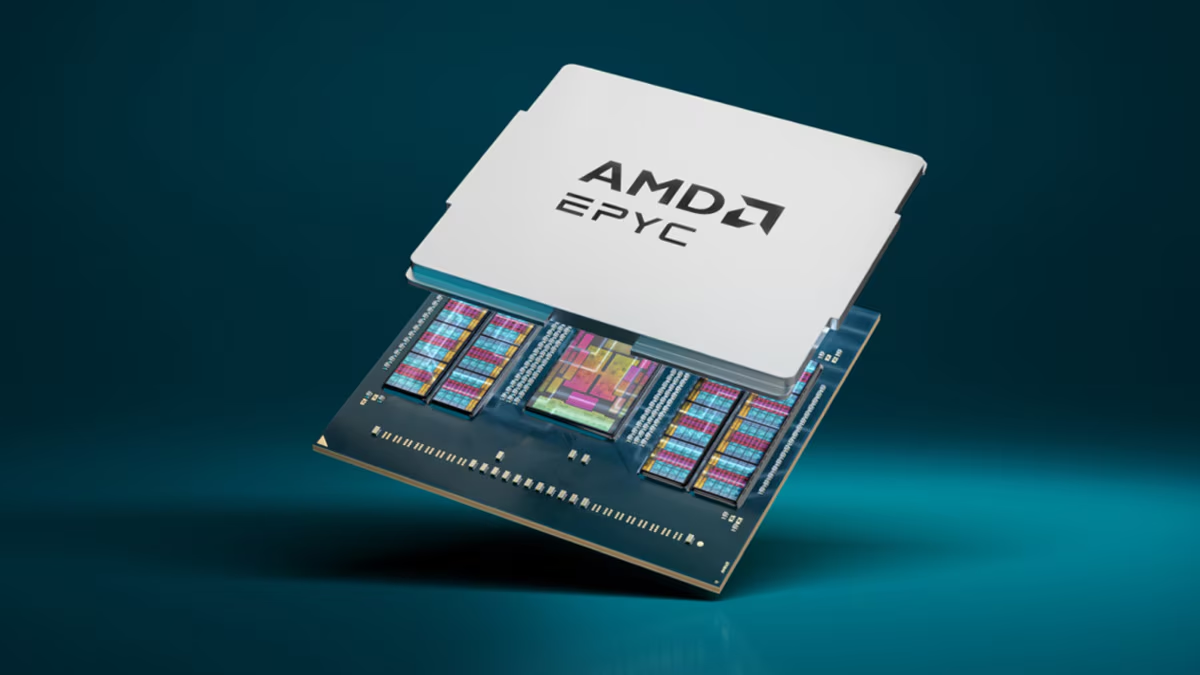
Gerra’s thesis rests on two pillars. First, he models $147 billion in AI GPU revenue for AMD by 2030, assuming AMD captures 15% of global data center AI workloads. Second, he sees the full-stack story landing: Helios rack-scale platforms, MI450 accelerators, and next-gen “Venice” EPYC CPUs deployed together at Microsoft, Meta, OpenAI, and Oracle. Lisa Su’s commentary aligns: “Customer engagement around MI450 Series and Helios is strengthening, with leading customer forecasts exceeding our initial expectations.”
Q1 non-GAAP EPS came in at $1.37, free cash flow surged 252.96% to $2.57 billion, and management guided Q2 revenue to ~$11.2 billion, a 46% jump. Prediction markets assign an 88.5% probability that AMD beats on its next print.
Ratings back the posture. Alpha Vantage tallies 5 Strong Buy, 37 Buy, 9 Hold, with no Sell calls, and recent revisions have skewed toward reiterations and raises.
AMD Fell Alone While the AI Group Diverged
AMD’s July drawdown stands out against every close comparable in the AI peer group.
NVIDIA (NASDAQ:NVDA) trades at $195.04 against a $302.83 average target, roughly 55% upside, and slipped only 2.52% in July. With 58 Buys, 2 Holds, and 1 Sell, sentiment remains firmly bullish.
Broadcom (NASDAQ:AVGO) rose 2.67% in July to $387.84, versus a $527.88 target and 44 Buys against 4 Holds, implying about 36% upside as custom AI silicon demand compounds.
Intel (NASDAQ:INTC) cratered 34.73% in July to $91.13 against a $115.27 target and a mixed 13 Buy, 32 Hold, 4 Sell posture.
The widest analyst-implied upside sits with AMD once Baird’s Street-high call is included: NVDA and AVGO barely moved, INTC’s rating quality is worse, and AMD gets the biggest bull thesis attached to the deepest recent pullback.
The Numbers Behind the Dislocation
AMD trades at $485.39 versus a consensus target of $575.49 from 51 covering analysts, roughly 19% consensus upside, stretching to about 155% at Baird’s Street high. The 52-week range runs from $149.22 to $584.73, and the stock sports a forward P/E of 63x.
AMD is up 126.65% year-to-date versus the S&P 500’s 8.76% gain, and up 170.4% over the past year. Even after the July slide, the longer-term chart remains intact.
Bull Case Wins If MI450 Ramps Cleanly
The bull case holds if MI450 and Helios ship on time in the second half, hyperscalers keep spending at the pace Microsoft validated, and Baird’s 15% share assumption in AI GPUs proves directionally right. In that world, $575 is a base case and $1,250 becomes a genuine multi-year target.
The bear case holds if the July selloff was signal: cheaper AI models eroding accelerator demand, MI450 slipping, or margin compression as AMD chases NVIDIA on price. With a forward P/E of 63x and heavy insider selling flagged recently, execution needs to be near-flawless.
On balance, the Microsoft print reaffirmed demand right into AMD’s catalyst window, and the analyst community is not budging. The dislocation looks more like opportunity than trap, provided investors size for the volatility a 2.47 beta implies.
Contact [email protected] for any questions or corrections.
Alex Sirois is a financial writer with experience spanning both retail and institutional investing. He has written for InvestorPlace and held roles at BNY Mellon and Bernstein, giving him a perspective that bridges Main Street portfolios and Wall Street analysis.
Alex holds an MBA from George Washington University and has built his career across multiple industries, including e-commerce, education, and translation — a breadth of experience that informs how he breaks down complex financial topics for everyday investors. His writing is conversational, actionable, and grounded in long-term, buy-and-hold investing principles.
At 247 Wall St., Alex focuses on delivering analysis that is both accessible and useful, with a clear emphasis on helping readers make more informed decisions with their money.