AMD is Down 18% Over a Month: One Analyst Targets $1,250, Meaning 190% Returns From Here
AMD just posted blowback-proof earnings with 37% revenue growth and a 252% surge in free cash flow, yet the stock cratered nearly 20% in a month while its closest rivals barely flinched. One analyst sees a path to 190% gains…


AMD (NASDAQ:AMD | AMD Price Prediction) trades at $429.56 against an average Wall Street price target of $575.49, a gap of roughly 34% between current levels and consensus. Baird analyst Tristan Gerra recently pushed a target of $1,250, implying roughly 191% upside. That outlier reflects AMD’s emergence as the number-two AI accelerator franchise behind NVIDIA at a moment the market is repricing the group.
The disconnect matters because operating performance held firm. Q1 FY2026 revenue of $10.253 billion grew 37.85% year over year, non-GAAP EPS of $1.37 beat the $1.2939 consensus, and Data Center revenue jumped 57%. The tape tells a different story than the P&L.
A Violent Reset in a Stock That Just Beat
AMD is down 20.38% over the past month and 22.23% in the past week. Measured from the June 30 close, shares have fallen 26.05%. That qualifies as violent for a large-cap semiconductor name that just guided Q2 revenue to approximately $11.2 billion, implying 46% year-over-year growth.
Catalysts trace to broader macro pressures. Broader tech sentiment has been pressured by renewed U.S.-Iran tensions, surging crude oil prices, and concerns about restrictive Federal Reserve policy, layered onto a narrative hitting AMD directly: fears that cheaper AI models could reduce demand for expensive AI infrastructure. JPMorgan CEO Jamie Dimon separately flagged potential credit risks from AI infrastructure financing, denting hyperscale capex sentiment.
Fundamentals held up cleanly. Non-GAAP gross margin expanded 170 basis points year over year to 55%, and free cash flow surged 252.96% to $2.566 billion. This looks like a valuation reset.
What Baird Sees at $1,250
The bull case has not softened. Consensus target of $575.49 still implies roughly 34% upside, and the rating profile of 42 Buys, 9 Holds, and zero Sells reflects reiterations rather than downgrades in recent weeks.
Gerra sits at the aggressive end with a multi-year full-stack capture thesis. He frames AMD’s server CPU and GPU total addressable market as expanding toward $220 billion-plus, and projects data center AI GPU revenue reaching roughly $147 billion by 2030 as AMD captures about 15% market share in enterprise and hyperscale AI accelerators.
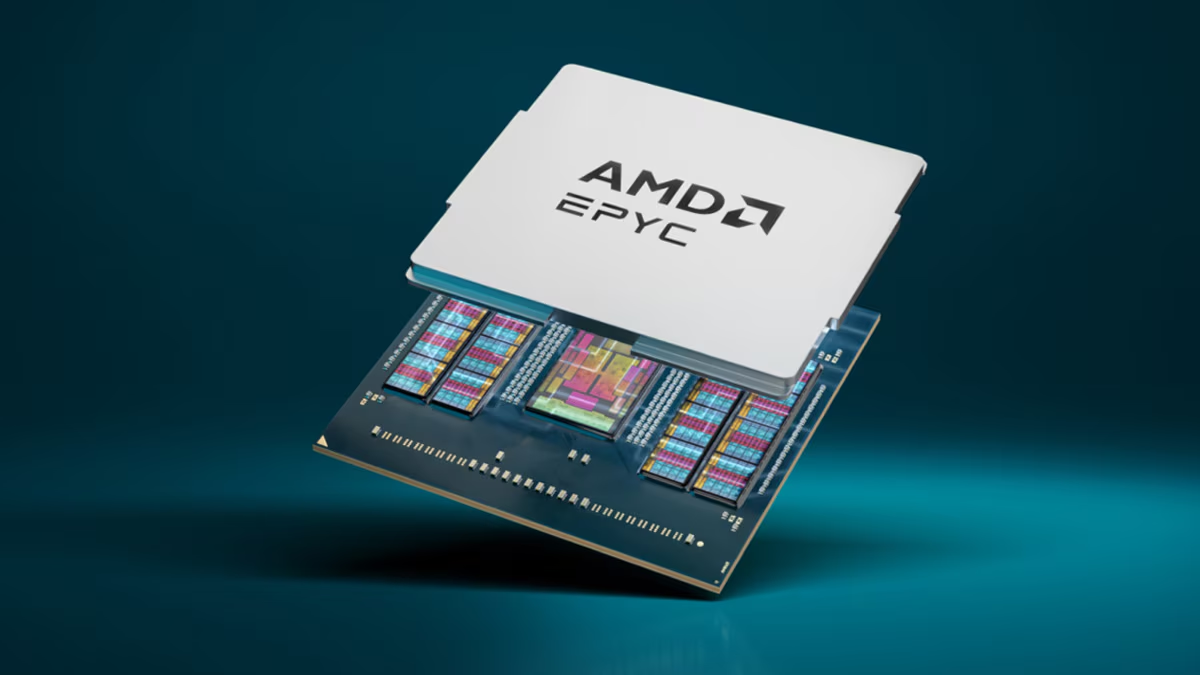
Catalysts are MI450 accelerator platform and next-generation Venice EPYC architecture ramping into hyperscale deployments alongside Meta, OpenAI, and Microsoft. Lisa Su told investors on the Q1 call that Meta has committed to up to 6 gigawatts of AMD Instinct GPU deployment, OpenAI to another 6 GW, and Oracle Cloud is standing up a 50,000-GPU Helios supercluster. The $1,250 is a swing rather than a base case, but underlying commitments are real.
The AI Chip Cohort Did Not Sell Off Together
AMD’s dislocation stands out. The rest of the AI accelerator complex barely moved.
NVIDIA (NASDAQ:NVDA) fell just 2.54% over the past month. At $190.01 versus an average target of $302.83, implied upside runs near 59%, on a rating stack of 58 Buys, 2 Holds, and 1 Sell. Recent revisions skewed higher after the Q1 FY27 report.
Broadcom (NASDAQ:AVGO) is down only 0.57%. Shares at $370.32 against a $527.00 target imply roughly 42% upside, with 44 Buys and 4 Holds and estimates trending up after AI semiconductor revenue guided to $16.0 billion for Q3.
Intel (NASDAQ:INTC) fell harder than AMD, off 37.84% over the month. At $81.88 versus a $115.27 average target, implied upside is around 41%, but conviction is thinner: 32 Holds against 13 Buys and 4 Sell-side ratings.
On consensus, largest analyst-implied upside sits at NVIDIA. Excluding Baird’s outlier, AMD ranks below NVDA and roughly even with AVGO and INTC. Include Gerra’s $1,250 target and AMD’s ceiling towers over the entire cohort.
What the Tape Actually Says
AMD trades at $429.56, with consensus target of $575.49 implying roughly 34% upside. Analyst posture across the 51-analyst coverage universe skews decisively bullish.
- Buy ratings: 42
- Hold ratings: 9
- Sell ratings: 0
The stock is up 100.58% year to date and 142.09% over the past year, even after the recent drawdown. The S&P 500 is up 6.97% year to date and down 1.56% over the past month. AMD has demolished the index on the year and given a large chunk back in four weeks.
Where I Come Out on AMD Here
The bull case holds if the Baird framework is directionally correct: MI450 and Venice EPYC convert announced Meta, OpenAI, and Oracle commitments into hyperscale revenue at the pace Su has signaled, and AMD holds mid-teens share of AI accelerators through the decade. That path leads back to the $575 consensus, with $1,250 sitting on top only if 2030 modeling proves right.
The bear case builds if the market correctly prices a demand ceiling on high-end AI infrastructure, or if China export controls on MI308 returns as a recurring drag. At 69x forward earnings, there is not much cushion for either.
My lean is modestly constructive. Q1 was too strong to read the 20% drawdown as fundamental, and peer tape shows selective damage across the cohort. The consensus $575 target looks defensible if August 4 earnings confirm trajectory. Baird’s $1,250 is a valid ceiling to note.
Contact [email protected] for any questions or corrections.
Alex Sirois is a financial writer with experience spanning both retail and institutional investing. He has written for InvestorPlace and held roles at BNY Mellon and Bernstein, giving him a perspective that bridges Main Street portfolios and Wall Street analysis.
Alex holds an MBA from George Washington University and has built his career across multiple industries, including e-commerce, education, and translation — a breadth of experience that informs how he breaks down complex financial topics for everyday investors. His writing is conversational, actionable, and grounded in long-term, buy-and-hold investing principles.
At 247 Wall St., Alex focuses on delivering analysis that is both accessible and useful, with a clear emphasis on helping readers make more informed decisions with their money.