China Fears Affect Nividia and AMD in Very Different Ways
Both chipmakers crushed their earnings estimates, yet the same geopolitical pressure that wiped out billions for one barely registered for the other. Understanding why reveals something surprising about where real AI market power actually sits.


NVIDIA (NASDAQ: NVDA | NVDA Price Prediction) and AMD (NASDAQ: AMD) both posted blowout quarters, but China hit each business in opposite ways. NVIDIA zeroed out China data center compute in guidance. AMD barely flinched. The gap between how these chipmakers absorb geopolitical shock has never looked wider.
One Zeroes Out China. The Other Barely Notices.
NVIDIA delivered $81.6 billion in revenue, up 85.23% year over year, with Data Center at $75.25 billion. Networking nearly tripled, up 199%. CFO Colette Kress told investors “We are not including any China data center compute revenue in our outlook.” H20 shipments to China fell from $4.6 billion a year ago to zero.
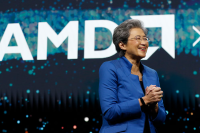
AMD posted $11.54 billion in revenue, up 50.11%, with Data Center up 107% to $6.72 billion. Lisa Su focused on Helios, EPYC, and named anchors: “We are very happy with our strategic anchor customers in OpenAI, Meta, and Anthropic.” China was mentioned mostly as historical context around the prior $800 million MI308 inventory charge.
Core Threat Versus Missed Opportunity
NVIDIA generated nearly $20 billion from China alone in FY2026 and controls roughly 80% of the global AI accelerator market, so export bans erase real revenue. AMD sits at a much smaller ~5 textendash7% global AI market share, meaning China is a lost expansion lane rather than a hit to current cash flow.
| Lens | NVIDIA | AMD |
| China DC Revenue in Guide | Zero | Modest MI308 residual |
| Non-GAAP Gross Margin | 75.0% | 56% |
| P/E | 45 | 182 |
| Core Bet | Blackwell and Vera Rubin | Helios and EPYC Venice |
The Next Test Is Whether China Returns
Jensen Huang’s team confirmed H-200 licenses were approved but zero revenue generated, so any China thaw is optionality. NVIDIA must extend its $91 billion Q2 guide without China, relying on Blackwell demand at Microsoft, AWS, and Anthropic. For AMD, the question is Helios execution: Su said shipments “begin later this quarter and ramp through the fourth quarter and into 2027,” with Anthropic committed to up to 2 gigawatts of MI450.
NVIDIA for Quality, AMD for the Trade
NVIDIA is the cleaner business. A 75% gross margin while writing off an entire country signals real pricing power, and the stock is up only roughly 5% to 7% since the filing, which feels reasonable given China removal. AMD’s setup appeals differently. Shares slipped 6.86% since its August 4 report despite a 107% Data Center result, and at a P/E near 182, the thesis rides on Helios stealing Western sockets from NVIDIA. NVIDIA offers the durable AI compounding profile, while AMD represents the higher-variance second-source bet. Investors should watch hyperscaler capex signals for signs of softening.
Contact [email protected] for any questions or corrections.
Alex Sirois is a financial writer with experience spanning both retail and institutional investing. He has written for InvestorPlace and held roles at BNY Mellon and Bernstein, giving him a perspective that bridges Main Street portfolios and Wall Street analysis.
Alex holds an MBA from George Washington University and has built his career across multiple industries, including e-commerce, education, and translation — a breadth of experience that informs how he breaks down complex financial topics for everyday investors. His writing is conversational, actionable, and grounded in long-term, buy-and-hold investing principles.
At 247 Wall St., Alex focuses on delivering analysis that is both accessible and useful, with a clear emphasis on helping readers make more informed decisions with their money.