Tesla Stock Is Recovering. The 3 Problems Underneath It Are Not.
Tesla's stock has bounced, but beneath the rally sit three structural problems that a rising share price cannot fix. Here is what the numbers actually say about where the company is headed.

Tesla (NASDAQ:TSLA | TSLA Price Prediction) shares have bounced from a recent 52-week low. The stock is up more than 4% over the past week and last seen trading around $345. Zoom out and the picture reverses: down 13.5% over one month, down 23.8% year to date, and up 2.0% from a year ago. The market cap is about $1.4 trillion, and the trailing P/E is near 306x. The bounce appears to be sentiment, while the problems underneath it are structural.
Wall Street is not confident either. More analysts say hold than buy, and they have a consensus target of $396.62. Prediction markets tell a similar story: the crowd prices a $326.34 target, or roughly 5.81% downside, at high confidence.

Problem One: Strategic Sprawl
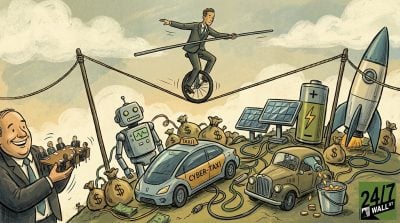
Tesla is running the most expansive capital program in its history. 2026 capex is guided above $25 billion versus $8.5 billion last year. Q2 capex hit $5.79 billion, up 141.81%, while free cash flow flipped to negative $1.09 billion. Simultaneous bets include Optimus, Cybercab, robotaxi, FSD, Dojo, in-house semiconductor fabrication, lithium refining, cathode production, a proposed Texas solar plant, and a redesigned Roadster that Reuters reported may be unveiled soon. Elon Musk framed the strategy on the July call: “It’s okay to be a little less capital efficient if we get things done sooner.” That choice has a cost.
Problem Two: The Core as Cash Cow
Record volume is not producing record profit. Q2 deliveries hit 480,126, up about 25% year over year, beating the 402,776 consensus. Morningstar’s Seth Goldstein said afterward it would be “very hard to see a decline for the full year.” Yet adjusted EPS came in at $0.33 versus $0.51 expected, operating margin compressed to 1.4%, and operating income fell 56.88%. Regulatory credit revenue collapsed to $146 million. Freedom Broker’s Dmitriy Pozdnyakov estimated U.S. sales likely declined at least 10% in the quarter after the EV tax credit was removed. The lineup is aging, and growth rides refreshes like the Model Y L six-seater. The auto business is being harvested to fund the moonshots.

Problem Three: Governance and Key-Person Risk
The roughly $1 trillion Musk pay package passed in November 2025 over significant institutional opposition, including New York State pension officials urging rejection. Stock-based compensation tied to that award is now an explicit driver of the 47% operating expenses surge to $4.35 billion.
The board is designed to represent independent shareholder interests, but in practice it operates under the immense gravitational pull of a single individual. Tesla’s identity and valuation are inextricably tied to Musk. Running multiple major entities simultaneously (Tesla, SpaceX, X, xAI, Neuralink, and The Boring Company) creates an inherent split in his focus. Concerns arise when corporate resources appear to be deployed in ways that align with the CEO’s broader vision rather than strictly Tesla’s stand-alone bottom line.
What Would Prove the Bear Case Wrong
There is a real bull case. UBS raised its target to $442 from $364, citing Optimus, FSD and Dojo. The Swedish IF Metall strike ended August 13, 2026, after nearly three years. Robotaxi has scaled to seven U.S. markets with over 380,000 unsupervised miles and zero notable incidents, growing at more than 10% a week. FSD attach rates cleared 55% of new North American deliveries, with 1.48 million active subscriptions. None of that resolves the three structural issues; it only justifies the spending if execution delivers.
Three specific things could prove the bear case wrong. First, operating margin recovering toward double digits without leaning on regulatory credits. Second, free cash flow returning to positive territory while capex stays elevated, evidence the moonshots are self-funding rather than draining the auto business. Third, a governance signal: an independent chair, a real capital allocation framework, or a credible succession plan. Until then, the chart is recovering while the fundamentals are not.
Contact [email protected] for any questions or corrections.
Trey has been an editor and author at 24/7 Wall St. for more than a decade, where he has published thousands of articles analyzing corporate earnings, dividend stocks, short interest, insider buying, private equity, and market trends. His comprehensive coverage spans the full spectrum of financial markets, from blue-chip stalwarts to emerging growth companies.
Beyond 24/7 Wall St., Trey has created and edited financial content for Benzinga and AOL's BloggingStocks, contributing additional hundreds of articles to the investment community.
Trey's editorial expertise extends across multiple publishing environments. He served as production editor at Dearborn Financial Publishing and development editor at Kaplan, where he helped shape financial education materials. Earlier in his career, he worked as a writer-producer at SVE. His freelance editing portfolio includes work for prestigious clients such as Sage Publications, Rand McNally, the Institute for Supply Management, the American Library Association, Eggplant Literary Productions, and Spiegel.
Outside of financial journalism, Trey writes fiction and has been an active member of the writing community for years, moderating workshop sessions at regional conventions.