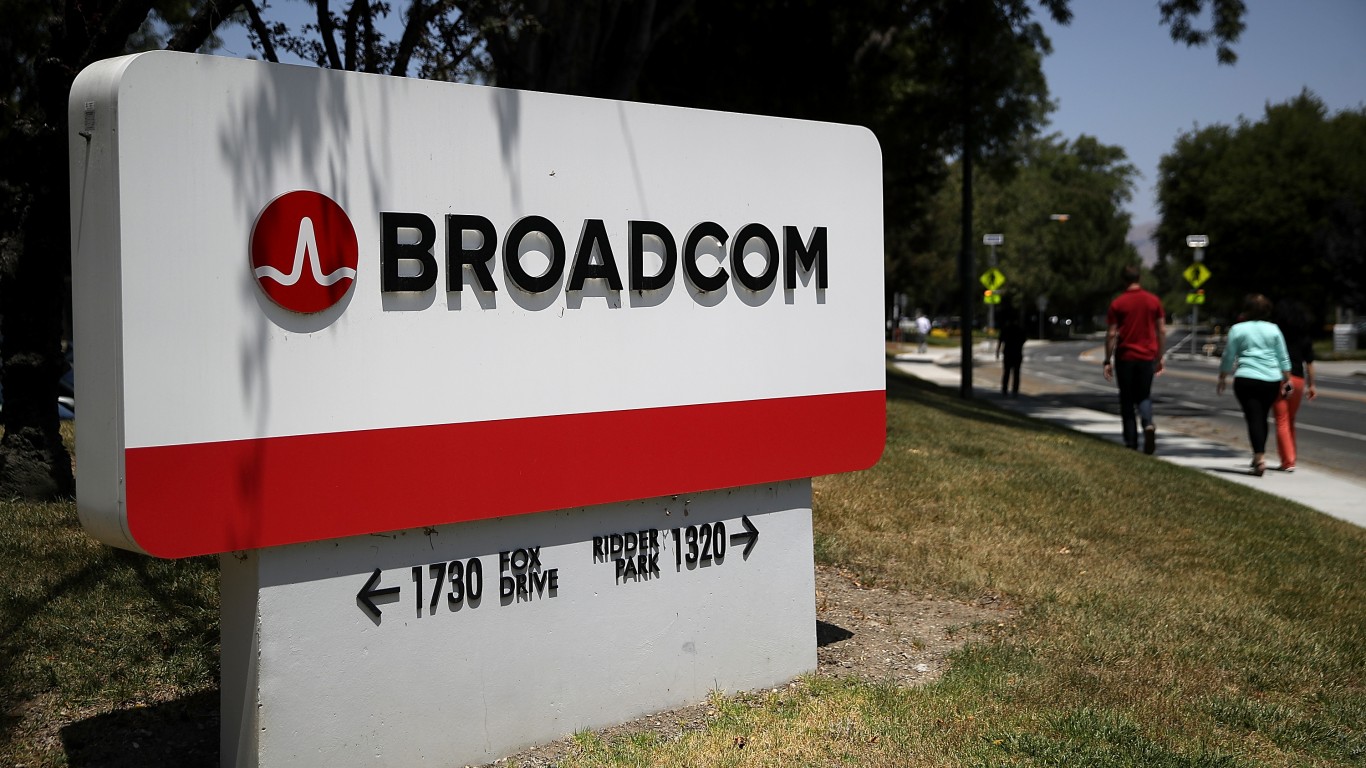
Wall Street’s Biggest Funds Are Dumping Broadcom and Adding Taiwan Semiconductor. Time to Follow the ‘Smart Money?’
Top hedge funds quietly rotated out of one chip giant and piled into another last quarter, and the price action since then suggests they knew something. Here is what Druckenmiller, Loeb, and Tepper actually did with their semiconductor books.

Second-quarter 13F filings, disclosed late last week for positions held as of June 30, tell a clear story inside the semiconductor trade: the biggest hedge funds rotated out of Broadcom (NASDAQ:AVGO | AVGO Price Prediction) and into Taiwan Semiconductor Manufacturing (NYSE:TSM). Let’s take a look at what funds bought and sold the two chip titans.
Loeb and Druckenmiller Both Sell Broadcom and Buy Taiwan Semi
On Taiwan Semiconductor, David Tepper’s Appaloosa added 322,500 shares to reach 1,650,000 shares worth $787,990,500, Dan Loeb’s Third Point added 185,000 shares to reach 460,000 shares worth $219,682,200, and Stanley Druckenmiller’s Duquesne Family Office added 94,400 shares to reach 589,680 shares worth $281,613,000. On Broadcom, the same books moved the opposite direction: Dan Loeb’s Third Point exited entirely, selling all 50,000 shares, and Stanley Druckenmiller’s Duquesne also exited entirely, selling all 195,955 shares.
Loeb’s rotation extended across the fabless and equipment ecosystem. Third Point exited Lam Research (75,000 shares), KLA (11,000), the VanEck SMH semiconductor ETF (40,000), and his entire NVIDIA position (190,000 shares), while adding ASML (+18,000).
Druckenmiller’s book is more selective: Duquesne exited Intel (411,400 shares), Micron (23,400) and Lattice (323,135), while adding STMicroelectronics (+490,000) and opening new positions in Lam Research (43,600), AMD (72,900), Entegris (118,300) and Rambus (173,000). The dissent: David Tepper’s Appaloosa opened a new Broadcom position of 150,000 shares valued at $56,662,500 in the same quarter, making Tepper the only manager who added both names. These are point-in-time snapshots, not real-time trading records, and value changes reflect price moves as much as share deltas.
Broadcom Remains Under Pressure
Recent price action has validated the smart-money read. Taiwan Semi is up 41% year-to-date and 78.82% over one year to $426.35, while Broadcom trades at $392.99, down 8.13% in the past week and up only 13.97% year-to-date. While semiconductor stocks have broadly rallied in recent weeks, Broadcom has sat out the rally.
Why is Broadcom out of favor? Supply chain ‘chatter’ hasn’t been in Broadcom’s favor. Researcher SemiAnalysis issued research late last week that led to Broadcom shares selling off nearly 6% on Friday. The broad read from markets was that Alphabet is moving from Broadcom and toward stronger partnerships with rivals AMD and MediaTek.
Yet, that read may be missing important nuance. First, while Google is diversifying suppliers with MediaTek and now reportedly custom chips from AMD, their spending plans for coming years appear to be massive. This is an expanding pie, and Broadcom will continue to command a large slice of it. Second, Broadcom recently signed a renewed 5-year partnership with Google. Third, research firms like SemiAnalysis lowering their TPU allocation to Broadcom could be due to a number of factors. For example, Broadcom is now scaling major projects across a number of customers that it needs to balance.
My Opinion: Both Stocks Are Worth Owning
And that’s the wrinkle for investors weighing whether to buy, sell, or hold Broadcom. The company’s operating results remain strong. Q2 FY2026 revenue hit $22.2 billion, up 48% year over year, with AI semiconductor revenue of $10.8 billion up 143%, and Q3 guidance calls for $29.4 billion in revenue and $16 billion in AI silicon. Hock Tan told analysts demand for XPUs and networking is “simply insatiable” and forecast FY2027 AI revenue “will exceed very easily $100 billion.” Funds sold anyway.
Taiwan Semi offers exposure to that same AI silicon buildout without customer concentration. TSMC delivered Q2 2026 revenue of $40.2 billion at the high end of guidance and lifted full-year 2026 growth to “slightly above 40% year over year in USD terms”. HPC is now 66% of the platform mix and 2026 CAPEX was raised to $60-64 billion. CEO Cici Wei stated “from this day on all the way to probably 2029, 2030, the demand is very strong”.
With the AI portfolio I managed as part of the AI Investor Podcast from 24/7 Wall St., I own both stocks. My position is simple: Broadcom appears underpriced based on excessive fears around losing TPU market share, and Taiwan Semi is a core holding across the AI era.
Contact [email protected] for any questions or corrections.
Eric Bleeker, CFA has been investing for more than 20 years. He began his career working at Microsoft before joining Motley Fool, one of the largest publishers of financial research. In his 15 years at Motley Fool Eric served as the General Manager for Fool.com and led coverage in the Technology & Telecom sector. In addition, he was a featured columnist and has hosted dozens of investing seminars attended by more than a million total investors. Eric has more than 1,000 financial bylines to his name and has been featured in The Wall Street Journal, CNBC, Fox Business, and many other leading publications. He is currently focused on artificial intelligence investing and is a CFA Charterholoder.