Bitcoin Jumps to $71,500 on Trump’s ‘Sizeable’ Buy Plan. Why MSTR Is Still the Wrong Bet
Trump just signaled the U.S. government could buy Bitcoin at a "sizeable" scale, sending prices past $71,500 and Strategy shares soaring nearly 10%. But a closer look at Strategy's latest moves raises a question every crypto investor should ask before…

This post may contain links from our sponsors and affiliates, and Flywheel Publishing may receive compensation for actions taken through them.
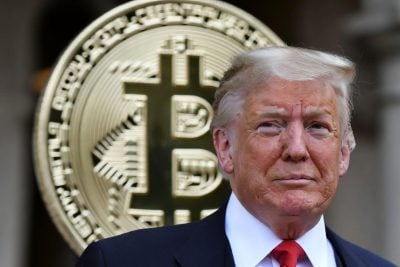
Bitcoin (CRYPTO:BTC) is back in the spotlight after Washington hinted that cryptocurrency could soon be more than just a private-sector investment. The price climbed above $71,500 following President Trump’s remarks that the U.S. government is reviewing plans to buy Bitcoin and other digital assets directly, at what he called a “sizeable” scale.
That would mark a real shift from the Strategic Bitcoin Reserve set up in March 2025, which was meant to be funded mainly through seized assets. Trump also pushed Congress to move forward on the CLARITY Act, a broader bill aimed at establishing market structure rules for digital assets.
For Bitcoin investors, the message is clearly bullish — but there’s a meaningful gap between a presidential signal and an actual government buying program.
Trump Raises the Stakes, But Details Are Missing
Trump didn’t say how much Bitcoin the government might buy, when purchases would start, or how they’d be paid for. So the White House event creates a powerful potential catalyst without yet generating any real demand. Still, a government willing to buy Bitcoin with taxpayer funds would represent a genuinely new source of institutional demand, on top of ETFs, corporations, and individual buyers. And if the CLARITY Act passes, it could ease regulatory uncertainty by giving digital assets clearer rules to operate under.
In short, Bitcoin’s investment case just got a policy tailwind. What it hasn’t gotten is an actual purchase order.
Strategy’s 10% Rally Looks Shakier Up Close
The more interesting reaction may be in Strategy (NASDAQ:MSTR | MSTR Price Prediction), whose shares jumped nearly 10% right alongside Bitcoin — even though the company’s own numbers tell a different story.
According to its latest filing, Strategy didn’t buy a single Bitcoin last week. Its holdings held steady at 840,447 BTC, while its cash reserve grew to $4.8 billion. That’s a sharp contrast with the week before, when the company actually sold 1,690 BTC for $108.6 million. Its remaining Bitcoin now carries a $63.36 billion cost basis — about $75,385 per coin — meaning the company is still sitting on a sizable paper loss at current prices.
Rather than buying more Bitcoin, Strategy raised cash by selling 3,458,866 of its own shares for $333.7 million. That money was split three ways:
- $149.1 million went to the company’s cash reserve
- $132.2 million was used to repurchase 1,388,720 shares of its Variable Rate Series A Perpetual Stretch Preferred Stock (NASDAQ:STRC)
- $52.4 million went toward preferred dividends
In other words, Strategy is increasingly leaning on its shareholders’ capital to shore up its preferred-stock structure and build liquidity — not to buy more Bitcoin. The company still has $653 million in unused preferred stock repurchase capacity, plus a separate $1 billion MSTR buyback authorization it hasn’t tapped.
Why Bitcoin Itself Looks Like the Cleaner Bet
That contrast makes the choice easier to see. Strategy’s $4.8 billion cash reserve is valuable for covering preferred dividends and debt obligations — but for an investor whose real goal is Bitcoin exposure, those very obligations are the problem. Strategy shareholders sit behind the company’s debt and preferred securities in line, and they face dilution whenever Strategy issues new shares to raise money.
There’s also a looming risk: MSCI (NYSE:MSCI) is weighing whether to exclude Strategy from certain global equity indexes. The consultation period runs through Sept. 30, with a decision expected by Oct. 16 and any changes taking effect in November’s index review.
A direct Bitcoin position sidesteps all of this corporate financial complexity. A spot Bitcoin ETF isn’t free of costs — it comes with fees and tracking considerations — but it still avoids the dilution, debt obligations, and index risk that come with owning Strategy.
Key Takeaway
Trump’s comments could turn into a major long-term catalyst if Washington eventually commits real money to Bitcoin. Until then, investors would do well to separate the policy signal from actual policy.
For straightforward cryptocurrency exposure, Bitcoin itself — or a low-cost spot Bitcoin ETF — remains the simpler choice. Strategy’s near-10% pop might look tempting, but its latest moves suggest the company is more focused on protecting its $4.8 billion liquidity cushion and preferred stock than on growing its Bitcoin stake.
The takeaway is simple: If what you want is Bitcoin, buying Bitcoin directly may be simpler than buying a company that owns Bitcoin while juggling everything else around it.
Contact [email protected] for any questions or corrections.
After two decades of patrolling the dark corners of suburbia as a police officer, Rich Duprey hung up his badge and gun to begin writing full time about stocks and investing. For the past 20 years, he’s been cruising the markets looking for companies to lock up as long-term holdings in a portfolio while writing extensively on the broad sectors of consumer goods, technology, and industrials. Because his experience isn’t from the typical financial analyst track, Rich is able to break down complex topics into understandable and useful action points for the average investor. His writings have appeared on The Motley Fool, InvestorPlace, Yahoo! Finance, Money Morning, and, of course, 24/7 Wall St. He has been featured in both U.S. and international publications, including MarketWatch, Financial Times, Forbes, Fast Company, and USA Today.