AMD Lost SpaceX to Nvidia. Is Its AI Challenge Already Falling Apart?
SpaceX just handed NVIDIA a high-profile win by locking in 20% of its next platform, leaving AMD without a flagship logo at the worst possible moment. The real question is whether this signals a crack in Lisa Su's ambitions or…

This post may contain links from our sponsors and affiliates, and Flywheel Publishing may receive compensation for actions taken through them.
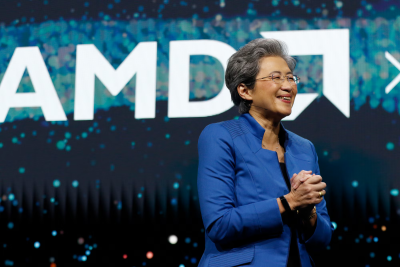
Elon Musk’s decision to build SpaceX’s (NASDAQ:SPCX | SPCX Price Prediction) AI infrastructure around NVIDIA’s (NASDAQ:NVDA) Vera Rubin platform, reportedly claiming 20% of NVIDIA’s next-platform capacity, is the kind of headline that makes AMD bulls nervous. It denies Advanced Micro Devices (NASDAQ:AMD) a flagship logo at exactly the moment Lisa Su is trying to convince Wall Street her Instinct roadmap can rival Jensen Huang’s.
The stock has felt it. Shares closed at $469.46 on Thursday, down 13.77% over the past month even after a blowout quarter.

The question is whether SpaceX is a symptom of something structural or a single lost deal in a market AMD believes will approach $2 trillion by 2030. The answer sits closer to the second interpretation than the first.
What the SpaceX Loss Actually Signals
Musk’s rationale centers on allocation guarantees. SpaceX wants guaranteed allocation on a platform NVIDIA controls, and NVIDIA chooses who gets capacity.
That gives NVIDIA a lever AMD cannot yet match: the ability to convert scarcity into exclusivity with the largest AI spenders on earth.
SpaceX also fits a very specific customer profile. It is a single-tenant buyer aligned philosophically with Musk’s xAI, and Grok training runs benefit from staying within a single hardware stack.
Losing that customer stings, but reading it as evidence that AMD is falling apart overlooks the fact that AMD actually won this cycle.
Counter-Evidence Is Loud
AMD reported Q2 revenue of $11.54 billion, up 50.1% year over year, with Data Center revenue of $6.72 billion, up 107%.

That segment now generates $2.1 billion in operating income, a swing from a loss a year ago tied to China export charges.
The customer list backing the forward story runs deep. AMD has committed deployments with OpenAI, Meta (NASDAQ:META), and Anthropic, whom Lisa Su called “strategic anchor customers,” plus a 2-gigawatt Anthropic deal on MI450 in Helios and Microsoft (NASDAQ:MSFT) Azure at scale.
Su told analysts, “We enter the second half with strong momentum as EPYC demand accelerates, Instinct deployments scale and Helios begins to ramp.”
Verdict: Contested, Not Collapsing
NVIDIA still commands preferential access to hyperscale capital and can still lock in customers like SpaceX through allocation politics rather than benchmarks. That advantage is real, and AMD’s forward P/E of 65 assumes it narrows.

But AMD’s challenge remains intact. Data Center is expected to more than double year over year in 2027, and management raised its long-term targets rather than trimming them. (We reverse-engineered what the biggest chip winners looked like early on and put the pattern in a free playbook, here.)
Reddit sentiment scored a neutral 48 this week, with the most upvoted thread titled “Looking for different perspectives, sell or reduce my position in AMD.” That caution is fair given the recent drawdown.
SpaceX is a loss worth acknowledging, although it is one customer inside a market where AMD has already secured multi-gigawatt commitments from the companies actually building frontier models. The AI challenge is being contested, which is a different thing entirely.
Contact [email protected] for any questions or corrections.
Omor Ibne Ehsan is a writer at 24/7 Wall St. He is a self-taught investor with a focus on growth, cyclical, and dividend equities that have strong fundamentals, value, and long-term potential. He also has an interest in high-risk, high-reward investments such as penny stocks.