Here’s Why I’m Buying More Broadcom as Spiking Treasury Yields Rock AI Stocks
Treasury yields just handed AI stocks a brutal week, and while most investors ran for the exits, one Broadcom buyer kept hitting the buy button. The reasoning behind that conviction goes deeper than a simple dip-buying reflex.

This post may contain links from our sponsors and affiliates, and Flywheel Publishing may receive compensation for actions taken through them.

I keep hitting the buy button on Broadcom (NASDAQ:AVGO | AVGO Price Prediction), and last week’s selloff handed me another reason to do it. When the 10-year Treasury yield ripped to 4.75% on July 31 and dragged AI names lower, AVGO fell 12.87% in a single week. I added again.
Here is what pulls me back. Broadcom designs the custom ASICs that hyperscalers like Alphabet (NASDAQ:GOOGL), Meta Platforms (NASDAQ:META), and OpenAI are locking into multi-year contracts to run their AI clusters. When borrowing costs climb, hyperscalers get pickier about capex, and pickier hyperscalers pick cheaper silicon over general-purpose GPUs. That is Broadcom’s edge, and rising Treasury yields sharpen it.
Data That Keeps Me Adding
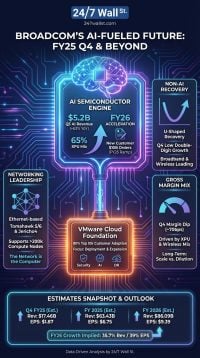
Start with the AI ramp. Q2 FY2026 AI semiconductor revenue reached $10.80 billion, up 143% year-over-year. Management guided Q3 AI revenue to $16.0 billion, over 200% year-over-year, and reiterated a fiscal 2027 target of “in excess of $100 billion”. Q2 AI bookings alone were over $30 billion against $10.8 billion shipped, with Hock Tan saying visibility now extends to 2028. That pipeline sits on signed contracts, including a 3 gigawatt Meta MTIA commitment through 2028 and a 10 gigawatt OpenAI deployment by 2029.
Second, the profitability is already here. Q2 operating income hit $10.788 billion, up 85.07% year-over-year. Free cash flow was $10.262 billion, or 46% of revenue. Adjusted EBITDA margin landed at 69% of revenue. Cash on the balance sheet more than doubled year-over-year to $19.628 billion. Fiscal 2025 threw off $26.914 billion in free cash flow.
Third, capital returns. Broadcom has raised its dividend for 15 consecutive years since fiscal 2011. The current quarterly payout is $0.65, and the company paid $3.1 billion in Q2 dividends. Management also authorized a $10 billion buyback through December 31, 2026, with $7.8 billion used in Q1 and another $600 million in Q2.
Why AVGO, Not Nvidia
NVIDIA (NASDAQ:NVDA) is the reflex pick, and I own some. My money keeps landing here because Broadcom trades at a forward P/E of 20x, a rare multiple for a business guiding AI revenue growth over 200% next quarter. Broadcom pairs that with a 15-year dividend increase streak that Nvidia’s token payout cannot match, plus the analyst target sits at $527.88. As for the Treasury bonds many retirees are reaching for, 4.65% is fair income, and it caps at 4.65%. Broadcom is compounding free cash flow at 60.07% year-over-year.
Risk I’m Watching
Customer concentration. A handful of hyperscalers drive the AI ramp. If Google, Meta, or OpenAI slow orders or shift to fully internal designs, the guidance breaks. Broadcom also carries $91.467 billion in total liabilities from the VMware deal, and higher rates make servicing that debt costlier. What blunts the risk for me is booking visibility through 2028, the gigawatt-scale contractual commitments already logged, and the fact that shareholders’ equity climbed to $87.691 billion while total liabilities actually declined 3.76% year-over-year.
Forward Conviction I Keep Acting On
Rate fear is compressing growth multiples, and AVGO now sits at $364.03, well below its 52-week high of $494.18. Full-year FY2026 AI revenue is guided to $56 billion, with the path to over $100 billion in FY2027 already backed by customer commitments. When the market marks down a business generating $26.914 billion in annual free cash flow with a 15-year dividend growth streak because the 10-year moved 5 basis points, I do not sit on my hands. I buy more.
Contact [email protected] for any questions or corrections.
Alex Sirois is a financial writer with experience spanning both retail and institutional investing. He has written for InvestorPlace and held roles at BNY Mellon and Bernstein, giving him a perspective that bridges Main Street portfolios and Wall Street analysis.
Alex holds an MBA from George Washington University and has built his career across multiple industries, including e-commerce, education, and translation — a breadth of experience that informs how he breaks down complex financial topics for everyday investors. His writing is conversational, actionable, and grounded in long-term, buy-and-hold investing principles.
At 247 Wall St., Alex focuses on delivering analysis that is both accessible and useful, with a clear emphasis on helping readers make more informed decisions with their money.