Cramer Warns iPhone Prices Will Rise Without Chinese Memory — Here’s Why Apple Can’t Wait for U.S. Production
Jim Cramer says Tim Cook told him directly that iPhone prices are heading up, and the only fix runs straight through a supplier U.S. trade policy is working hard to cut off.


Jim Cramer used his Stop Trading segment on CNBC on August 24, 2026, to argue that Apple (NASDAQ:AAPL | AAPL Price Prediction) is quietly pushing to source memory from Chinese suppliers because domestic production simply cannot meet current demand. He said, “Apple very vehemently says we got to get a hold of chinese memory because there’s just not enough made in america,” and tied the point to his own reporting trip, saying, “The dram supply and memory storage supply is very constrained. That’s one of the reasons why I went out to Micron. (NASDAQ:MU)”
The consumer stakes were the loudest part of the segment. Cramer said, plainly, “Your price of your cell phone is going up unless we do this.” He also indicated that Tim Cook has told him in private conversations that Apple would prefer to lower iPhone prices if it could secure Chinese memory supply, a point Cramer attributed directly to Cook.
What Cramer Said and How Memory Names Reacted
Cramer framed the memory market as the tightest link in the AI supply chain, and he extended the concern beyond phones, saying, “We’re seeing weakness across the sort of so-called data center ecosystem. In fact, Nvidia (NASDAQ:NVDA) is down five.”
Trading in the memory complex reflected that concern. SanDisk (NASDAQ:SNDK) fell 6.45% on August 24, and Micron Technology (NASDAQ:MU) fell 5.83% the same session.
Western Digital (NASDAQ:WDC), now a pure-play hard drive company after the SanDisk spin, dropped 5.24% on the day, and Nvidia closed lower by 2.91%.
Apple, the alleged buyer, was essentially unchanged, closing up 0.32%. The pain sat with the suppliers.
Cramer’s Named Conflict Is Real
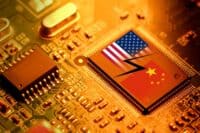
There is a genuine conflict inside this story, and it deserves to be stated directly rather than admired as a paradox. Cheaper iPhones for American consumers and a stronger domestic memory industry are, on this specific question, in direct opposition, because the only near-term source of enough bits is the one U.S. policy is trying to reduce dependence on.
Cramer is right that domestic capacity cannot be conjured on a product cycle. Micron itself said on its June call that “DRAM and NAND industry demand continues to significantly exceed industry supply” and warned that “greenfield projects are large, complex, and time-consuming.”
The segment also noted that domestic memory lines are already running six days a week to meet first-quarter 2027 targets. That is a supply picture the U.S. cannot solve by asking politely.
Apple has told investors this pressure is real, listing reliance on third parties for components and geopolitical tensions among its principal risks in its most recent 10-Q.
Why the Selling Looks Like a Sentiment Reaction
A single large customer exploring alternative sourcing still leaves the underlying demand curve intact. Micron just reported $41.5 billion in fiscal Q3 revenue, up 346% year over year, and guided fiscal Q4 revenue to roughly $50 billion.
SanDisk closed fiscal 2026 with revenue up 371.59% and datacenter revenue up 437% for the full fiscal year, with CEO David Goeckeler describing datacenter as “a key growth pillar”. A shortage this deep is a supportive backdrop for suppliers even if one buyer diversifies.
The consumer part of Cramer’s argument also deserves a check. Memory is one input in the bill of materials for a phone, and iPhone pricing reflects tariffs, currency, mix, subsidies, and Apple’s own margin choices well beyond memory contracts alone.
Reddit discussion this past week has been circling the same anxiety, with the top post on SanDisk asking whether “rapidly increasing volatility among memory stocks” is a sign of a bubble breaking. The story Cramer told is credible, but the selling in the memory complex looks more like a headline reaction than a durable change in the demand curve, unless AI capex itself begins to roll over.
Memory is one slice of the AI buildout, and the same tightness Cramer described shows up in power, cooling, and networking too. We rounded up seven suppliers outside the chipmakers benefiting from that spend in a free report on the AI infrastructure names most investors overlook.
Contact [email protected] for any questions or corrections.
Omor Ibne Ehsan is a writer at 24/7 Wall St. He is a self-taught investor with a focus on growth, cyclical, and dividend equities that have strong fundamentals, value, and long-term potential. He also has an interest in high-risk, high-reward investments such as penny stocks.