Boeing Has No Rival on a New $131 Billion F-15 Contract. Should Investors Chase BA Stock?
The Pentagon just handed Boeing a sole-source F-15 contract with a staggering ceiling figure, but the amount actually obligated tells a very different story about what investors are really buying.

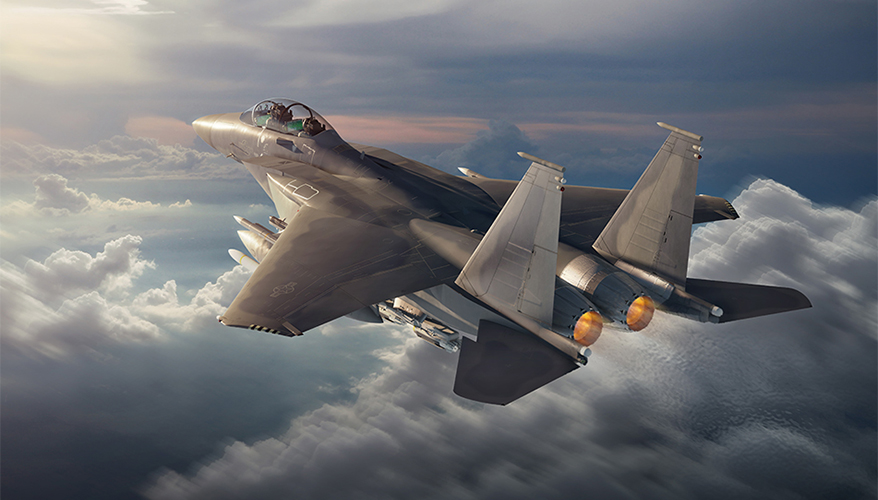
The number that matters for Boeing (NYSE:BA | BA Price Prediction) after its new F-15 award is $343,740. And yes, that’s not even half a million. That is the amount actually obligated when the Pentagon announced the sole-source Eagle Crest contract in the official notice on August 24, 2026. Everything above that figure is merely potential.
The $131.23 billion figure cited across financial media is a ceiling for an indefinite-delivery, indefinite-quantity contract. The vehicle can cover aircraft production, modernization, retrofits, sustainment, and depot capabilities for the Air Force, Air National Guard, and overseas customers such as Israel, Japan, Saudi Arabia, and South Korea. Its ordering window stretches into 2036, with work expected to continue through August 2037.
Boeing does not receive that money by signing. Task orders are placed and funded one at a time, and each one must be negotiated, delivered, and paid for.
Someone could reasonably assume the company just booked a decade of guaranteed revenue. Buying BA stock off of that would be a misreading. What Boeing received is an exclusive lane, and whether that lane fills with profitable orders depends on Air Force budgets, foreign military sales approvals, and, above all, Boeing’s own execution, which has been the segment’s persistent weakness.
That said, it’s still worth looking deeper into Boeing to see if it’s worth buying regardless.
What a $131 Billion Ceiling Actually Means
An IDIQ contract is a purchasing framework. The government authorizes itself to place task orders with a selected contractor up to a maximum aggregate value of $131.23 billion over a defined period.
Only the tiny initial obligation is contract dollars in hand. The $343,740 figure is the funded floor of a framework whose ceiling depends on future appropriations, future foreign military sales approvals, and future decisions within the Pentagon that have not yet been made.
For context on realistic scale, the FY 2027 request procures 24 F-15EX aircraft and funds the conversion of legacy F-15C/D and A-10 units to the F-15EX airframe. That is a real, funded program, and its annual dollars sit far below the headline ceiling.
The sole-source language is where the value quietly lives. Boeing owns the airframe, so no competitor can bid on this vehicle, which guarantees who receives whatever orders arrive. Sole-source status simply routes demand toward Boeing.
Market Signals Skepticism On the Award
Boeing shares closed at $212.09 on August 26, 2026, up 0.48% on the day. Over the past week, the stock is down 4.55%, and over the past year it is down 9.68%.
The award was announced on August 24 with after-hours strength. Two sessions later, the stock had given back more than it had added over the prior week, which suggests the market does not view the ceiling as a step-change in earnings power.
Valuation explains the caution. Boeing trades at a trailing PE of 76 on TTM diluted EPS of 2.78, with a book value of $7.72 per share and no dividend paid since early 2020.
Analysts still carry an average target of $274.04 with a ratings mix of 4 strong buy, 17 buy, 6 hold, and 1 strong sell. That optimism was priced in before the F-15 headline, which is why the ceiling announcement has moved the stock so little.


Bear Case: Execution Is the Real Constraint
Boeing’s Defense, Space & Security segment produced revenue of $7.483 billion in the second quarter of 2026, up 13% year over year. It swung to an operating loss of $15 million from a profit of $110 million a year earlier, driven by a $280 million charge on the VC-25B presidential aircraft program.
That is the pattern to worry about, because revenue growth at BDS keeps arriving alongside charges on fixed-price development programs. Management has guided the segment to a full-year 2026 operating margin of about 2.5%, including the VC-25B charge, with a stated goal of high single-digit operating margins by the end of the decade.
The F-15 line itself is a mature program with an existing global customer base, so it is less likely to produce fresh development surprises. It also cannot repair the segment’s structural profitability on its own, because most of the ceiling value depends on task orders that have not yet been priced or scoped.
Consolidated results reinforce the concern. Q2 2026 revenue of $24.56 billion, up 7.96%, produced a core loss per share of -0.76 against a consensus of -0.34, missing expectations by a wide margin.
Free cash flow was positive at $631 million, and net income remained negative at -$428 million. Interest and debt expense continues to run near $600 million per quarter, with debt ending the quarter at $45.9 billion against cash and marketable securities of $20 billion.

A ceiling contract contributes nothing to servicing that debt until task orders are issued and executed profitably. Given a defense segment that just booked another fixed-price charge, treating $131.23 billion as revenue is the exact analytical error the announcement invites.
Bottom Line
The clean reading of the F-15 award is that it removes competition from a race Boeing already led. That is worth something for a company whose commercial recovery is real, but whose defense segment keeps giving back margin through charges on programs it committed to years ago.
Investors chasing the stock at the ceiling figure are trusting Boeing to convert a decade of potential orders into on-time, profitable deliveries, even as the same segment is guided to a 2.5% operating margin for 2026. The near-term evidence does not yet support that trust.
A more careful posture is to wait for BDS margins to move toward management’s stated glide path before treating the F-15 ceiling as meaningful future earnings. That means watching whether the VC-25B stays within its current loss estimate through first delivery in 2028, whether the KC-46 stays quiet, and whether early F-15 task orders include pricing that reflects Boeing’s uncontested position.
For long-term holders, caution here means distinguishing between an award that guarantees Boeing exclusive access to future orders and a company that has yet to prove it can convert that access into profitable deliveries. On the headline alone, the stock is a bear.
Contact [email protected] for any questions or corrections.
Omor Ibne Ehsan is a writer at 24/7 Wall St. He is a self-taught investor with a focus on growth and cyclical stocks that have strong fundamentals, value, and long-term potential. He also has an interest in high-risk, high-reward investments such as cryptocurrencies and penny stocks.