Is the AI Buildout Becoming Too Dependent on the Bank of Nvidia?
Nvidia's record-breaking chip sales are only half the story. The company has quietly taken on a financing role so vast that a single OpenAI data center deal carries more exposure than most banks would stomach, and investors are only beginning…

This post may contain links from our sponsors and affiliates, and Flywheel Publishing may receive compensation for actions taken through them.

The AI infrastructure boom has entered a new phase. What began as a pure hardware arms race among tech giants has evolved into a capital-intensive buildout measured in hundreds of billions of dollars. Power, land, chips, and financing now form a tightly linked chain. At the center sits Nvidia (NASDAQ:NVDA | NVDA Price Prediction), the company that supplies the essential GPUs while increasingly helping customers afford them.
That dual role has sparked a pointed question: Is the AI buildout becoming too dependent on the Bank of Nvidia?
How Nvidia Expanded Beyond Selling Chips
Nvidia still generates the bulk of its revenue from selling accelerated computing systems. In the just-reported fiscal 2027 second quarter, data center revenue hit $89 billion, up 117% from a year earlier. Total revenue reached a record $96.2 billion.
Yet the company is no longer just a supplier. It has extended payment terms on large multi-quarter deals with investment-grade customers, pushing days sales outstanding from 45 to 60 days and accounts receivable to $63.1 billion. Nvidia has:
- Committed roughly $99 billion in equity investments across AI labs and infrastructure players.
- Provided residual-value and revenue guarantees totaling as much as $108.5 billion, including a $105 billion exposure tied to an OpenAI data-center project.
- Partnered with Apollo Global Management (NYSE:APO), BlackRock (NYSE:BLK), Blackstone (NYSE:BX), Brookfield (NYSE:BAM), Goldman Sachs (NYSE:GS), and KKR (NYSE:KKR) on platforms designed to mobilize more than $500 billion in third-party capital.
CFO Colette Kress noted that AI labs relying on Nvidia’s balance sheet could represent about a quarter of the business next year. In short, Nvidia is acting as technology provider, collateral standard-setter, and selective credit supporter at once.
This support broadens access beyond the largest hyperscalers. Smaller AI clouds and model makers can secure capacity they might otherwise struggle to finance. The company receives payment on the hardware sale and, in some structures, a share of downstream rental revenue.
The Cash Flow Noodle Point
The financing activity carries visible short-term costs. Operating cash flow fell to $24.1 billion in the second quarter from $50.3 billion in the first, a 52% sequential decline, while free cash flow dropped to $21.3 billion from $48.6 billion. The main driver was the $22 billion rise in receivables tied to those extended terms.
Granted, absolute free cash flow remained substantial, and Nvidia returned a record $26 billion to shareholders in the quarter. Liquidity stayed solid at $56.6 billion in cash and marketable debt securities. Still, the gap between reported profits and cash conversion is a metric investors should track in coming quarters. If days sales outstanding continues climbing or receivables outpace revenue growth, it would signal heavier reliance on vendor-style financing.
Credit risk exists but is tempered. Management emphasizes that the customers receiving longer terms are investment-grade. Concentration is real — five direct customers accounted for a large share of the receivables balance — but the counterparties are not speculative startups. Contingent exposures are capped and often residual, meaning Nvidia steps in only after other recovery efforts have been exhausted.
Compared with pure chip peers such as Advanced Micro Devices (NASDAQ:AMD), Nvidia’s approach is more aggressive on the balance-sheet side. AMD has focused more narrowly on product competition without the same scale of ecosystem financing.
Nvidia’s Position and Investor Implications
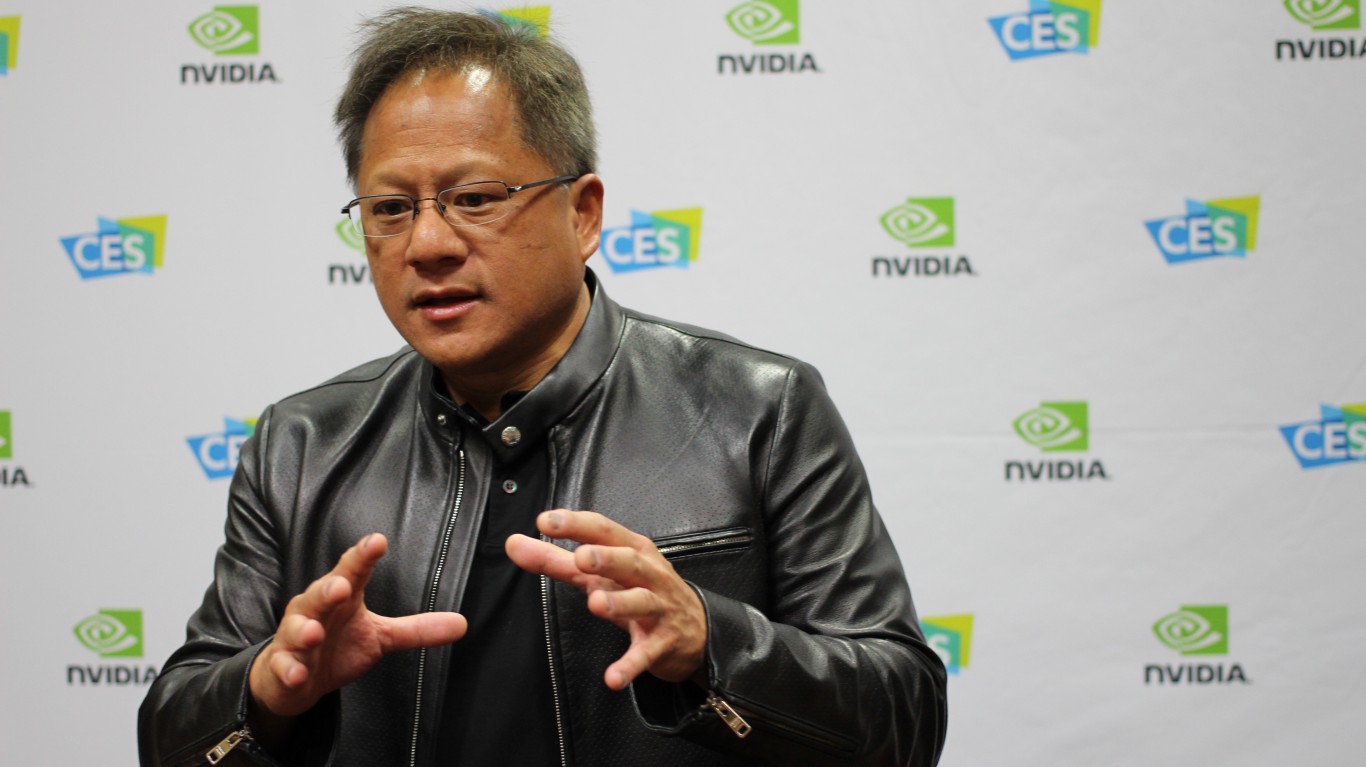
Nvidia pushes back against circular-financing concerns. Kress has stressed that the company is not making traditional loans and that third-party capital is being brought in deliberately. CEO Jensen Huang has framed the activity as necessary to keep the infrastructure buildout moving at the pace of demand. Preliminary expectations call for roughly 70% revenue growth in fiscal 2028.
The demand backdrop remains strong. Supply is still the binding constraint through at least the end of fiscal 2028. Hyperscaler capital spending continues to climb, and non-hyperscale customers now represent a growing share of Nvidia’s business.
For investors, the core thesis holds: Nvidia remains the indispensable platform for AI training and inference. Its high gross margins — 75% in the latest quarter — and enormous absolute cash generation give it capacity to support the ecosystem without jeopardizing its own financial strength. The financing role accelerates adoption rather than inventing demand out of thin air.
That said, the dependency is real and growing. Smart investors will watch three indicators closely:
- Trajectory of days sales outstanding and cash conversion,
- Size of new contingent commitments,
- Evidence that AI workloads are generating durable returns for end customers.
Key Takeaway
The AI buildout does depend more on Nvidia’s balance sheet than it did two years ago. That dependence introduces new risks around credit concentration and cash-flow timing. Yet the numbers still favor the company. Record revenue, robust free cash flow even after the sequential dip, and unmatched platform dominance outweigh the near-term friction.
Investors who own Nvidia for its central role in AI should hold onto the stock, while monitoring the receivables trend and commitment levels as leading indicators of whether the Bank of Nvidia is enabling sustainable growth or stretching too far.
Contact [email protected] for any questions or corrections.
After two decades of patrolling the dark corners of suburbia as a police officer, Rich Duprey hung up his badge and gun to begin writing full time about stocks and investing. For the past 20 years, he’s been cruising the markets looking for companies to lock up as long-term holdings in a portfolio while writing extensively on the broad sectors of consumer goods, technology, and industrials. Because his experience isn’t from the typical financial analyst track, Rich is able to break down complex topics into understandable and useful action points for the average investor. His writings have appeared on The Motley Fool, InvestorPlace, Yahoo! Finance, Money Morning, and, of course, 24/7 Wall St. He has been featured in both U.S. and international publications, including MarketWatch, Financial Times, Forbes, Fast Company, and USA Today.