2 Dividend Kings, 2 Crises: Why Coca-Cola and Exxon Face Divergent Payout Pressures
Coca-Cola and Exxon both carry decades-long dividend streaks and nearly identical yields, but the pressure threatening each payout originates in completely different parts of the business, and only one company can fix its problem with a single phone call.

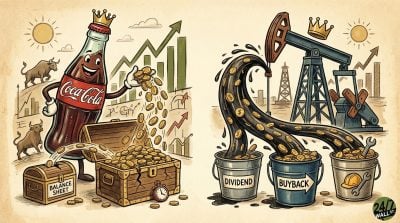
Coca-Cola (NYSE:KO | KO Price Prediction) and Exxon Mobil (NYSE:XOM) both just reported quarterly results. Coke posted a 6% organic revenue quarter and raised guidance. Exxon delivered $14.5 billion in earnings and $23.6 billion in operating cash flow despite Middle East disruptions. Both are long-streak dividend payers, but the strain on each payout shows up in very different places.
Dividend Kings With Very Different Cash Profiles
Coke has raised its dividend for 63 straight years, with the quarterly payout climbing from $0.39 in 2018 to $0.53 in 2026. Exxon has achieved 43 consecutive years of annual dividend growth, with the quarterly rate held at $1.03 for four straight declarations since November 2025. That flat stretch aligns with its normal autumn raise cadence.
Both stocks have rallied this year, so the yields reflect strength rather than distress. Coke is up 28.3% year to date, and Exxon is up 30.2% year to date. That inverts the usual dividend-risk setup, where a fat yield signals trouble.
Coke’s Constraint Lives in the Cash Flow Statement
In FY2025, Coca-Cola reported $7.408 billion in operating cash flow, against $8.779 billion in dividends paid. In FY2024, operating cash flow of $6.805 billion also sat below the $8.359 billion dividend. Operating cash flow ran materially higher from 2021 to 2023, peaking at $12.625 billion in 2021, before dropping while the payout kept climbing. The 2024 and 2025 declines tie to an ongoing IRS transfer-pricing dispute where Coke has already deposited disputed amounts and bottler-refranchising working-capital swings, not brand erosion. Q2 2026 operating cash flow rebounded to $5.522 billion, and management guided full-year 2026 free cash flow to roughly $12.4 billion.

Exxon’s Constraint Lives in the Priority Queue
The dividend alone is easily covered. In FY2025, Exxon generated $51.97 billion in operating cash flow and paid $17.231 billion in dividends. Crowding starts once you stack the rest. Capex ran $28.358 billion, and buybacks totaled $20.273 billion. Adding those to the dividend exceeds total operating cash flow. In Q1 2026, operating cash flow of $8.705 billion trailed the combined $6.470 billion capex plus $4.334 billion dividend, before the June quarter recovered to $23.555 billion in operations.

| Metric | KO | XOM |
| Dividend yield | 2.4% | 2.6% |
| FY2025 OCF vs. dividend | $7.4B vs. $8.8B | $52.0B vs. $17.2B |
| Buyback pace | $746M in 2025 | $20.3B in 2025 |
What to Watch For
For Coke, will full-year 2026 operating cash flow close the gap with the dividend? If reported operating cash flow lands near the guided $14.6 billion, coverage returns cleanly. For Exxon, the swing factor is Guyana’s fifth FPSO startup by year-end and Permian volumes above 1.8 million barrels per day.
Why Coke’s Payout Is the More Constrained One
Between the two, Coke’s dividend is the more structurally stretched. Exxon’s crowding is a choice: management can dial the $20 billion 2026 buyback down without touching the dividend. Coke has less optionality because the shortfall shows up in operations themselves. Watch whether Coke’s trailing four-quarter operating cash flow reclaims the roughly $12 billion level it held from 2021 to 2023. If it does not, the payout stays funded by the balance sheet rather than the business.


Contact [email protected] for any questions or corrections.
Trey has been an editor and author at 24/7 Wall St. for more than a decade, where he has published thousands of articles analyzing corporate earnings, dividend stocks, short interest, insider buying, private equity, and market trends. His comprehensive coverage spans the full spectrum of financial markets, from blue-chip stalwarts to emerging growth companies.
Beyond 24/7 Wall St., Trey has created and edited financial content for Benzinga and AOL's BloggingStocks, contributing additional hundreds of articles to the investment community.
Trey's editorial expertise extends across multiple publishing environments. He served as production editor at Dearborn Financial Publishing and development editor at Kaplan, where he helped shape financial education materials. Earlier in his career, he worked as a writer-producer at SVE. His freelance editing portfolio includes work for prestigious clients such as Sage Publications, Rand McNally, the Institute for Supply Management, the American Library Association, Eggplant Literary Productions, and Spiegel.
Outside of financial journalism, Trey writes fiction and has been an active member of the writing community for years, moderating workshop sessions at regional conventions.