Chevron or PepsiCo: Whose Dividend Is Standing on Thinner Ice?
Chevron and PepsiCo both raised their dividends this year, but the forces threatening each payout could not be more different. One faces a commodity cycle, the other a slower and harder problem to fix.

This post may contain links from our sponsors and affiliates, and Flywheel Publishing may receive compensation for actions taken through them.
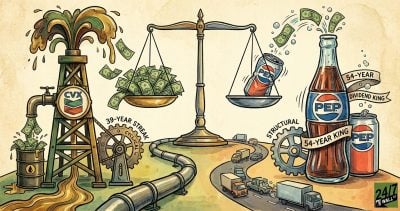
Chevron (NYSE:CVX | CVX Price Prediction) and PepsiCo (NASDAQ:PEP) both reported Q2 2026 results and raised dividends this year. Chevron carries a 39-year streak. PepsiCo, at 54 consecutive annual increases, is classified as a Dividend King. The pressures on each payout differ sharply for income-focused owners.
Gushing Cash at Chevron, Grinding Margins at PepsiCo
Chevron’s Q2 2026, reported July 31, 2026, delivered adjusted EPS of $6.06, revenue of $67.2 billion, and quarterly operating cash flow of $22.63 billion. Free cash flow reached $15.4 billion. CEO Mike Wirth noted the Hess assets are generating cash that has been “roughly double the incremental dividends and accretive to shareholders on a per share basis.” Debt fell by more than $8 billion in the quarter, showing the cycle working as intended.

PepsiCo’s Q2 2026, reported July 9, 2026, showed core EPS of $2.20 on revenue of $24.18 billion, with core operating margin contracting 40 basis points. CEO Ramon Laguarta described the North American consumer environment as “worse than what we had anticipated and driven mainly by gas prices.” CFO Steve Schmitt said full-year EPS “may be towards the low end” of guidance. International is outperforming while Frito-Lay volumes soften.

Cyclical Cushion Versus Structural Squeeze
| Dividend Durability Lens | Chevron (FY2025) | PepsiCo (FY2025) |
| Operating cash flow | $33.9B | $12.1B |
| Capital expenditures | $17.3B | $4.4B |
| Dividends paid | $12.8B | $7.6B |
| Net income | $12.3B | $8.2B |
| Yield | 3.5% | 4.1% |
Chevron’s fiscal 2025 dividend outlay exceeded reported net income; buybacks added another $12.1 billion in shareholder returns. That coverage gap reflects the cycle. Q2 2026 confirmed recovery, with net debt to CFFO at 0.6 times and debt/equity at 0.2.
PepsiCo’s problem is structural. The gap between operating cash flow and capex plus dividends is thin, net income has flattened, and shares are down 5.4% over one year and 9.8% lower over five years. Debt/equity is 2.4. The 4% yield partly rewards patience and partly signals a repricing for lower growth. (For investors who want streaks measured in half-centuries rather than years, we ranked 10 Dividend Kings by valuation in a free report here).
Triggers That Would Change the Verdict
For Chevron, watch Brent. The EIA’s May 2026 outlook pegged Brent averaging $79.39 in 2026. A sustained slide below $60 paired with continued buybacks would compress cushion fast. For PepsiCo, watch whether North American Foods volumes turn and operating cash flow reclaims its 2023 level of $13.44 billion.
Why PepsiCo’s Payout Looks Tighter Today
Chevron’s dividend looks safer than FY2025 headlines suggest. Q2 2026 free cash flow of $15.4 billion and rapid deleveraging restore clear headroom. The risk here is variance in cash flow through the cycle. PepsiCo’s payout is structurally tighter: coverage is intact, but the cushion is narrow, earnings have flattened, and the yield climbs as the share price stalls. The view on PepsiCo would change if two consecutive years show operating cash flow comfortably above capex plus dividends with Frito-Lay volumes reaccelerating. The view on Chevron changes if Brent parks below $60 while buybacks continue. Both dividends remain funded. The nature of the stresses each company faces, however, is distinct.


Contact [email protected] for any questions or corrections.
Trey has been an editor and author at 24/7 Wall St. for more than a decade, where he has published thousands of articles analyzing corporate earnings, dividend stocks, short interest, insider buying, private equity, and market trends. His comprehensive coverage spans the full spectrum of financial markets, from blue-chip stalwarts to emerging growth companies.
Beyond 24/7 Wall St., Trey has created and edited financial content for Benzinga and AOL's BloggingStocks, contributing additional hundreds of articles to the investment community.
Trey's editorial expertise extends across multiple publishing environments. He served as production editor at Dearborn Financial Publishing and development editor at Kaplan, where he helped shape financial education materials. Earlier in his career, he worked as a writer-producer at SVE. His freelance editing portfolio includes work for prestigious clients such as Sage Publications, Rand McNally, the Institute for Supply Management, the American Library Association, Eggplant Literary Productions, and Spiegel.
Outside of financial journalism, Trey writes fiction and has been an active member of the writing community for years, moderating workshop sessions at regional conventions.