Caterpillar or Exxon: Which Dividend Has More Room to Grow?
Caterpillar just hit $20 billion in quarterly sales for the first time ever, while Exxon pumped out $23.6 billion in operating cash flow. Both companies raised their dividends, but their very different balance sheets tell a story about which payout…


Caterpillar (NYSE:CAT | CAT Price Prediction) and Exxon Mobil (NYSE:XOM) both delivered fresh dividend signals. Caterpillar posted its first $20 billion sales quarter in company history and lifted its payout. Exxon delivered $14.5 billion in earnings and $23.6 billion in operating cash flow in Q2. Yet only one has meaningful headroom to keep pushing payouts higher.
Machines Meet Molecules: How the Quarters Landed
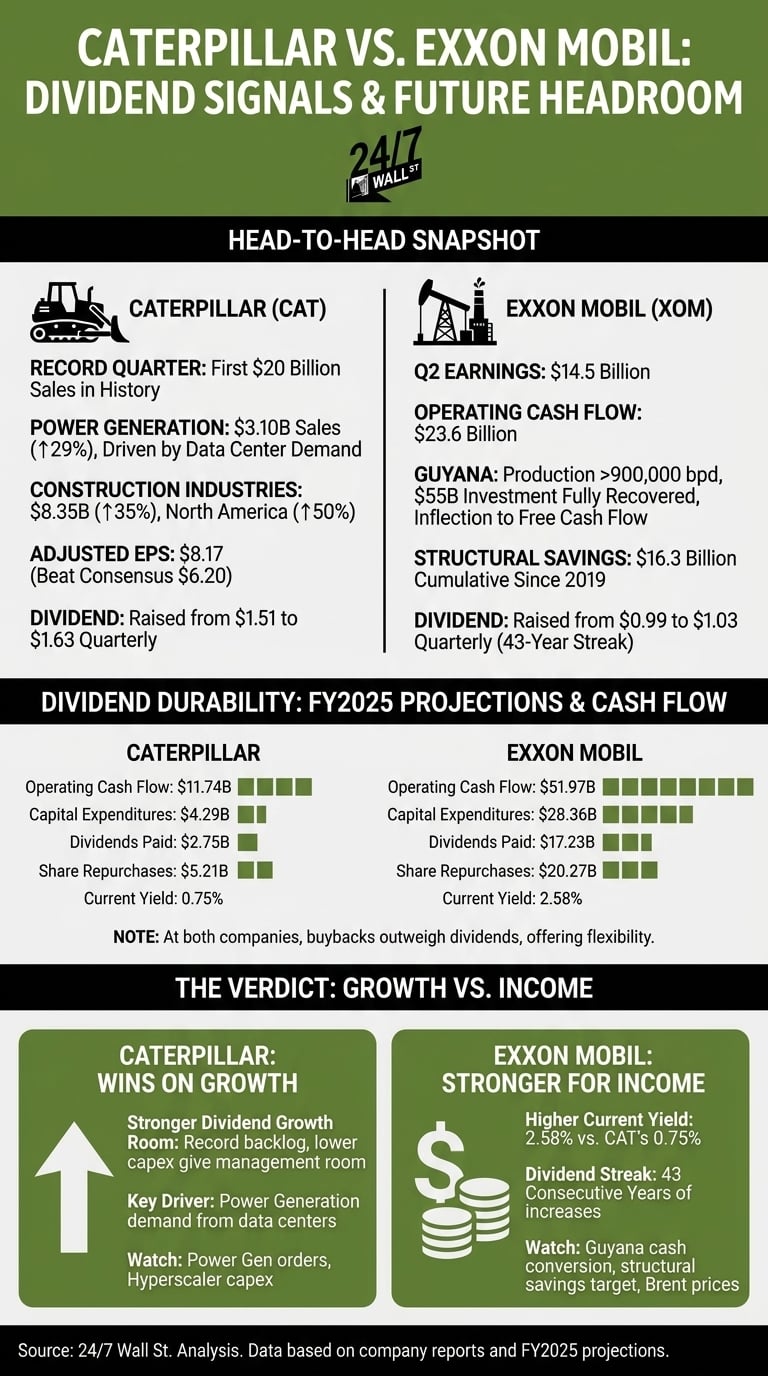
Caterpillar is riding specific tailwinds. Power Generation sales jumped 29% to $3.10 billion on data center demand. Construction Industries came in at $8.35 billion, up 35%, with North America up 50%. CEO Joe Creed cited “strong order rates and a growing backlog” across segments. Adjusted EPS of $8.17 beat the $6.20 consensus.

Exxon leaned on advantaged assets. Upstream production ran at 4.6 million oil-equivalent barrels per day, with Guyana above 900,000 gross barrels/day. CFO Neil Hansen said Guyana has “fully recovered the $55 billion of investment along with all the operating costs,” calling it “an inflection into free cash flow.” Cumulative structural cost savings reached $16.3 billion since 2019.

Dividend Durability, Side by Side (FY2025)
| Metric (FY2025) | Caterpillar | Exxon Mobil |
|---|---|---|
| Operating cash flow | $11.74B | $51.97B |
| Capital expenditures | $4.29B | $28.36B |
| Dividends paid | $2.75B | $17.23B |
| Share repurchases | $5.21B | $20.27B |
| Net income | $8.88B | $28.84B |
| Current yield | 0.75% | 2.58% |
At both companies, buybacks outweigh dividends. Repurchases can be reduced if conditions deteriorate; a dividend cut, by contrast, punishes the stock for years.
Two Cyclicals, Two Very Different Cycles
Caterpillar’s payout rides equipment demand from data centers, mining, and infrastructure. Exxon’s rides Brent and refining spreads. The EIA projects Brent between $53 and $87 per barrel across its baseline range, capping Exxon’s operating cash flow growth without volume gains. Exxon spent $28.36 billion on capex last year versus Caterpillar’s $4.29 billion. That gap matters when assessing what is left for raises.
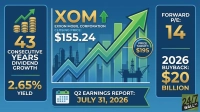
Caterpillar just proved it. The quarterly dividend moved from $1.51 to $1.63. Exxon’s most recent bump took the quarterly from $0.99 to $1.03, extending a streak of 43 consecutive years.
What Would Change the Verdict
For Caterpillar, watch Power Generation orders. If hyperscaler capex cools, that 29% growth compresses fast. (We profiled seven suppliers riding the same data-center buildout, from power to cooling, in a free report here.) For Exxon, watch Guyana cash conversion and whether structural savings reach the $20 billion target by 2030. Brent sliding toward the low end would slow raises even with Guyana humming.
Takeaway
Caterpillar wins on growth. The increase from $1.51 to $1.63, lower capex, and record backlog give management real room. The 0.75% yield is thin, but growth is doing the heavy lifting. Exxon’s 2.58% yield and four-decade streak make it the stronger choice for income investors. For dividend growth specifically, Caterpillar has more room.


Contact [email protected] for any questions or corrections.
Trey has been an editor and author at 24/7 Wall St. for more than a decade, where he has published thousands of articles analyzing corporate earnings, dividend stocks, short interest, insider buying, private equity, and market trends. His comprehensive coverage spans the full spectrum of financial markets, from blue-chip stalwarts to emerging growth companies.
Beyond 24/7 Wall St., Trey has created and edited financial content for Benzinga and AOL's BloggingStocks, contributing additional hundreds of articles to the investment community.
Trey's editorial expertise extends across multiple publishing environments. He served as production editor at Dearborn Financial Publishing and development editor at Kaplan, where he helped shape financial education materials. Earlier in his career, he worked as a writer-producer at SVE. His freelance editing portfolio includes work for prestigious clients such as Sage Publications, Rand McNally, the Institute for Supply Management, the American Library Association, Eggplant Literary Productions, and Spiegel.
Outside of financial journalism, Trey writes fiction and has been an active member of the writing community for years, moderating workshop sessions at regional conventions.