Forget Diversification — Investors Are Betting Everything on Tech ETFs (And the Numbers Are Jaw-Dropping)
Global fund flows are piling into a single sector at a pace that dwarfs every other corner of the market, and the trade hinges entirely on four companies delivering good news in October.


A Deutsche Bank research note circulated to clients late last week put a number on something equity strategists have been muttering about for months. Global technology funds have pulled in $195 billion over the trailing 12 months as of August 26, more than the other nine equity sectors combined. The next closest category, industrials, took in $55 billion. Materials attracted $45 billion. Energy funds pulled $25 billion, and healthcare — the sector that dominated flow tables for a decade — managed just $15 billion. Strip out the fund-flow jargon, and this is a single, undiversified wager: that artificial intelligence will lift corporate earnings enough to justify paying today’s prices for a narrow slice of the S&P 500.
Why the Flows Accelerated Now
The flows are fresh and accelerating. Inflows into technology funds have doubled over the last four months, which lines up with the earnings cycle that pushed hyperscaler capital-spending guidance higher and with a sharp fall in perceived risk. The CBOE Volatility Index closed at 14.43 on August 28, down 30.2% from a month earlier and sitting in the range the index itself flags as complacency. That calm arrived even as the 10-Year Treasury yield hit 4.73% on the same day, near a period high of 4.75% set on July 31. Long-duration growth stocks are supposed to hate that. Buyers are showing up anyway.
What the Money Is Actually Buying
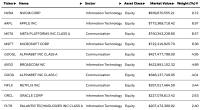
The concentration inside these funds is the story behind the story. Invesco QQQ Trust (NASDAQ:QQQ), the largest tech-adjacent ETF, reported $490 billion in net assets as of June 30, with NVIDIA at 7.6% of the fund, Apple at 6.7%, and Micron at 5.6%. The Technology Select Sector SPDR Fund (NYSEARCA:XLK) is more extreme. NVIDIA is 14.7% of the fund, Apple 12.8%, and Microsoft 8.4%. Three names carry more than a third of the portfolio. When investors pour $195 billion into “tech,” they are overwhelmingly buying five to ten companies whose earnings depend on the AI capex cycle continuing.
The performance table explains the enthusiasm. QQQ is up 16.68% year to date and 25.66% over the past year. The SPDR S&P 500 ETF Trust (NYSEARCA:SPY) returned 12.48% year to date and 18.91% over the last twelve months. Every dollar chasing that outperformance concentrates further into the same handful of stocks.
Earnings Have to Show Up
The macro backdrop hints at what is being priced in. Information-industry corporate profits reached $352.5 billion in the first quarter of 2026, up from $244 billion at the end of 2023. That is real. But information still contributed only 5.6% of GDP in the first quarter, and sector growth slowed to 1.5% from 3.2% in the third quarter of 2025. Flows are accelerating into a sector whose underlying output growth is decelerating.
The specific signal to watch is the capital-expenditure guidance from Microsoft, Meta, Amazon, and Alphabet in the October earnings cycle, a data point that matters more than the next Consumer Price Index release or Federal Reserve dot plot. If those four confirm another leg higher in AI infrastructure spend, the $195 billion looks early (and the beneficiaries extend well beyond the chipmakers, something we mapped across power, cooling, and networking suppliers in a free report on the AI buildout). If any one of them guides capex flat, the concentration inside QQQ and XLK becomes the fastest way to give back a year of gains. The trade is directional, and the tell arrives in about eight weeks.
Contact [email protected] for any questions or corrections.
After two decades of patrolling the dark corners of suburbia as a police officer, Rich Duprey hung up his badge and gun to begin writing full time about stocks and investing. For the past 20 years, he’s been cruising the markets looking for companies to lock up as long-term holdings in a portfolio while writing extensively on the broad sectors of consumer goods, technology, and industrials. Because his experience isn’t from the typical financial analyst track, Rich is able to break down complex topics into understandable and useful action points for the average investor. His writings have appeared on The Motley Fool, InvestorPlace, Yahoo! Finance, Money Morning, and, of course, 24/7 Wall St. He has been featured in both U.S. and international publications, including MarketWatch, Financial Times, Forbes, Fast Company, and USA Today.